
How will customers find the right product in the future? No longer exclusively through Google or the online store’s search function. AI systems are increasingly taking over product searches, comparing offers, and suggesting suitable products. For this to work, they must not only be able to read product information but also understand it in a structured way.
This is exactly where Shopify Catalog comes into play. Shopify provides product information—such as titles, descriptions, images, prices, options, and availability—in a structured format for AI platforms, shopping experiences, and AI agents. Eligible products are automatically added to Shopify Catalog.
For merchants, this shifts part of the optimization workload: in addition to having a well-designed product page, the quality of the underlying product data is becoming increasingly important.
In this post, we’ll explain exactly what Shopify Catalog is, which data points matter, and how you can prepare your Shopify store step by step for AI-powered product search.
Understanding and Optimizing Shopify Catalog
Want to dive deeper into the topic? In our webinar on Shopify Editions, we’ll show you the significance of Shopify Catalog for the future of product search and what merchants should keep in mind when it comes to their product data.
Request the webinar recording nowWould you like to check whether your product data is already optimized for AI-powered product search? We’ll analyze your data structure, identify areas for improvement, and suggest specific steps to increase your visibility in AI and e-commerce experiences. Feel free to contact us for a no-obligation consultation.
What is Shopify Catalog?
Shopify Catalog is a structured source of product information from Shopify stores. AI platforms, shopping websites, and AI agents can use this data to discover products and understand information such as price, availability, variants, or attributes.
One important point is easy to overlook: Merchants do not need to manually set up Shopify Catalog like a traditional product feed. It is automatically generated for stores and products that meet the requirements and is continuously updated with product data.
Quick Insight: Shopify Catalog
Shopify Catalog is the structured product database that makes eligible Shopify products available for various AI and shopping experiences. This includes, among other things, product name, description, images, price, variants, and availability.
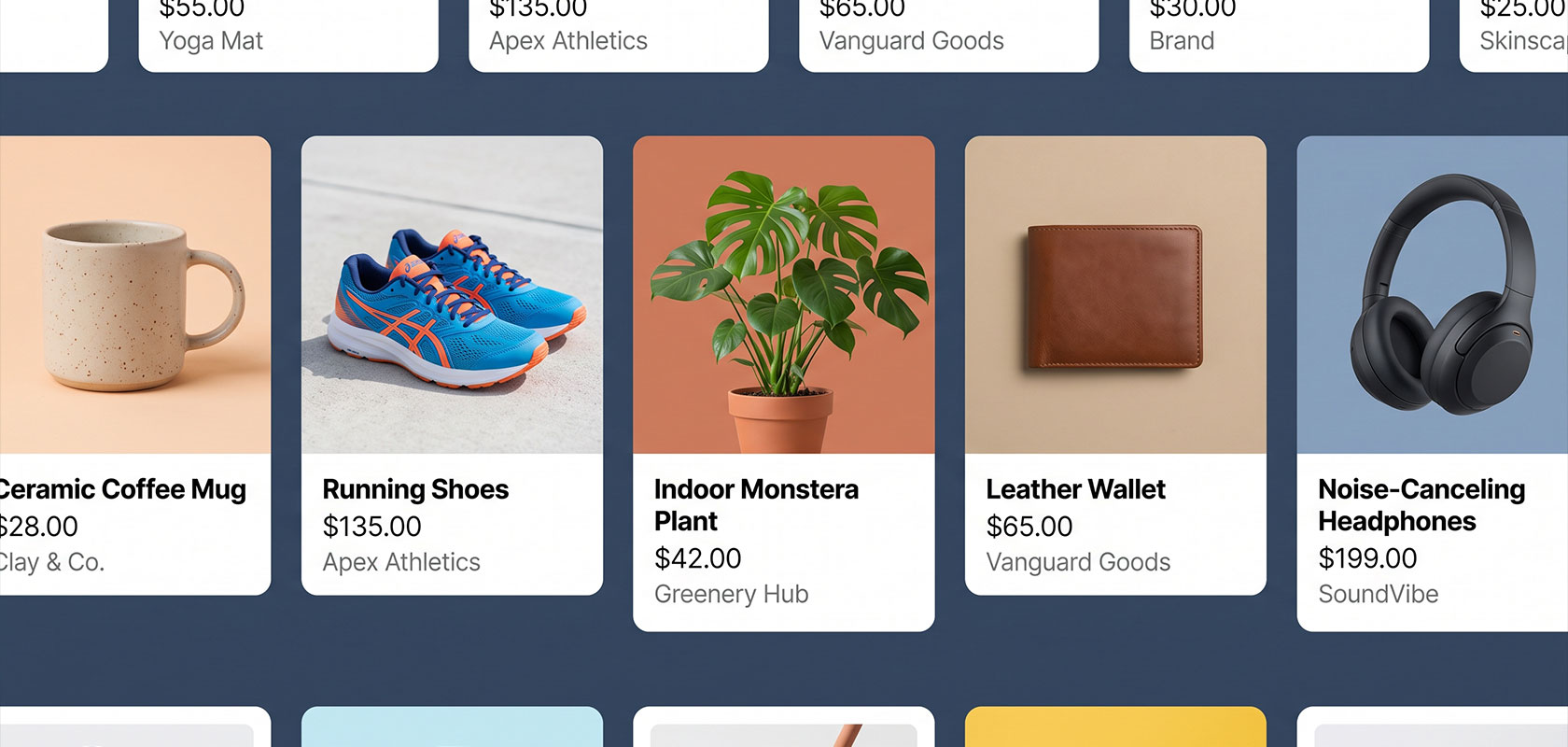 However, inclusion in Catalog does not automatically mean that a product will be recommended in ChatGPT, Google AI Mode, or another AI system. Each AI channel decides for itself which products to display for a specific query.
Why is Shopify Catalog becoming important for merchants?
The way customers search for products and make purchasing decisions is changing. Instead of working their way through search results, categories, and product pages themselves, they are increasingly able to formulate their needs directly to AI systems. These systems take over part of the search process, compare suitable products, and can make specific recommendations.
For merchants, this means that it’s not just the visibility of their own product pages that matters, but also how well product information is understood by AI systems and can be used to address relevant queries.
Traditional product search often follows this pattern:
Search engine → Product page → Online store → Purchase
With AI-powered search, the customer journey can look different:
Question → AI understands requirements → Products are searched for and compared → Recommendation → Purchase
For example, a customer might ask:
“I’m looking for a waterproof running jacket for winter, under 200 euros, made from recycled materials if possible.”
 For AI to respond meaningfully, it must link various product attributes together. Price, material, use case, availability, and variants thus become relevant information.
This does not mean that traditional SEO is becoming unimportant. On the contrary: SEO, structured product data, and GEO are increasingly complementary.
If product information isn’t provided clearly and completely, it becomes more difficult for systems to correctly classify a product and compare it with other offerings.
From Product Descriptions to Product Data
A good product description remains important. However, it shouldn’t be the only source of relevant attributes.
Instead of simply writing:
“Our innovative outdoor jacket impresses with outstanding weather resistance and maximum comfort.”
specific details for machine processing are much clearer:
Material: 100% recycled polyester
Water column: 20,000 mm
Weight: 280 g
Intended use: Winter running
Temperature range: down to -5 °C
The reasoning behind this is simple: The more clearly a product is described and structured, the easier it is for a system to understand it and match it with relevant search queries.
Reading tip: We explain in more detail how AI is changing search and what role SEO, AEO, and GEO play in this process in our article “AEO & GEO: AI Visibility in E-Commerce."
What product data is crucial?
Shopify Catalog provides key product information—such as titles, descriptions, images, prices, options, and availability—in a structured format. This data forms the foundation that enables products to be found, understood, and compared in AI-powered search and shopping experiences.
However, it’s not just about providing as much information as possible. What matters most is that the data is complete, unambiguous, consistent, and up-to-date. Which pieces of information are particularly relevant also depends on the specific product lineup and the type of products.
Product Name and Description
The product name should make it clear at a glance exactly which product it is. Instead of purely creative or internal brand-specific names, clear and understandable product names are therefore recommended.

The description should also specifically list key product features. While statements such as “high-quality,” “innovative,” or “particularly lightweight” may be useful in product communication, they provide little actionable information. Details such as material, dimensions, weight, intended use, or technical specifications are much more specific.
The more specifically the product information is formulated, the easier it is for systems to match a product’s characteristics to a specific search query.
Variants and Options
For products with multiple variants, options such as size, color, material, or finish should be maintained consistently. For example, if a color is labeled “Navy” for one product, “Dark Blue” for another, and “Blue” for a third, this creates unnecessary inconsistencies in the data structure.
Variants themselves should also be clearly distinguishable. Especially for extensive product ranges, consistent naming helps ensure that products and their respective variations are correctly categorized.
Price and Availability
Price and availability are among the most important factors in making a specific purchasing decision. An AI-powered product search, for example, must be able to determine whether a product falls within a specific budget and whether the desired variant is even available.
Shopify Catalog provides this commerce data in a structured format and keeps it up to date based on the underlying product data. That’s why prices, inventory levels, and variant statuses should also be reliably maintained in the Shopify Admin.
Categories and Product Attributes
A precise product category provides additional context about the type of product being offered. Especially with large product ranges, proper categorization can help distinguish products from one another by theme.
In addition, depending on the product type, other attributes may be relevant. For a piece of clothing, for example, material, fit, size, and intended use may be important. For a technical product, on the other hand, dimensions, performance, compatibility, or connection types may play a greater role.
The most important question, therefore, is: What information would a customer need to compare this product with similar products? It is precisely this information that should be represented as clearly as possible in the product data.
Unique Product Identifiers
SKUs, GTINs, and other unique product identifiers help clearly identify products and variants. This becomes particularly important when a retailer offers a large product range across multiple sales channels or manages similar products and variants.
Clear mapping not only prevents mix-ups within your own store; it also creates a consistent database that can be used across various commerce and sales systems.
Latori Expert Tip
Review your product data not only from the store’s perspective, but also from the perspective of someone who has never seen the product before. Could they determine—based solely on the structured information—what the product is, what features it has, who it’s suitable for, and why it matches a specific search query?
If key answers are only apparent from images or marketing copy, it’s worth taking a closer look at the underlying product data.
Shopify Catalog, Agentic Storefronts, UCP, and ACP: What’s What?
When it comes to AI-powered commerce with Shopify, you’ll encounter various terms that serve different functions. The following overview shows how they differ from one another and what they mean for merchants.
| Term | What is it? | What does it mean for merchants? |
|---|---|---|
| Shopify Catalog | Structured product database from Shopify stores | The quality of your product data determines how well AI systems understand your products |
| Agentic Storefronts | Sales channel in the Shopify admin used to distribute products to AI platforms | You can see in the admin which channels are available for your store |
| UCP (Universal Commerce Protocol) | Open standard jointly developed by Shopify and Google, introduced in January 2026 | Governs how AI agents interact with merchants, all the way through to checkout |
| ACP (Agentic Commerce Protocol) | Standard by OpenAI and Stripe, forming the basis for checkout in ChatGPT, among other things | Also supported by Shopify |
| Catalog API / Global Catalog MCP | API for developers to utilize product data for custom AI shopping experiences | Relevant for agencies and developers building custom agentic applications |
Reading tip: For more information on the protocols behind the scenes, check out our article “Shopify UCP: What the Universal Commerce Protocol Means for Online Retail.”
Optimizing Shopify Catalog: Step by Step
Since Shopify Catalog is automatically generated for eligible products, the actual task isn’t to create the catalog manually. The key is to optimize the product data behind it.
Step 1: Check Prerequisites
First, you should verify whether the products are generally eligible for the Shopify Catalog. Shopify lists several requirements for this, including an existing product title, at least one product image, a price greater than zero, and other requirements for the store and the product.
This allows you to quickly determine whether individual products might not be able to appear in the Catalog at all.
Step 2: Review Product Information in the Shopify Admin
In the Shopify Admin, go to Products → All Products and first select a few representative products.
Don’t just check whether a description is present. Above all, ask yourself:
Can someone—or an AI system—clearly understand from this information what the product is, what features it has, and who it’s suitable for?
Product names, descriptions, images, variants, and prices should all align.
Step 3: Structure product attributes
Many stores already have additional information in the system but store it exclusively in plain text or inconsistent fields.
This is where metafields can help. Under Settings → Metafields & Metaobjects → Products, you can define your own fields for additional product attributes.
For example, for a running shoe, you can create structured fields for the following information:
Intended use
Cushioning
Weight
Heel-to-toe drop
Material
Surface
The advantage: This information isn’t just included in the description text, but is available as clearly defined data.
Step 4: Use Metaobjects for Recurring Information
If information is reused across many products, Shopify's metaobjects can be useful.
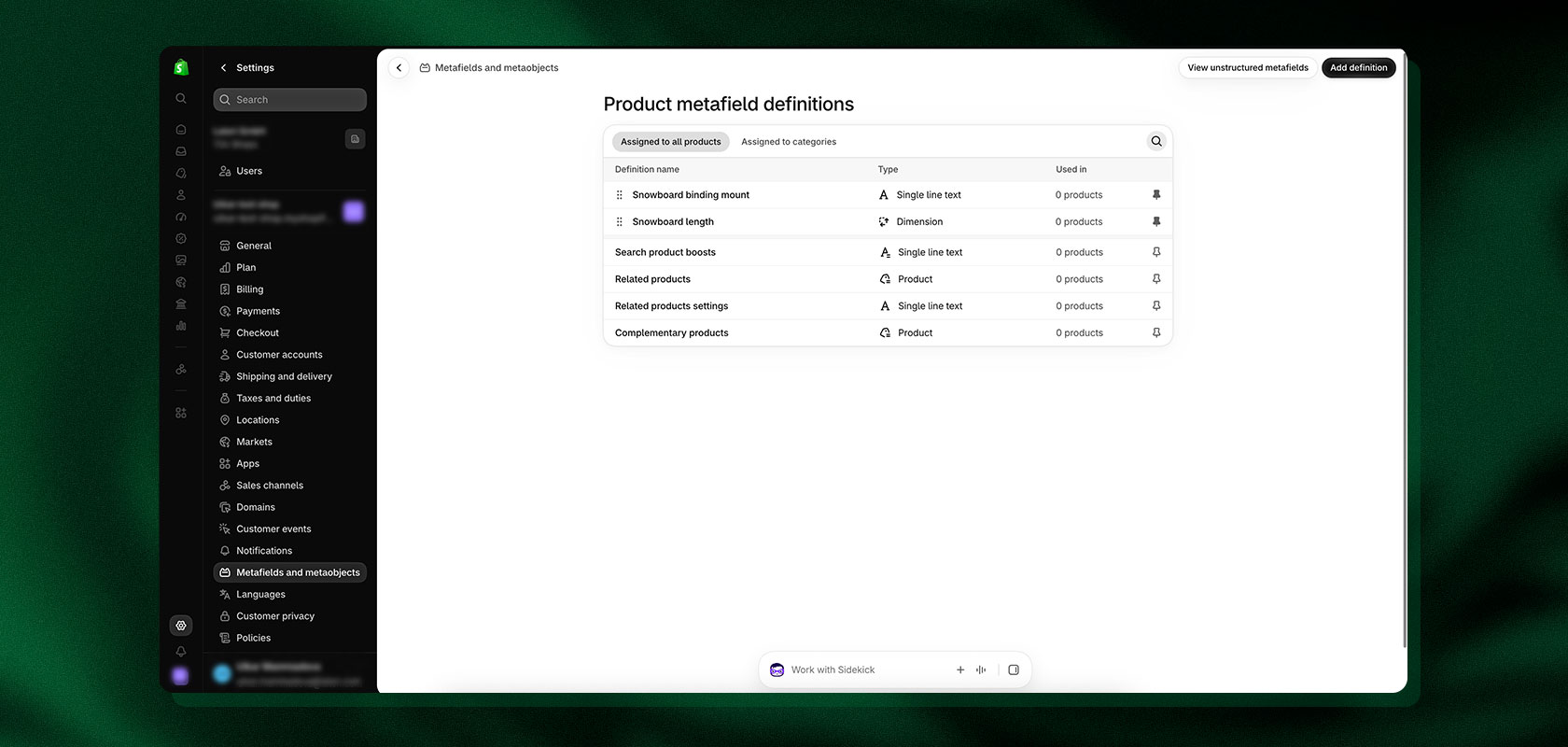 For example, a merchant could create a standardized data model for materials, manufacturers, or technical specifications. This eliminates the need to maintain the same information differently for each product.
This reduces inconsistencies and makes it easier to use the data later in various areas of the store.
Step 5: Check Catalog Mapping for Custom Data Structures
This becomes particularly relevant for larger or more technically complex stores.
If important product information isn’t stored in the standard Shopify product fields—but rather in metafields, metaobjects, or custom structures, for example—you can use Shopify Catalog Mapping.
In the Shopify Admin, you’ll find this feature under:
Sales Channels → Agentic → Shopify Catalog → Check Product Data Mapping
There, you can specify sources for product titles, product descriptions, and product categories, among other things. Product attributes, Metafields, or Metaobject references can serve as sources.
This is particularly relevant for stores whose product data model has been heavily customized.
Latori Expert Tip
If you already manage product information using metafields or metaobjects, you shouldn’t simply create additional data fields. First, check whether the existing data structure is well-organized and determine which information is actually relevant for product search.
A consistent data structure is more valuable in the long run than having as many individual fields as possible.
Step 6: Test product data in Catalog Search
Shopify now offers a search preview in the “Sales Channels → Agent” section. There, you can enter search queries to see how products might perform in Catalog Search. However, Shopify notes that this preview does not accurately predict how a product will be ranked in an actual AI-powered search experience.
Therefore, don’t just test product names—test real customer queries:
“Which sustainable running jacket under 200 euros is suitable for winter?”
“Which coffee maker with a grinder is suitable for two people?”
“I’m looking for a black leather bag for a laptop up to 16 inches.”
Afterward, you should check whether your products appear for such queries and whether the product information you’ve provided actually matches the requirements.
Reading tip: Shopify Catalog is a key component of Agentic Commerce. In our Agentic Commerce Guide for Shopify merchants, we explain what AI agents require from product data and how you can prepare your store for this, step by step.
Shopify Catalog: Greater Visibility Through Structured Product Data
Shopify Catalog lays an important foundation for ensuring that products can be found and considered in AI-powered search and shopping experiences. Product data is the key factor here: The more complete, unambiguous, and up-to-date the data is, the better systems can understand a product and match it with relevant search queries.
This is particularly relevant because AI searches often do not rely on a single keyword. Instead, users formulate specific requirements and combine multiple criteria.
A query such as:
“Which waterproof running jacket under 200 euros is suitable for winter and made from recycled materials?”
already contains several product attributes: category, feature, price, intended use, and material.
For a product to be considered for such a query, the system must recognize this information and be able to link it together. If the information is incomplete or contradictory, a suitable product may be overlooked during the selection process despite actually meeting the criteria.
From the Product Page to Structured Product Information
This is exactly where Shopify Catalog complements traditional product page optimization. A well-written product description remains important, but it should be supplemented by structured and unambiguous product information.
For example, a product might be described in its listing as a “lightweight, breathable outdoor jacket for demanding hikes.” However, specific attributes are much easier for an AI search to process:
Weight: 320 g
Material: 100% recycled polyester
Water column: 20,000 mm
Breathability: 20,000 g/m²/24 h
Intended use: Hiking and trekking
Season: Fall and winter
This information does not automatically improve a product’s ranking. However, it provides a better data foundation for selection and comparison.
Reading tip: When answers appear directly in the AI interface, visibility counts even without a click: Zero-Click Marketing: Why Visibility Matters Today, Even Without Clicks.
Why Complete Product Data Is Important for GEO
For GEO, therefore, it is not just a matter of whether a brand or product is mentioned online. Equally important is what information an AI system can capture about the product.

For example, when an AI is asked for “sustainable sneakers made from recycled materials under 150 euros,” the relevant product attributes must be clearly identifiable. The better the data is structured, the more specific points of reference there are for matching such search queries.
Shopify Catalog can be viewed as the link between a store’s product database and new AI-powered commerce experiences.
This interaction can be simplified as follows:
Product data → Shopify Catalog → AI understands the product → Match with search query → Potential product recommendation
It’s important to note that a complete and well-structured Catalog presence does not guarantee visibility in a specific AI response. Rather, it creates the necessary foundation for a product to be properly categorized and considered for relevant queries in the first place.
Catalog and Traditional SEO Complement Each Other
The quality of product data remains relevant for traditional search engines as well. Optimized product names, descriptions, categories, and structured data not only help AI systems but also improve the quality of information on a product page.
This creates an important synergy: A clean product data structure can support multiple search and commerce channels, rather than being optimized for just a single AI channel.
For merchants, this means that Shopify Catalog shouldn’t be viewed as a standalone optimization measure. Instead, it’s worth taking a look at your existing product data from the perspective of various systems:
Can a search engine find the page? Can AI understand the product? And is there enough specific information available for the product to be selected in response to a relevant search query?
It is precisely at this intersection that SEO, AEO, GEO, and structured commerce data converge.
Reading tip: We explore in more detail how AI is changing search and what role SEO, AEO, and GEO play in this in our article SEO, AEO, and GEO: Optimizing for the Future of Search.
Testing Product Data for AI Search
Optimizing product data is not a one-time task. What matters most is whether, in practice, the information ensures that your products can be understood and taken into account for relevant search queries. To achieve this, it’s worth regularly comparing your own product data with the questions that potential customers actually ask.
1. Collect Real Customer Questions
Start with search queries and questions that already exist within your company. Google Search Console, your internal store search, customer inquiries from support, and typical questions from consultations provide valuable insights for this.
 Of particular interest are not only specific product names, but also search queries that include multiple criteria. These include, for example, queries regarding a specific price range, material, intended use, size, or specific product features.
2. Test Relevant Queries in AI Systems
You can then test these queries in relevant AI systems. When doing so, check not only whether your brand is mentioned, but also which products are recommended and what characteristics the AI uses to make those recommendations.
For example, document the following:
Is your own brand mentioned?
Which products are recommended?
Which competitors appear?
Which product features are mentioned?
Which sources or product information are used?
This helps you determine how visible and understandable your brand and product lineup already are in AI-powered product searches.
3. Compare with Shopify Catalog Search
For stores that can use Shopify Catalog, it’s a good idea to then compare the results with the Catalog search preview. Test the same or similar search queries there and check which products are found for each query.
This comparison is particularly useful when a product generally matches the search query well but doesn’t appear in the results. In that case, it’s worth taking a closer look at the product data on file.
Reading tip: To learn how to test your store using simulated AI shoppers, see “Test Your Shopify Store with AI Shoppers (Before Your Customers Do).”
4. Identify Data Gaps and Opportunities for Optimization
Do competitors appear in search results, but not your own products? Or is a product found but described using incorrect or incomplete attributes? If so, you should check which information is missing or not clearly structured.
Possible causes may include, for example:
relevant product attributes are missing,
variants are maintained inconsistently,
important information is only included in the body text,
product categories are too vague,
prices or availability are out of date,
or relevant metafields and other structured data are missing.
Specific actions can then be derived from these findings. Instead of asking in general terms whether a store is “optimized for AI,” merchants can thus specifically address individual gaps in product data and visibility.
Important: A complete and well-structured catalog presentation does not guarantee placement in a specific AI response. AI and shopping systems decide on their own which products to select for a search query, how to rank them, and what information to display. Catalog search therefore serves primarily as a valuable guide and testing tool.
Conclusion
Shopify Catalog does not automatically change an online store’s entire SEO strategy. However, it clearly demonstrates how important structured, high-quality product data will be for the next generation of product search.
The good news: For eligible Shopify stores, no time-consuming manual setup is required. Shopify Catalog is deployed automatically. The key factor lies in the quality of the data: unique product names, specific descriptions, well-organized variants, up-to-date prices and availability, and sensibly structured additional product attributes.
For larger stores in particular, it’s therefore worth taking a closer look at Metafields, Metaobjects, and, if necessary, Shopify Catalog Mapping.
While SEO has long primarily answered the question of how a product is found, a second question is increasingly coming to the fore:
Can an AI understand why this specific product matches a customer’s query?
Those who structure their product data cleanly today are laying an important foundation for AI-powered product search and agentic commerce.
Would you also like to improve your visibility in AI search results, or do you have questions about Shopify Catalog? The Latori team would be happy to assist you. Please contact us.
