)
The advent of AI assistants, autonomous agents, and generative search systems is changing not only how customers find information, but also how purchasing decisions are made and implemented. Traditional web shops as the sole sales channel are increasingly reaching their structural limits.
The Universal Commerce Protocol (UCP) is an open standard that was jointly promoted by Shopify and Google. It enables different trading systems to communicate with each other by connecting them via a single, programmable interface. It takes commerce beyond traditional websites by establishing a standardized language for agentic commerce. This enables AI agents to autonomously discover products, negotiate terms, and securely process transactions directly through the merchant's backend—potentially turning any digital interface into a ready-to-use sales channel.
In this article, we explain what's behind UCP, how the protocol works, and what strategic and technical implications it has for Shopify merchants. Even though UCP and Agentic Commerce are currently only available in the US and Canada, we would like to provide information about the underlying concepts and developments at an early stage.
Table of contents
- Decoding Shopify UCP: The new protocol for agentic commerce
- How the protocol creates added value: The most important functions
- What merchants need to do: The checklist for AI sales
- The paradigm shift: UCP vs. traditional e-commerce
- Strategic implications: High-level implications for Shopify merchants
- The flip side of the coin: challenges for online retailers
- Roadmap to launch: Preparing your store for “UCP fluency”
- Conclusion
Would you like to optimize your Shopify or Shopify Plus store and need professional support? We're happy to help! Simply contact us and we'll discuss your requirements.
Decoding Shopify UCP: The new protocol for agentic commerce
Traditional online retail is based on a simple principle: users visit a store via a website, navigate through categories, add products to their shopping cart, and complete the purchase using a form. This logic is entirely designed for human interaction with graphical user interfaces.
AI-based assistants are fundamentally changing this model. Users are increasingly expressing their purchase intentions in natural language, for example:
“Find me a black shirt in size M that can be delivered by tomorrow.”
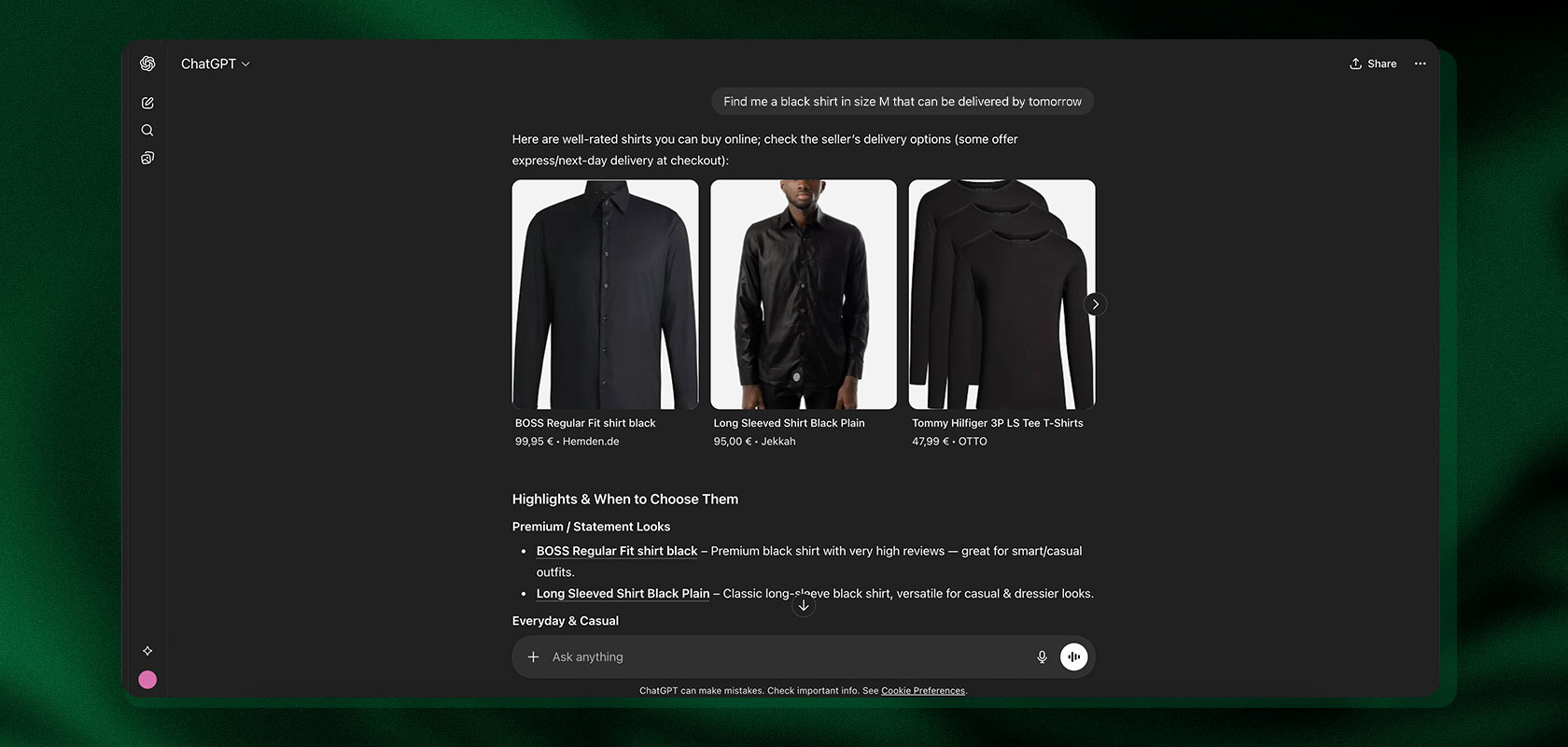
The actual product selection, price check, availability check, and checkout can theoretically be carried out entirely by an agent. This is exactly where the Universal Commerce Protocol (UCP) comes in.
A UCP is an open standard that defines how:
products are discovered,
purchase conditions are negotiated,
and transactions are technically processed,
without each platform having to build its own integrations.
Instead of each AI provider integrating individual APIs for each store, a UCP defines a uniform language for commerce interactions between agents and trading systems. Shopify is positioning itself not only as store software, but as infrastructure for agent-enabled commerce. Some features are already available, while others require developer integration.
Reading tip: Agentic Commerce with Shopify – here's how it works.
How the protocol creates added value: The most important functions
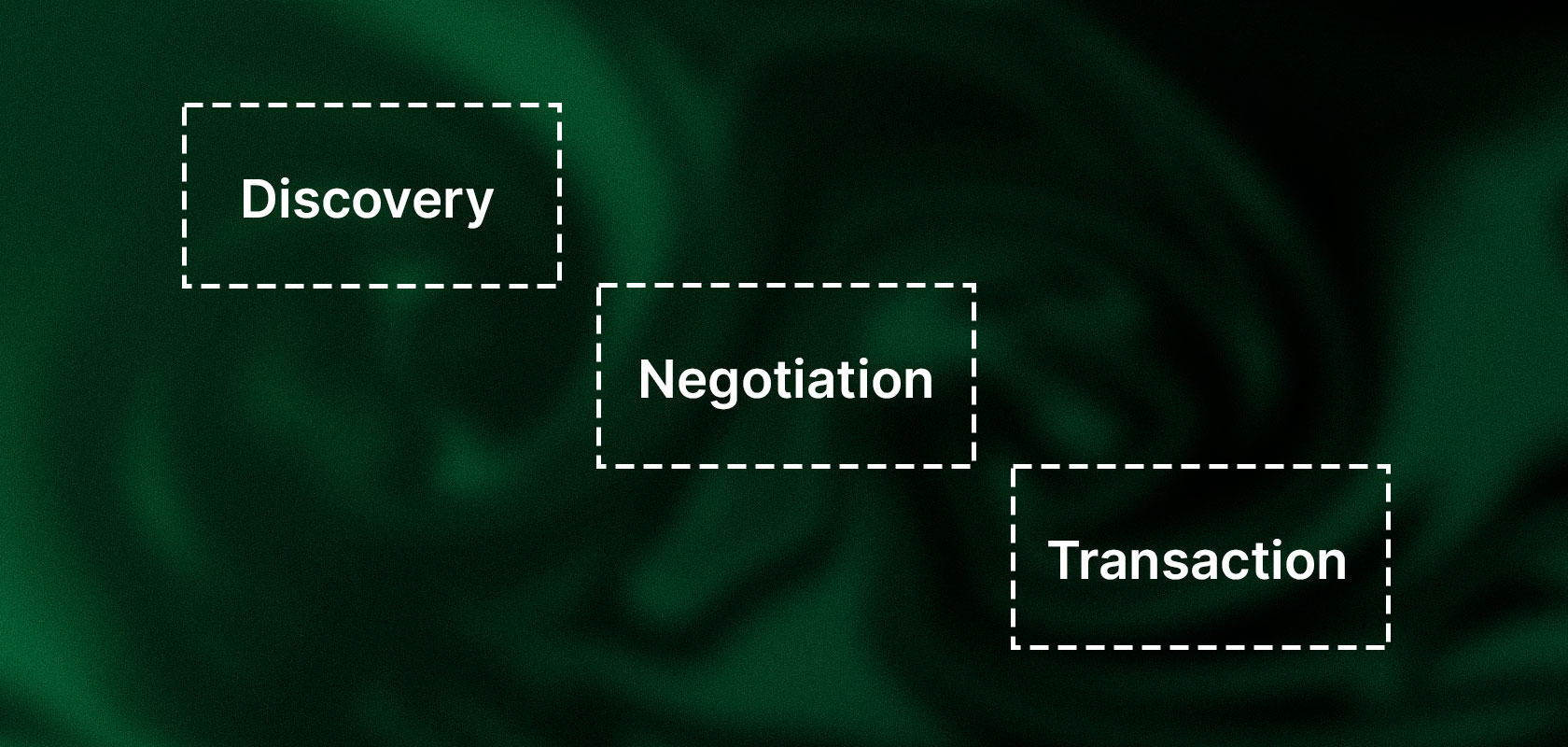
The Universal Commerce Protocol (UCP) defines how AI agents can interact directly with your store. It ensures that products are found, purchase terms are negotiated, and transactions are processed—regardless of whether the customer visits the website.
The UCP model is based on three core functional processes that come into play in every purchase:
Discovery
In the discovery phase, products, prices, variants, delivery options, and policies are made available in a machine-readable format. This allows agents to compare offers from different retailers without having to analyze websites.
Unlike traditional product feeds, Discovery is interactive and context-sensitive. An agent can specifically ask for products with certain characteristics and availability.
Negotiation
The Negotiation phase determines how the purchase can be processed in concrete terms. This includes, among other things:
Payment methods
Delivery times
Age verification
Taxes and customs duties
Return policies

In the future, the agent will check whether its own capabilities are compatible with the shop guidelines. If not, it can involve the user or suggest alternative options. Parts of this process can be automated; some steps still require user or developer interaction today.
Transaction
Only when all the framework conditions have been clarified does the actual transaction take place. This can be fully automated or require explicit confirmation from the customer in some cases.
Checkout is thus no longer understood as a UI form, but as a transactional API process that also works outside of classic shop interfaces.
What merchants need to do: The checklist for AI sales

Certain technical requirements must be met in order for a shop to participate meaningfully in the UCP ecosystem. For Shopify merchants, this primarily means a clean data and process structure.
Depending on the degree of maturity and integration goal, the following technical building blocks may be relevant:
Unique product identification: Products should be assigned standardized IDs (e.g., GTINs) to enable comparisons and verifications.
Structured metadata: Product and variant information must be available in its entirety in meta fields or structured objects.
UCP Capability Profile: The shop publishes which functions are supported in a machine-readable format (checkout options, payment methods, policies).
Discovery and negotiation endpoints: Systems must be able to process and respond to UCP-compliant requests.
Compatible payment and fulfillment flows: Payment processing and shipping logic must be controllable via API.
Escalation mechanisms: If additional customer data is required, the agent must be able to request it from the user in a structured manner (e.g., if size information is missing).
The paradigm shift: UCP vs. traditional e-commerce
The difference between classic online retail and agent-based commerce is not only technological, but also conceptual.
| Traditional E-Commerce | UCP-Based Commerce |
|---|---|
| Humans navigate via UI | Agents communicate directly with the store |
| Focus on Design & UX | Focus on structured data & APIs |
| Platform-specific integrations | Standardized protocol |
| Manual purchasing processes | Semi- or fully automated purchases |
| Visibility via SEO & Ads | Visibility in AI response systems |
This does not replace the shop, but it does lose its role as the sole entry point into the purchasing process. Instead, it becomes part of a distributed commerce network orchestrated by agents.
Strategic implications: High-level implications for Shopify merchants
From a merchant's perspective, UCP is a technical standard that allows external AI systems to interact directly with their own store without requiring individual integrations for each platform. The store thus becomes part of a comprehensive commerce ecosystem in which purchasing processes are no longer triggered exclusively via the merchant's own website, but can also be initiated from AI-based search, consulting, and assistance systems.
Reading tip: Shopify AI: We show you what Shopify's AI tools can do.
This results in several concrete advantages for retailers. On the one hand, visibility increases in AI-supported search and recommendation systems, where purchasing decisions are increasingly prepared or completed directly. On the other hand, UCP enables participation in automated purchasing decision processes, in which agents compare products, check availability, and carry out transactions on behalf of customers.
At the same time, it reduces dependence on traditional traffic channels such as search engine ads or social ads, as the purchase process no longer necessarily has to start with a visit to the store's website. Thanks to the standardized technical connection, retailers can also serve multiple agent platforms via a common protocol instead of having to maintain separate interfaces for each system.
Implementation can be carried out internally in parts, particularly with regard to the maintenance of structured product data, the consistency of guidelines, and the quality of meta fields. However, in many cases, the full implementation of UCP endpoints, capability profiles, and agent-enabled checkout processes requires technical expertise that goes beyond traditional shop configuration. Accordingly, it will often be necessary to involve developers or specialized service providers.

Prerequisites for successful UCP integration:
Clean, structured, and consistent product data
Uniform and clearly defined shop policies (shipping, returns, taxes, etc.)
API-enabled checkout and payment processes
Basic understanding of UCP specifications and capability models
Setup of test and staging environments for agent interactions
Testing of automated purchase processes before going live
Testing of escalation mechanisms for missing or conflicting data
Simulation of error cases and exception processes
The flip side of the coin: challenges for online retailers

The Universal Commerce Protocol creates new opportunities for retailers, but it also brings with it technical, organizational, and strategic challenges.
High demands on data quality and consistency
UCP requires product, price, inventory, and policy data to be complete, structured, and consistent. Incomplete meta fields, inconsistent variant logic, or contradictory shipping and return policies can cause agents to misinterpret products or cancel transactions. Data quality thus becomes an operational prerequisite for visibility and saleability.
Increased technical implementation effort
Even though Shopify provides parts of the infrastructure, full UCP integration requires a solid technical foundation. Merchants must ensure API-enabled checkout and payment processes, define capability profiles, and understand agent-based interactions. For many companies, this goes beyond classic shop configuration and requires additional development resources.
Less control over the purchase context
When purchases are made via external AI agents, the decision-making process no longer takes place exclusively in the retailer's own shop frontend. Retailers have less influence on the presentation, comparison situation, and context in which their products are selected. Brand messaging, visual presentation, and storytelling take a back seat to structured data and objective criteria.
Dependence on external agent ecosystems

With UCP, part of the access to customers shifts to AI platforms and agent providers. Retailers must accept that these systems pre-filter, prioritize, or automate purchasing decisions. Changes to agent logic or ranking criteria can directly impact visibility and sales without retailers having any immediate influence.
Complexity in compliance, liability, and responsibility
Automated purchasing processes raise new questions, such as incorrect orders, misinterpretations of products, or regulatory requirements (e.g., age verification, tax logic, product safety). Retailers must clearly define which steps can be automated and when explicit customer approval is necessary in order to minimize legal risks.
Increased testing and monitoring requirements
Agent-based interactions cannot be monitored using traditional conversion tracking methods alone. Retailers must establish new testing and monitoring approaches to identify automated purchasing processes, escalation mechanisms, and error cases at an early stage. Without appropriate testing environments, unexpected cancellations or faulty transactions may occur.
Changes to internal processes and responsibilities
The introduction of UCP affects not only technology, but also internal processes. Product management, IT, marketing, and legal departments must work more closely together, as product data, policies, and technical configurations directly influence automated purchasing decisions. Existing silos can thus become an organizational risk.
Roadmap to launch: Preparing your store for “UCP fluency”
In order for a Shopify store to participate meaningfully in the Universal Commerce Protocol, a number of technical and structural preparations are necessary. UCP is an open standard that defines how AI agents can perform discovery, negotiation, and transaction workflows with merchant systems. To do this, merchants must ensure that their data model and interfaces meet the requirements.
Data quality and standardization
A clean database is essential for agents to process meaningful information. This includes ensuring that product data is complete and consistently structured, that unique variant identifiers are available, and that information on prices, availability, and return policies is clearly defined. Agents access this data directly and “read” it in a machine-readable format instead of interpreting content visually.
Use of metadata and schema mapping
UCP manifest files (/.well-known/ucp) provide agents with an overview of the features and endpoints supported by the store. In addition, custom attributes (e.g., delivery windows or material properties) should be provided in meta fields or standardized schema fields so that they can be interpreted unambiguously by the protocol.
Enable and configure UCP capabilities
Shopify provides initial configuration options and APIs for agent-enabled commerce features, which are available depending on your account, feature status, or developer setup.
Testing agent interactions

Before going live, you should check that agent queries are answered correctly and that business rules such as shipping options or payment terms are negotiated cleanly. Tools for simulating agent requests and checking possible escalation paths (e.g., when human input is required) are helpful for this.
Conclusion
The Universal Commerce Protocol marks a fundamental change in online commerce. In the future, the purchasing process will no longer be controlled exclusively by websites, but by standardized protocols that can be used by AI agents.
For Shopify merchants, this means that new sales channels are emerging outside of traditional shops, data quality is becoming a strategic resource, and technical infrastructure is becoming a competitive advantage. At the same time, the demands on data maintenance, system stability, and technical expertise are increasing, while merchants have to relinquish some control over the purchasing context to external agents.
UCP is not a short-term functional enhancement, but part of a long-term development toward agent-enabled commerce systems. Those who address the technical and organizational requirements early on will lay the foundation for remaining visible and purchasable even in AI-driven shopping environments.
We are happy to assist you with implementing UCP for your Shopify store! Simply contact us and we will discuss your project together.
Frequently asked questions about Shopify UCP
What is Shopify's Universal Commerce Protocol (UCP)?
UCP is an open technical standard that defines how AI agents can interact with Shopify online stores. It defines processes for product search, negotiation of purchase terms, and transactions without the need for individual integrations per platform.
What role do AI agents play in UCP-based commerce?
AI agents are increasingly taking on tasks such as product selection, price and availability checks, and checkout on behalf of customers. UCP ensures that these processes can run in a standardized and secure manner between agents and stores.
Do Shopify merchants need to actively implement UCP?
Basic requirements such as structured product data and API-enabled processes are necessary. Parts of the UCP functionality are provided by Shopify, but additional technical adjustments may be necessary for more extensive integrations.
Will the online store lose importance due to UCP?
The online store will remain central to brand presence, content, and customer loyalty. UCP supplements the shop with additional access points through which purchases can also be made outside of traditional websites.
When will UCP become relevant for retailers?
With the increasing use of AI-supported search and assistance systems, UCP is gaining in importance. Retailers who adapt their data and process structures at an early stage are better prepared for agent-based purchasing processes.
