)
E-commerce is currently undergoing a fundamental transformation. More and more product searches no longer begin on Google or directly in the online store, but in AI systems such as ChatGPT, Microsoft Copilot, or Google Gemini. Users enter specific requirements there and receive not only search results but also pre-filtered product recommendations.
This is shifting the role of modern shop systems: it is no longer just people who need to be able to understand products, but increasingly AI agents as well. For these systems, structured data, clear product information, reliable delivery details, and machine-readable content are what matter most. Shopify is currently responding to this with new technologies centered around Agentic Commerce, the Shopify Catalog, and the Universal Commerce Protocol (UCP).
For merchants, this doesn’t mean completely reinventing their store, but rather a new prioritization of technical and content quality. This guide shows how Shopify merchants can prepare their stores for this development step by step.
Quick inside: What is Agentic Commerce?
Agentic Commerce refers to a form of digital commerce in which AI agents handle product searches, evaluations, comparisons, and, in some cases, purchasing decisions on behalf of users.
Table of contents
- How AI Agents Make Purchasing Decisions
- Shopify and the Universal Commerce Protocol (UCP)
- Step 1: Make product data machine-readable in the Shopify backend
- Step 2: Implement structured data and Schema Markup
- Step 3: Optimize content for AI Search, GEO, and AEO
- Step 4: Demonstrate trust and legal certainty in the DACH region
- Step 5: Utilizing the Shopify Ecosystem for Agentic Commerce
- Step 6: Understanding the agent journey rather than just the user journey
- Agentic Commerce Readiness Check
- Conclusion
Would you like to prepare your Shopify store for Agentic Commerce? We’d be happy to help you analyze, prioritize, and implement the next steps. Just get in touch with us.
How AI Agents Make Purchasing Decisions

The Difference Between Humans and AI Agents
Humans and AI agents make purchasing decisions in different ways. While humans often react emotionally, are influenced by images, brands, or product presentations, and can cope with incomplete information, AI agents operate in a much more structured manner. They evaluate products based on concrete data, systematically compare different options, and analyze technical specifications, prices, delivery times, or reviews. For AI systems, clear, consistent, and machine-readable information is therefore far more important than emotional advertising messages or visual impressions.
What Data AI Agents Evaluate
An AI agent analyzes, among other things:
Product data
Technical specifications
Materials
Variants
Compatibilities
Sizes and colors
Commerce data
Price
Delivery time
Stock levels
Shipping costs
Return policies
Trust signals
Reviews
Certifications
Brand information
Company data
Emotional advertising copy plays a significantly smaller role here than in traditional e-commerce.
Why structured information is becoming more important
Many online stores contain data structures that have evolved over time:
inconsistent variants
free text instead of clear attributes
missing technical information
contradictory delivery details
People can often still make sense of this. For AI systems, however, it creates problems with analysis and comparability. This is precisely why standardized product data is becoming increasingly important.
Shopify and the Universal Commerce Protocol (UCP)
Shopify is currently developing an infrastructure that allows AI systems to analyze structured store data directly.
This includes, among other things:
the Shopify Catalog
new agent-based commerce features
API-based real-time data
standardized product feeds
the Universal Commerce Protocol (UCP)
The goal: to make product information available in a machine-readable format across platforms.
Why this matters
Until now, stores have primarily been optimized for search engines. In the future, another factor will become relevant: How well can an AI agent understand, compare, and evaluate products?
As a result, data quality is increasingly becoming a direct factor in visibility.
Reading tip: Shopify Universal Commerce Protocol: We've compiled all the information for you.
Step 1: Make product data machine-readable in the Shopify backend
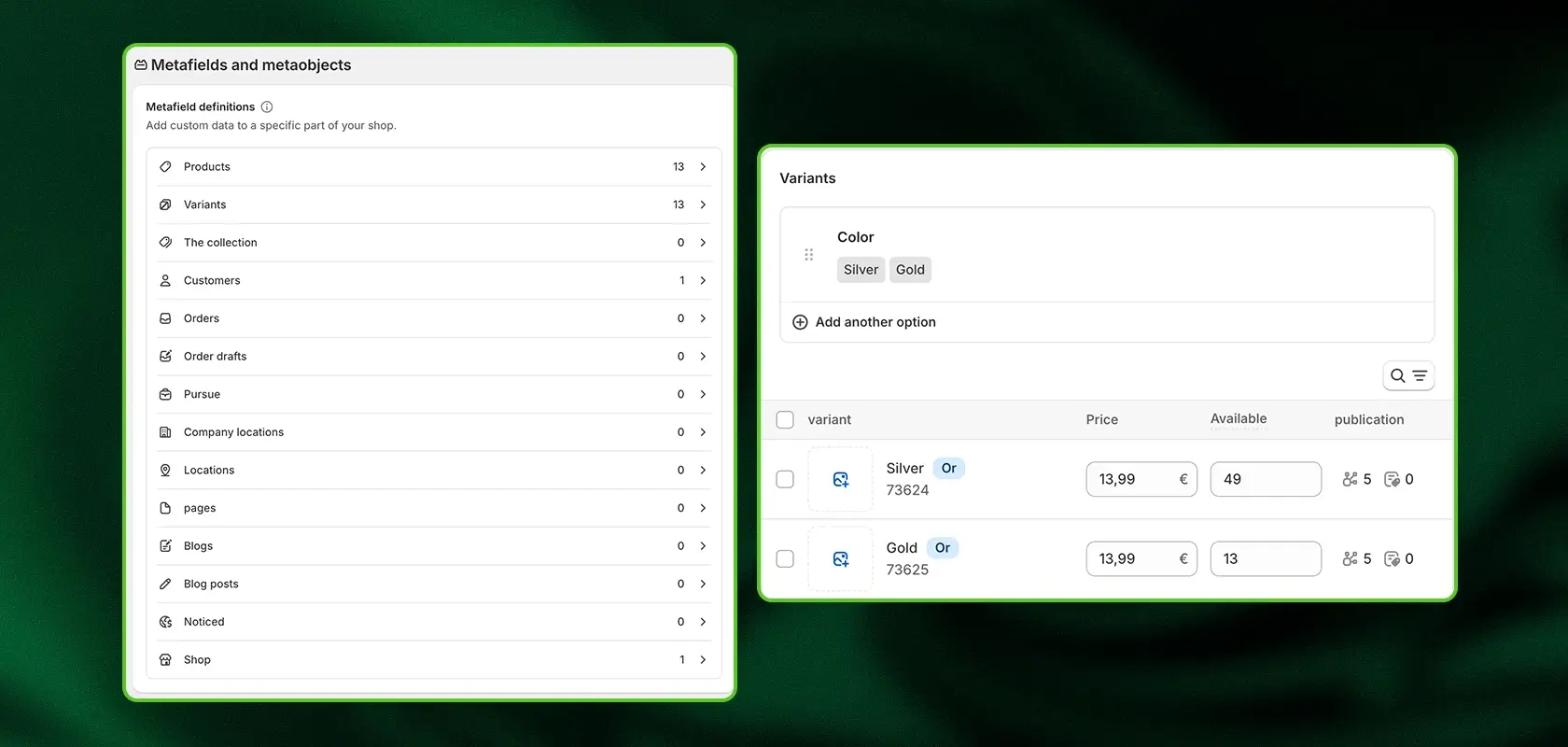
Define consistent product attributes
Clean and standardized product data is the foundation of Agentic Commerce.
Poor data structure
“Blue-ish”
“Large”
“approx. 2–5 days”
Material listed only in the body text
Better data structure
Color: Navy Blue
Size: L
Material: 100% cotton
Delivery time: 1–3 business days
The clearer the information is, the better AI systems can compare products.
Make effective use of Shopify Metafields and Metaobjects
Shopify already provides the appropriate technical foundation:
Metafields
Ideal for:
technical data
additional information
compatibilities
material specifications
certifications
Metaobjects
Suitable for:
reusable data structures
standardized product information
structured brand or material data
This allows information to be managed consistently throughout the entire store.
Reading tip: Shopify Meta Objects: More possibilities and flexibility for store customizations.
Structure variant logic clearly
Consistent variant names are particularly important. Often, the same attributes are named differently within a shop, for example as “Dark Blue,” “Blue Navy,” or “Navy.” People can usually tell that these refer to the same color. AI systems, however, may interpret such differences as distinct attributes.
To reliably compare and categorize products, variants should therefore be named consistently—for example, uniformly as “Navy Blue.” The more consistent the data structure, the easier it is for AI agents to process the information.
Real-time data is becoming more important
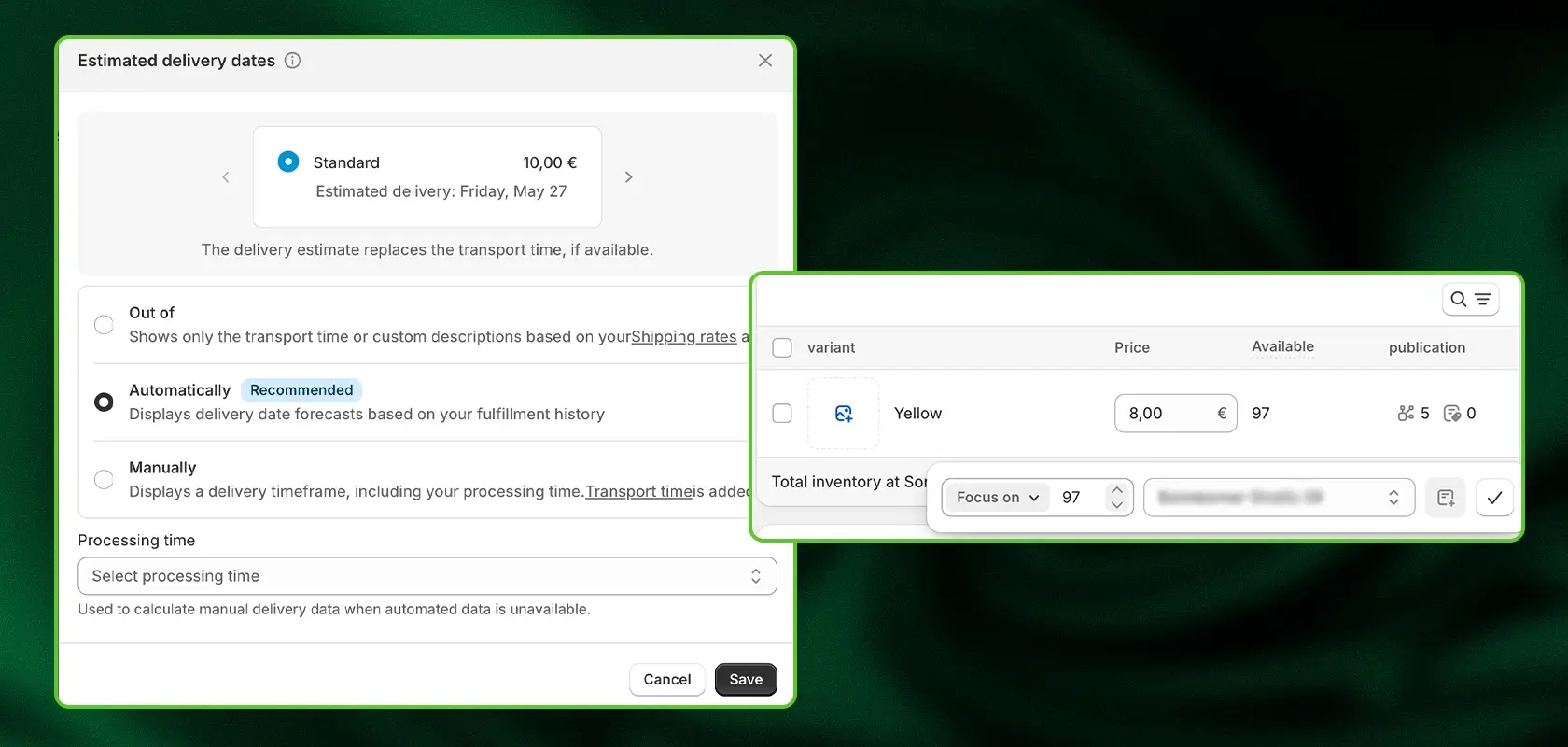
Availability and delivery times are increasingly becoming critical indicators.
Key factors include:
current inventory levels
precise delivery times
transparent shipping information
reliable pricing
Incomplete data can result in products being ranked lower.
Step 2: Implement structured data and Schema Markup

Why Schema Markup is becoming important
Schema Markup helps search engines and AI systems understand content in a machine-readable format.
While traditional SEO has long focused on rankings, modern AI systems are increasingly analyzing structured data directly from the frontend.
The most important schema types for Shopify
Product Schema
Contains information such as:
Product name
Description
Brand
Images
Variants
Offer Schema
Important commerce data:
Price
Currency
Availability
Delivery status
FAQ Schema
Helps AI systems:
Understand user queries
Extract answers directly
Better contextualize information
Organization Schema
Relevant for:
Company information
Brand identity
Trust signals
Why AI Search Works Differently from Traditional Search
Traditional search engines link to websites. AI systems, on the other hand:
analyze content
extract information
generate direct answers
automatically compare products
The clearer the data structure, the easier it is to process a Shopify store.
Step 3: Optimize content for AI Search, GEO, and AEO
The shift from SEO to AEO and GEO
New terms such as:
AEO (Answer Engine Optimization)
GEO (Generative Engine Optimization)
describe the shift from document-based search to AI-generated answers. There are no fixed standards for this yet. However, the trend is clear: fact-based content is gaining importance.
Reading tip: From SEO to AEO/GEO: We'll show you what you need to keep in mind now.
Product descriptions are changing
Many traditional product descriptions are dominated by marketing jargon:
“revolutionary”
“premium”
“ultimate”
For AI systems, such terms provide little useful information.
Better options include:
specific features
technical details
clear use cases
understandable benefits
Comparative content is becoming more important
AI systems prefer content that clearly structures information and enables a direct comparison between products. Therefore, buying guides, comparison tables, structured FAQ sections, and information on compatibility and typical use cases are particularly helpful. Such content makes it easier for AI agents to identify relevant product features, compare products with one another, and derive suitable recommendations for specific user queries.
Topic relevance is becoming more important than individual keywords
In the past, the focus was often on individual keywords. Today, AI systems analyze relationships between:
Products
Brands
Features
Categories
Usage contexts
Content should therefore be structured more thematically rather than keyword-centric.
Step 4: Demonstrate trust and legal certainty in the DACH region
Why trust is crucial for AI agents
AI agents are designed to minimize risks in purchasing decisions as much as possible. That is why transparent and reliable information plays a key role in evaluating products and online stores. The most important trust signals include customer reviews, seals of approval, certifications, comprehensive company information, and clearly communicated shipping and delivery terms.
The easier this information is to access and understand, the higher the likelihood that a store will be classified as trustworthy by AI systems.
Transparent Pricing in the DACH Region
Additional requirements apply in German-speaking countries:
Price Indication Regulation
Transparent shipping costs
Clear communication of discounts
The 30-day rule for price reductions
Unclear pricing information is problematic for AI systems because it makes comparison difficult.
Return policies as an exclusion criterion
Unclear return information can result in products being prioritized lower.
Particularly important are:
clear return deadlines
transparent shipping terms
unambiguous delivery times
understandable cost information
Step 5: Utilizing the Shopify Ecosystem for Agentic Commerce
The Shopify Catalog
The Shopify Catalog serves as a central database for structured product information. It enables external systems to retrieve and process product data in a standardized manner. This allows AI agents and other commerce platforms to analyze products, extract relevant information, check current availability, and compare prices. For merchants, this lays the groundwork for their products to be reliably found and evaluated even outside their own store.
APIs and real-time data are becoming more important
AI systems rely on up-to-date and reliable information to make informed product recommendations. Data such as inventory levels, delivery times, price changes, and the current status of product variants are particularly important.
Outdated or incomplete information can lead to products being incorrectly rated or not considered at all. That is why real-time data and API-based data sources are becoming increasingly important, while static data feeds are often no longer sufficient in the long term.
Data errors become more visible
The more AI systems rely on structured data, the faster problems become apparent:
missing attributes
incorrect variants
incomplete delivery information
inconsistent prices
As a result, data quality is becoming a direct competitive factor.
Step 6: Understanding the agent journey rather than just the user journey

How AI agents filter products
An AI agent typically works with:
Decision parameters
Price
Delivery time
Material
Size
Compatibility
Reviews
Exclusion criteria
Out of stock
Missing technical data
Unclear return policies
Poor reviews
Contradictory information
Example of a typical agent query
A user asks: “Find me a height-adjustable desk under 700 euros with fast delivery and cable management.”
The AI agent then analyzes:
Price limit
Delivery time
Technical specifications
Additional features
Reviews
Availability
Stores with clearly structured data have significant advantages here.
Agentic Commerce Readiness Check
The 10-point checklist for Shopify merchants
Product data
Are product attributes standardized?
Are variants clearly structured?
Are meta fields used consistently?
Technical Structure
Is Schema Markup implemented?
Is structured FAQ data available?
Are APIs and real-time data properly maintained?
Trust & Legal Certainty
Are prices presented transparently?
Are delivery times clear?
Are return policies clearly stated?
Are reviews visibly integrated?
The more points that are met, the better a store is prepared for AI-Commerce.
Conclusion
Agentic Commerce does not spell the end of traditional online stores. However, the demands placed on digital commerce systems are changing.
In addition to design, branding, and traditional SEO, one factor is becoming increasingly important: How well can AI systems understand and compare products?
Many of the necessary optimizations simultaneously improve:
traditional SEO visibility
data quality
internal processes
conversion rates
user experience
That is why it is worth preparing, regardless of how quickly autonomous shopping systems actually become the standard.
Companies that establish structured data and clear information architectures early on create long-term advantages for themselves, both for traditional search systems and for upcoming AI commerce platforms.
As a Shopify Premier Partner, we’re happy to assist you with any questions or concerns regarding Shopify and Shopify Plus. Feel free to contact us with no obligation, and we’ll discuss your project.
Frequently Asked Questions About Agentic Commerce
What is Agentic Commerce?
Agentic Commerce refers to e-commerce systems in which AI agents handle product search, comparison, and, in some cases, the purchasing process.
Can AI agents already shop autonomously today?
Can AI agents already shop autonomously today?
To some extent, yes. Early systems can already research products, compare them, and prepare purchases. However, fully autonomous shopping processes are still in their early stages.
Is this topic relevant only to Shopify Plus merchants?
No. Smaller Shopify stores also benefit from clean product data and a structured technical infrastructure.
How can revenue from AI channels be measured?
Tracking capabilities are still evolving. However, Shopify is increasingly working on new commerce integrations centered around AI systems.
Which measures currently have the highest priority?
The most important fundamentals are:
structured product data
clean variant logic
Schema markup
reliable shipping information
technical product attributes
How does Agentic Commerce differ from traditional SEO?
Traditional SEO primarily focuses on optimizing search engine rankings. Agentic Commerce also focuses on how AI systems analyze, compare, and select products.
Which Shopify features support Agentic Commerce?
Shopify already offers several features that help merchants prepare for agentic commerce. Of particular importance are structured product data via Metafields and Metaobjects, the Shopify Catalog, API interfaces for real-time data, and support for Schema Markup. These features help AI agents capture and compare product information, prices, availability, and delivery times in a machine-readable format. In addition, Shopify is working on new agentic commerce solutions designed to simplify data exchange between online stores and AI systems. For merchants, clean product data, consistent variant structures, and up-to-date commerce data form the most important foundation for remaining visible in AI-powered shopping systems.
What is the Universal Commerce Protocol?
The Universal Commerce Protocol (UCP) is a standard for agentic commerce introduced by Shopify. The protocol’s goal is to provide AI agents with secure and standardized access to product data, availability, prices, and purchasing processes. Instead of extracting information from websites, AI systems can use the Universal Commerce Protocol to access structured commerce data directly and compare products efficiently. This is intended to significantly simplify product search, product selection, and future purchasing processes between online stores and AI agents. The Universal Commerce Protocol is considered a key building block for the next generation of e-commerce, in which AI agents are increasingly acting as digital shopping assistants.
