A Deep Dive into the Shopify Prestige Theme: Features, SEO, and User Experiences
A Shopify theme forms the foundation for the design, user experience, and numerous features of an online store. For premium and lifestyle brands in particular, it’s not just the technical foundation that matters: the visual presentation of products, brand impact, and a customer journey that’s as seamless as possible are also crucial.
Maestrooo’s Prestige theme has been one of the established premium themes in the Shopify Theme Store for years. It is specifically designed for brands that want to combine a high-quality, visually striking, and editorial-style look with extensive merchandising and conversion features. Currently, Prestige offers, among other things, more than 30 configurable sections, five preconfigured designs, and features for product search, cross-selling, product presentation, and conversion.
But how well-suited is the Prestige Theme for a modern Shopify store? What features does it offer, what are its limitations, and how does it fare in terms of SEO, performance, and customization?
In this deep dive, we’ll take a closer look at the Shopify Prestige Theme.
Quick Insight: What is the Shopify Prestige Theme?
The Prestige Theme is a premium Shopify theme from Maestrooo. It provides a ready-made technical and design foundation for online stores and can be customized to meet a brand’s specific needs using sections, theme settings, and custom code adjustments.
Do you need help with your Shopify store? As Shopify Plus experts, we're here to assist you and help you customize your store to meet your needs. Contact us.
Prestige Theme at a Glance: Development and Positioning
Prestige has been established in the Shopify marketplace for more than eight years and has made a name for itself, particularly among brands with high standards for design and product presentation. While the requirements for modern online stores have changed significantly during this time, the theme has been continuously refined and adapted to the capabilities of the Shopify ecosystem.
The Prestige Theme is updated regularly; the version currently listed in the Shopify Theme Store is 11.4.0, dated July 3, 2026.
The price for the Prestige Theme is $400 USD.
Today, Prestige combines a highly visual design language with extensive features for merchandising, navigation, and conversion. Rather than serving solely as a design template, the theme thus provides a comparatively comprehensive framework for designing a modern Shopify store.
The Shopify Theme Store offers various presets tailored to different brand identities. At the same time, the base can be further customized through individual sections, settings, and code modifications. For store owners, the question is therefore not so much whether Prestige looks good in general, but rather how well the theme adapts to their own brand.
Design and Brand Presentation
One of Prestige’s greatest strengths is its visual presentation. Large image areas, lookbooks, galleries, product videos, image zooms, hotspots, and various animations make it possible to present products in a way that really grabs the viewer’s attention.
This makes Prestige particularly appealing for brands where brand experience and product aesthetics play a key role. Fashion, beauty, jewelry, lifestyle, and premium consumer brands can benefit from its strong visual focus.
At the same time, this is precisely where the challenge lies: The more a store relies on visual effects, the more important it is to implement them in a controlled manner. Not every available animation or design element should be used automatically.
The Prestige Problem: When a Theme Looks Too Distinctive
A premium theme is meant to support a brand—not replace the brand with the theme. If the theme is adopted virtually unchanged, the store can quickly come across as a standard installation.
Our CEO, Jan Laußmann, is particularly critical of one well-known effect in this regard:
Jan Laußmann
CEO at Latori
“The Prestige Theme has been around for more than eight years now. My personal opinion: Back then, the iconic hover effect on buttons was really cool. Today, I find this effect rather outdated, and it practically screams ‘unmodified Prestige Theme’—which quickly comes across as cheap. So, if I were working on a project using the Prestige Theme, removing this effect would be the first thing I’d do.”
The underlying point is more fundamental: A theme should be viewed as a technical and design foundation. Customizations can prevent different stores from using the same visual patterns despite having different brand identities.
Reading tip: Find out what you should keep in mind when planning a redesign in this blog post.
Overview of the Prestige Theme's Features
The Prestige Theme offers numerous features that can be applied to various areas of e-commerce. As a result, the theme can already meet many requirements without the need to use an additional app for each feature.
Editorial content · Image-text sections · Galleries · Storytelling elements · Various banner and media layouts
Internationalization
Translations · Multi-language support · Features for international stores
Shopify Plus
Combined Listings support · Quantity pricing / Volume pricing
Note: Which features are actually available and useful may vary depending on your Shopify plan, theme version, and individual configuration.
Latori Expert Tip:
A wide range of features isn’t automatically an advantage. What matters is which elements actually support your customer journey. Before activating a feature, check whether it offers concrete added value for users and conversion—and whether it places an unnecessary technical burden on your store.
Reading tip: Want to use cross-selling and upselling strategically for your Shopify store? In our guide, you’ll learn which strategies work best and what to keep in mind when implementing them.
Product Presentation and Navigation
In addition to visual design, Prestige places a strong emphasis on product discovery—that is, how users find, compare, and discover products.
Among other features, the theme supports
an advanced search,
mega menus,
product filters and sorting,
category page navigation,
swatch filters,
recommendations, and
recently viewed products.
This is particularly relevant for stores with many variants or a larger product range.
The product detail page also offers various options for presenting information in a structured way. These include, for example, product tabs, size information, color swatches, and high-resolution product images.
For internationally oriented stores, Prestige also offers translations for several EU languages. Shopify Plus-specific features such as volume pricing and combined listings are also supported.
Why Information Architecture Remains Crucial Anyway
A theme can provide good navigation features, but it cannot replace a well-thought-out information architecture.
Categories, filters, product attributes, and internal links should be structured so that users can quickly understand:
What product categories are available?
Which features are relevant?
Which products meet my needs?
How do variants differ?
Which products can be combined with one another?
This isn’t just important for usability. A clear information architecture also creates a better foundation for SEO, AEO, and Generative Engine Optimization (GEO).
DACH-Specific Considerations: Legal Requirements and High-End Design
Anyone using the Prestige Theme for a store in the DACH region should consider not only design and conversion but also the specific requirements of German e-commerce law. The internationally oriented theme provides a technical and design foundation for this, but it does not replace an individual legal review and configuration.
Especially with a highly design-oriented theme, it is important to integrate mandatory information in such a way that it remains clear, legible, and accessible without unnecessarily impairing the visual user experience.
Base prices in product overviews:
For goods for which a base price must be displayed in accordance with § 4 PAngV, the base price must be clearly visible and legible alongside the total price. This applies in particular to certain goods sold by weight, volume, length, or area. When designing product cards and category pages, sufficient space should therefore be allocated for additional price information. Depending on the layout, it may be advisable to customize the product cards accordingly.
Price Reductions and Strikethrough Prices:
When advertising price reductions, the lowest total price that the retailer has charged consumers within the 30 days prior to the price reduction must always be stated. The specific implementation of strikethrough prices and discount displays should therefore not depend solely on the theme layout but should be reviewed from both a technical and legal perspective.
Important Information During the Order Process:
Even with a user-friendly cart drawer, the legal requirements for providing information during the order process must be met. For consumer contracts, certain information must be provided clearly and comprehensibly immediately before the order is placed. Additionally, the order screen must make it unambiguously clear that clicking the button triggers an obligation to pay. The design of the relevant sections should therefore be implemented in such a way that relevant information and control elements are not obscured by other elements, such as chat widgets or cookie banners.
Maestrooo positions Prestige as a performance-optimized theme. The current theme entry also highlights a design focused on accessibility.
Nevertheless, the performance of a Prestige store should never be judged solely on the basis of the theme.
This is because the actual load time depends, among other things, on the content, apps, tracking solutions, images, and customizations used.
Particularly relevant factors include:
Image sizes and image compression
Number and implementation of apps
Third-party JavaScript
Tracking and marketing scripts
Animations
External fonts
Custom theme adjustments
Number and size of embedded media
Especially with an image-heavy theme like Prestige, images should therefore be optimized for the specific display and not served in unnecessarily large sizes.
Latori Developer Insight:
Mohamed Hamid
Developer at Latori
“From a developer’s perspective, what we particularly like about the Prestige Theme is that its visual design doesn’t come at the expense of technical performance. Animations and interactions remain smooth even across different viewports, while the comparatively lean technical foundation helps avoid unnecessary rendering overhead. However, the specific implementation remains crucial here as well: Extensive customizations, additional apps, or external scripts can affect a store’s performance regardless of the theme used.”
Mobile First Is a Must
Prestige is designed to be responsive. Nevertheless, an online store should not be optimized solely for the desktop view.
On mobile devices, navigation, product presentation, and interaction change significantly. Features such as mega menus, sticky elements, quick buy, and image galleries must therefore be tested just as carefully on small screens as they are on desktop devices.
Quick Insight: Core Web Vitals
Core Web Vitals are metrics used by Google to measure key aspects of the user experience, including page load speed, visual stability, and interactivity. A theme can lay a solid foundation—but the actual values depend on the specific implementation of the online store.
Prestige Theme and SEO
Is the Prestige Theme SEO-friendly? Basically, yes. The theme supports Shopify’s native SEO capabilities and provides a solid technical foundation. However, the specific configuration is crucial.
SEO-relevant elements such as product titles, meta descriptions, URLs, and image alt text do not automatically translate into an optimal SEO strategy just because the theme supports them. This content still needs to be managed carefully.
Structured data should also be reviewed. Maestrooo even provides a guide for fixing Google Microdata Schema errors—an indication that structured data should also be technically verified when customizing the theme.
What to Look for in the Prestige Theme from an SEO Perspective
1. Technical Performance
Check Core Web Vitals and load times after actual implementation—not just in an unmodified theme demo.
2. Images
Use descriptive filenames and alt text, and avoid unnecessarily large image files.
3. Heading Structure
H1, H2, and other headings should form a logical hierarchy and not be used solely for design purposes.
4. Meta Data
Product titles, meta titles, and meta descriptions should be customized and optimized for search intent.
5. Structured Data
Product, organization, breadcrumb, and other relevant structured data should be implemented correctly from a technical standpoint and reviewed regularly.
6. Internal Linking
Navigation, categories, content, and product pages should be linked together in a logical manner.
7. App and Script Hygiene
Apps and tracking scripts that are no longer needed can load unnecessary resources and should be reviewed regularly.
8. Mobile Experience
The mobile version should be tested separately for navigation, content, load time, and interaction.
Latori SEO Expert Tip:
Linda Kasner
SEO Specialist at Latori
“The Prestige Theme, with its visually striking hero sections, is extremely tempting to hide text within graphics or to incorrectly place H1 headings purely for design reasons. If you want to achieve SEO success with Prestige, you mustn’t use the visual sections as mere photo galleries; instead, you need to consistently back them up with machine-readable text—otherwise, the visual impact will remain invisible to Google.”
Thinking of SEO, AEO, and GEO as a Unified Concept
For modern Shopify stores, optimization doesn’t stop at Google.
Search engine optimization ensures that content is discoverable and technically understandable. AEO (Answer Engine Optimization) aims to directly answer specific questions. GEO (Generative Engine Optimization) goes a step further and optimizes content so that generative AI systems recognize it as a relevant source and include it in their answers.
Especially for luxury brands, visual content should therefore be combined with clear text and structured information.
A product should not only look good but also be described in a way that’s machine-readable:
What is the product?
Who is it suitable for?
What variations are available?
What materials or ingredients are used?
What features distinguish it from other products?
How is it used?
What sizes or dimensions are available?
This transforms a purely visual product presentation into a source of information that users, search engines, and AI systems can all understand better.
Reading tip: Check out our GEO & AEO Guide to learn how to prepare your Shopify store for AI and LLMs.
Customizability and Technical Implementation
A key advantage of an established Shopify theme is that many features are already built in. Prestige offers numerous configurable sections, enabling a comparatively high degree of customization within the theme editor.
For specific requirements, adjustments can also be made to the theme code.
However, the following applies: The more a standard theme is modified, the more important it is to have clean technical documentation and a controlled update process.
Maestrooo explicitly states in its documentation that new features are not automatically carried over to older theme versions. A full theme upgrade may therefore be required for new features.
This should be taken into account during the development phase.
When is a theme sufficient—and when does custom development make sense?
Prestige is a good choice when requirements can be largely met using existing theme features and targeted customizations.
Custom development may be advisable if, for example:
complex product logic is required,
custom configurators are needed,
external systems must be deeply integrated,
specific B2B processes need to be mapped,
a completely customized user experience is desired,
or theme features need to be significantly expanded beyond their original design.
The goal should therefore not be to overhaul Prestige as much as possible. It makes more sense to first assess which requirements the theme already meets and where custom development actually adds value.
Technical Architecture and Code Quality
In addition to design and feature set, a Shopify theme’s technical architecture also plays an important role in the selection process. A modular code base and clearly structured components are crucial, especially if a theme is to be further developed and customized over the long term.
From a developer’s perspective, Prestige offers several interesting features in this regard. The theme relies on modern web standards and a modular architecture that can facilitate custom extensions.
Native Web Components:
Prestige uses native Web Components and ES modules instead of relying on extensive external JavaScript libraries for core interactions. Components such as the drawer, modals, or variant picker are thus structured and can be extended in a targeted manner to meet specific requirements.
Modular JavaScript:
The individual features are not only intended as ready-made interfaces but can also be extended at the code level. This is particularly relevant when, for example, an existing drawer needs to be supplemented with custom functions.
CSS Custom Properties:
Prestige uses CSS Custom Properties for dynamic styling requirements. This allows certain design parameters to be controlled centrally without requiring extensive additional CSS rules for each variation.
Structured Liquid Code:
The Liquid structure is also modular. Sections such as product cards, facets, and media galleries are broken down into individual components or snippets. This makes it easier to navigate the code and can simplify customization.
Latori Developer Insight:
“I’ve already implemented the Prestige Theme on several client projects, and from a developer’s perspective, I really enjoy working with it. I particularly appreciate its modern, modular architecture. Native Web Components, ES modules, and the structured Liquid and CSS foundation make it much easier to implement custom features without unnecessarily overwriting the existing theme structure. This is a significant advantage, especially for long-term Shopify projects.”
— Mohamed Hamid, Developer at Latori
Experiences and Reviews of the Shopify Prestige Theme
You can’t judge how well a theme performs in real-world use based solely on its feature list or the theme demo. That’s why looking at the experiences of other store owners provides an additional perspective.
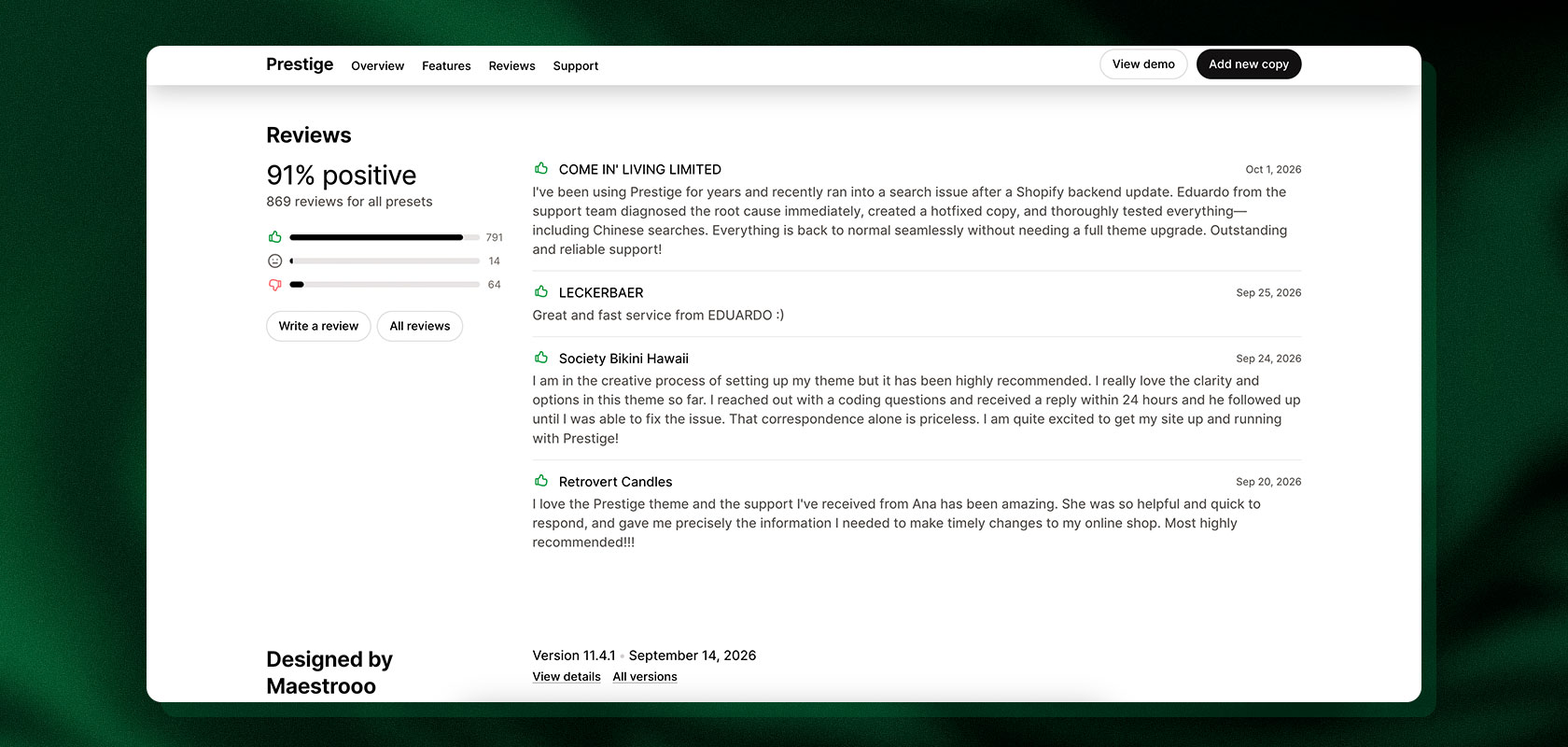
91% Positive Reviews in the Shopify Theme Store
The Prestige Theme currently has a 91% positive rating in the Shopify Theme Store, based on 869 reviews across all available Prestige presets. Only 2% of the reviews are neutral, and 7% are negative.
In recent reviews, Maestrooo’s support is frequently mentioned in a positive light. Users also highlight the theme’s design options and ease of customization. One recent review describes Prestige as high-quality, fast, and highly customizable, while also emphasizing satisfaction with the support received in resolving a more complex issue.
What users highlight most frequently:
high-quality and modern design
extensive customization options
fast and competent assistance from the theme support team
easy management and configuration
positive experiences with performance and user experience
However, the reviews are not exclusively positive. Some users criticize missing features or certain limitations in the design of product and collection pages.
This shows that Prestige offers a comprehensive foundation but may require customizations depending on the store’s concept.
Prestige in Use by Latori Clients
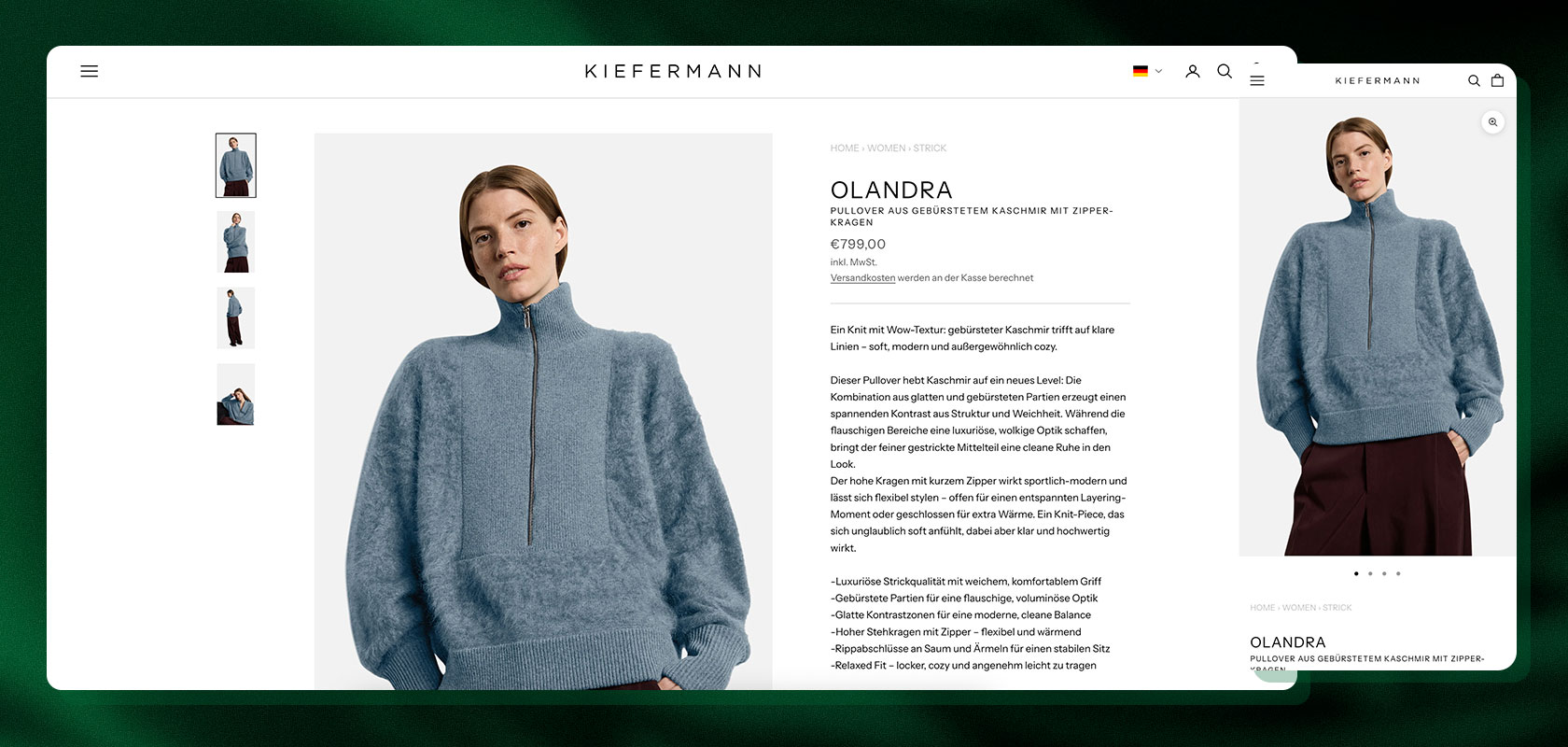
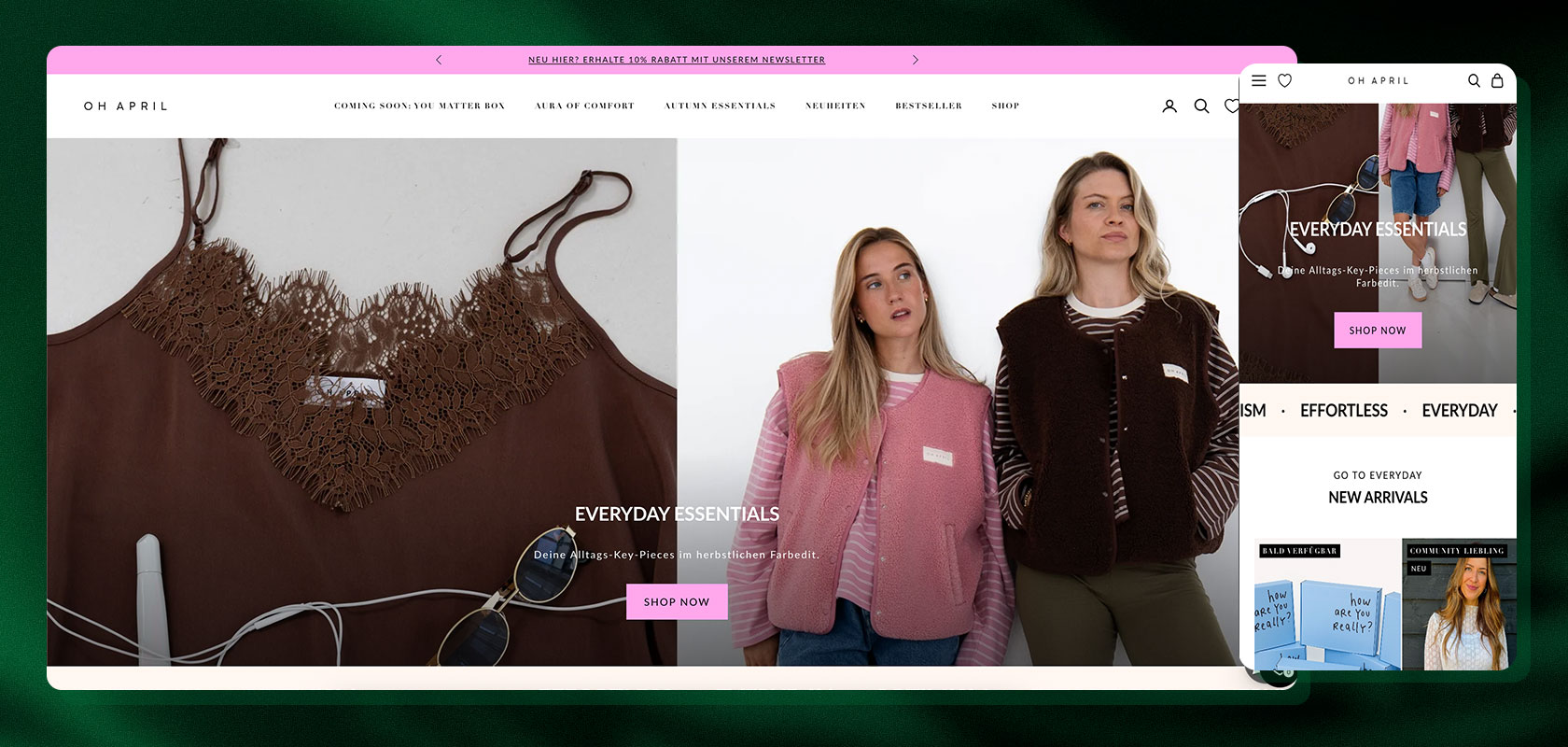
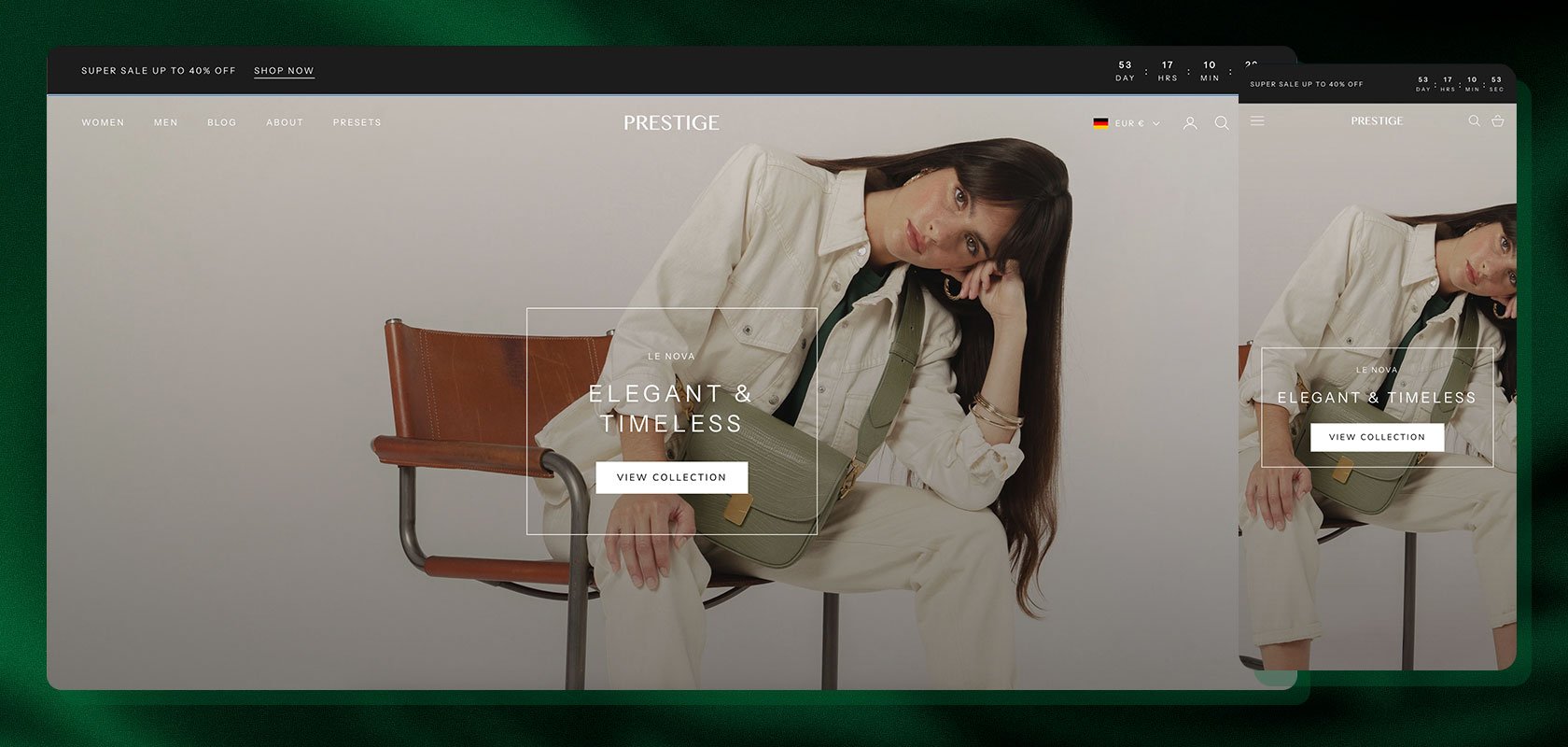
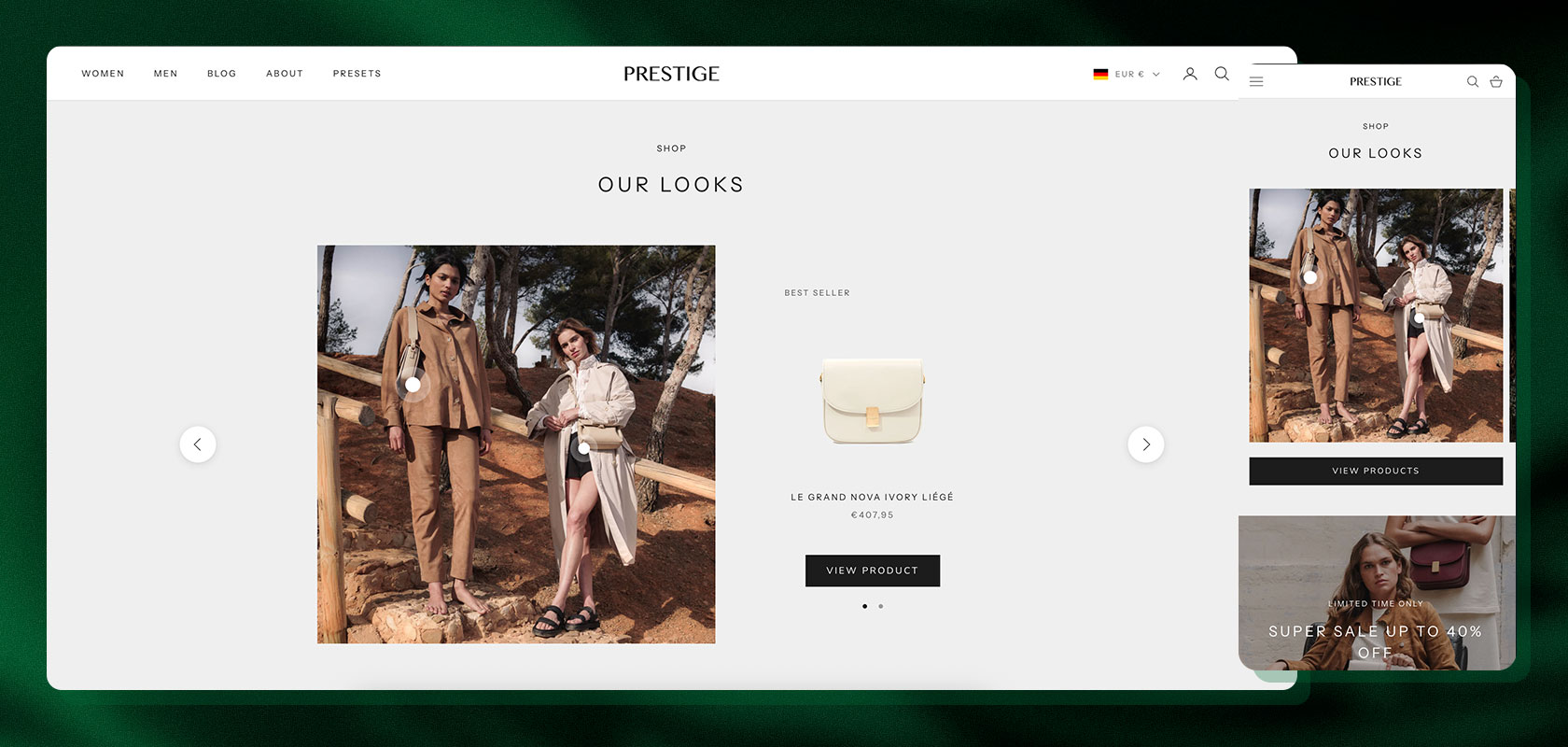
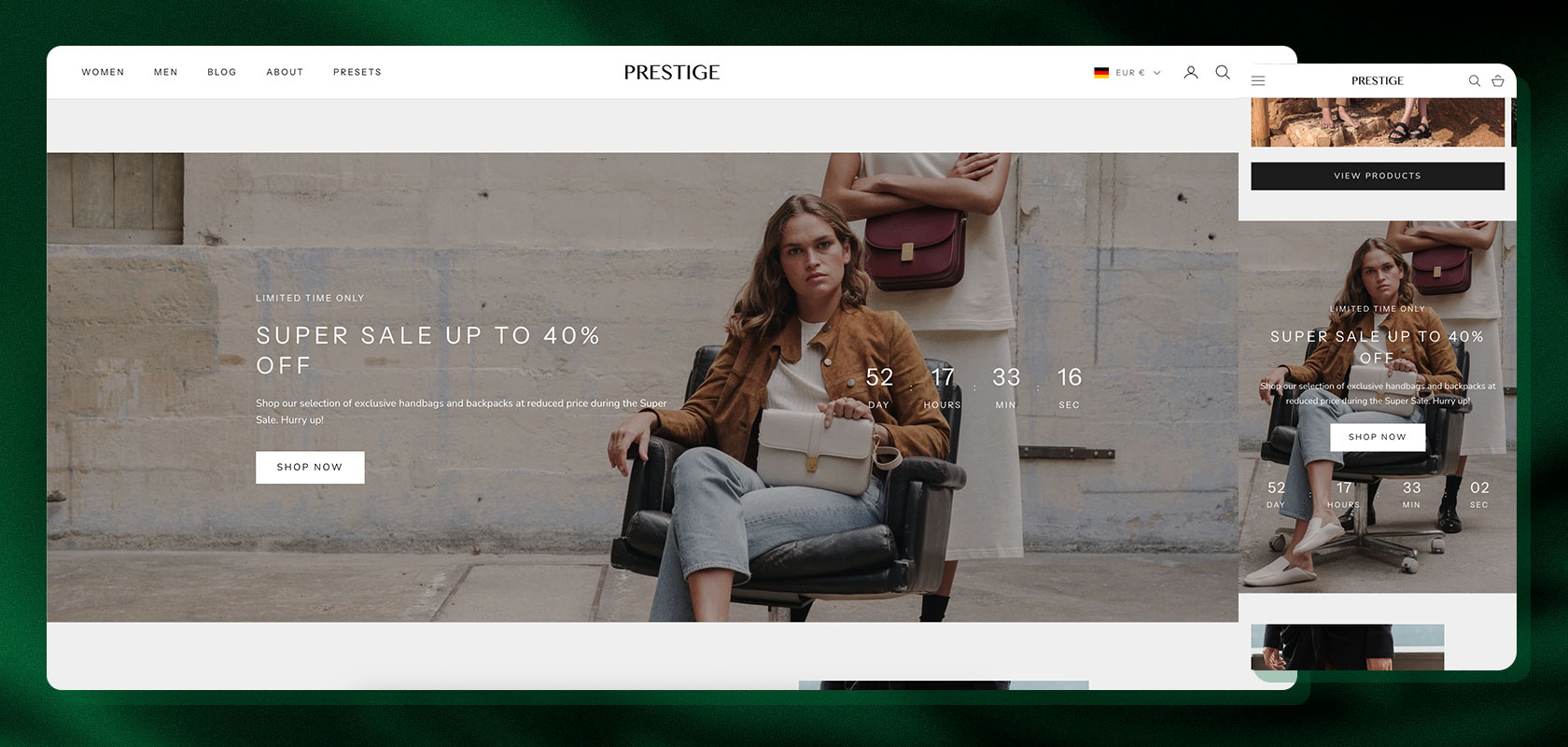
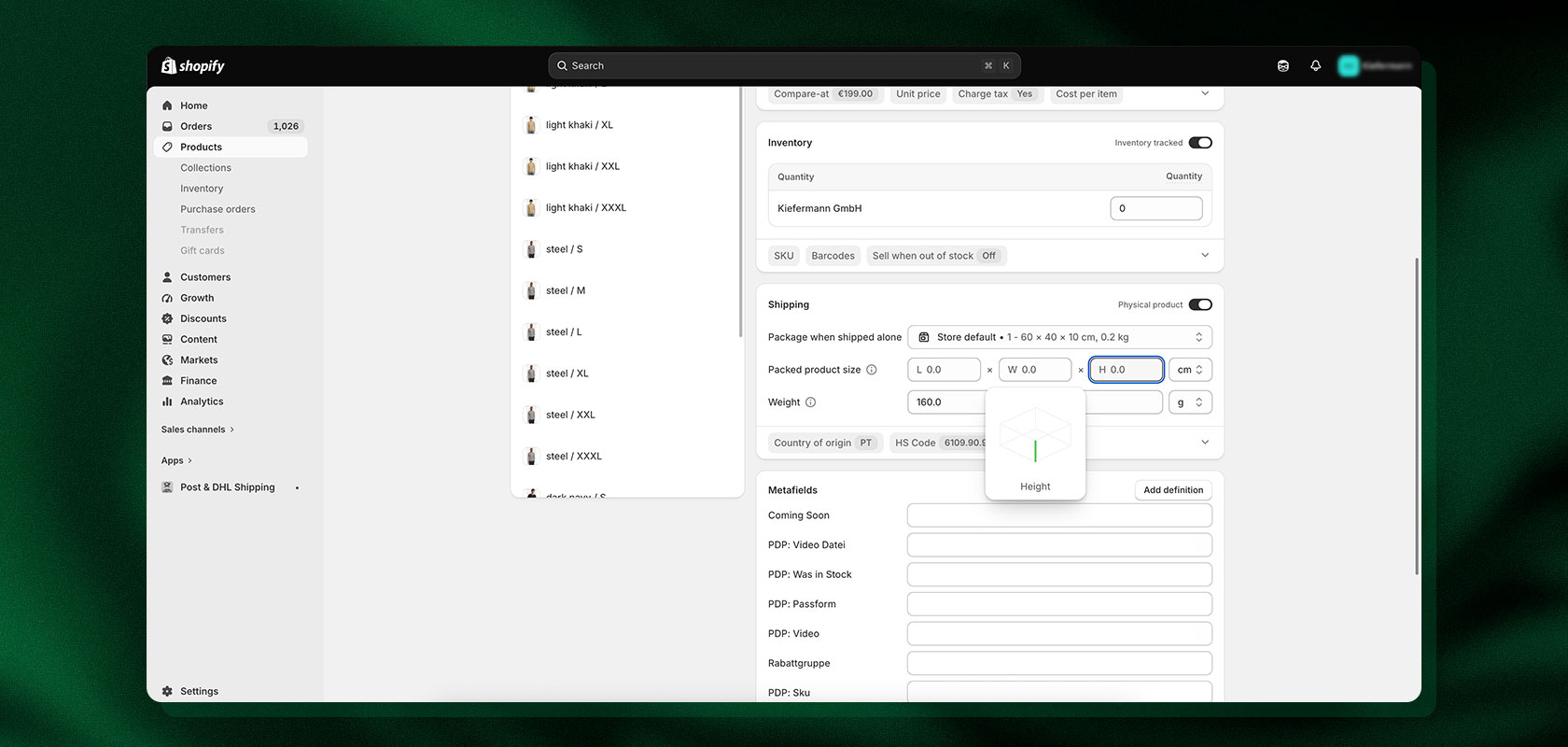
In practice, brands also rely on the Prestige theme to present their products in a high-quality manner and build a unique brand identity. Among the Latori clients who use Prestige are Oh April and Kiefermann.
These two examples from the fashion industry show that the theme can serve as a modern foundation for strong brand presentations. The key lies in the customized implementation: sections, navigation, product presentation, and other elements can be tailored to the specific brand and customer journey.
This combination of visual presentation, extensive theme features, and customization options can be particularly appealing for fashion, beauty, and lifestyle brands.
Latori’s Practical Tip:
Reviews are a good guide when selecting a theme. However, an even more meaningful question is whether the theme meets your specific requirements. Therefore, before making a decision, be sure to evaluate not only the design and reviews but also product presentation, navigation, performance, SEO requirements, and any custom features.
Who is the Shopify Prestige theme best suited for?
Prestige is particularly appealing to brands that place a strong emphasis on design, product presentation, and brand impact, while also wanting access to a wide range of integrated e-commerce features.
Typical use cases include:
Fashion
Beauty and cosmetics
Jewelry and accessories
Lifestyle
Premium consumer brands
High-end food and beverage brands
Home & Living
Prestige can also serve as a suitable foundation for larger Shopify stores, provided that the requirements can be met using the theme’s features and necessary customizations.
Ultimately, the question of how customized the store should be and what technical requirements exist is more important than the industry itself.
A theme serves as a good foundation when it supports the brand identity without dominating the design—and when its technical structure can keep pace with the store’s requirements over the long term.
Quick Insight: Theme vs. Custom Development
A Shopify theme provides a ready-made technical and design foundation. Custom theme development goes significantly further and enables a tailor-made user experience. In between lies a hybrid approach: An established theme like Prestige serves as the technical and design foundation and is specifically enhanced through customizations.
Prestige Compared to Other Shopify Themes
To determine whether Prestige is the right choice, it’s worth comparing it directly with other popular themes in the Shopify ecosystem:
Prestige vs. Dawn (Shopify Standard Theme): Dawn is Shopify’s free reference theme and offers a comparatively streamlined technical foundation. This makes it a good starting point for stores where features and design are to be extensively customized. Prestige, on the other hand, already comes with numerous features for merchandising, product presentation, and visual storytelling. As a result, the development effort required for certain requirements may be lower, though the technical foundation is more complex than that of a theme designed to be deliberately streamlined.
Prestige vs. Impulse or Motion: Impulse focuses on extensive catalogs, merchandising, and sales-oriented features, while Motion works primarily with animations and dynamic content. Prestige also combines extensive merchandising features with a design strongly focused on brand presentation and visual product display.
Reading tip: Are you wondering if the free default theme is enough for your store, or what its limitations are? You'll find all the details, performance tests, and practical tips in our Shopify Dawn Theme Deep Dive.
Conclusion: How good is the Shopify Prestige theme?
The Shopify Prestige theme combines a high-quality, visually striking design with numerous features for merchandising, product search, and conversion. Brands in the fashion, beauty, lifestyle, and other premium segments can particularly benefit from its focus.
From an SEO perspective, Prestige also provides a solid foundation. However, the key lies in the actual implementation: images, apps, scripts, structured data, content, internal linking, and performance must all be optimized on a case-by-case basis.
The biggest advantage of a theme like Prestige, therefore, isn’t that everything is already set up. Rather, it provides a comprehensive foundation on which to build a customized Shopify store.
The importance of customization, in particular, should not be underestimated. After all, a high-quality store shouldn’t just look like a high-quality theme—it should look like your own brand.
If you need help customizing your Shopify store, we—as Shopify Plus experts—are here to assist you. Contact us today to learn more.
Frequently Asked Questions about the Shopify Prestige Theme
What is the Shopify Prestige Theme?
A premium theme developed by Maestrooo, specifically designed for high-impact visual merchandising and visual storytelling. It includes over 30 pre-built sections to showcase products exclusively without needing to write custom code directly.
How much does the Shopify Prestige Theme cost?
Merchants can purchase and install the Prestige Theme from the Shopify Theme Store for $400 USD.
Is the Prestige Theme good for SEO?
Technically, the theme delivers a clean HTML foundation and supports all native Shopify SEO features. However, practical execution is key to good rankings: text should not be hidden inside images, and heading hierarchies must be maintained logically despite the elegant design.
Is the Prestige Theme fast?
Out of the box, the theme code is lean and well-optimized. How fast the store loads in practice primarily depends on the media used: uncompressed 4K hero images, excessive animations, and resource-heavy third-party apps will noticeably slow down Prestige as well.
Is the Prestige Theme suitable for Shopify Plus?
Yes, newer versions natively support Plus features like Combined Listings (combining color variants into their own URLs) or tiered pricing directly within the layout. This often saves Plus merchants the effort of integrating additional apps.
Which industries are best suited for the Prestige Theme?
It excels in segments requiring strong visual presentation—such as fashion, jewelry, cosmetics, lifestyle, or premium food. It is less suited for purely B2B wholesale catalogs or discount-driven stores.
Can the Prestige Theme be customized?
Very well, in fact. Sections, colors, and typography can be flexibly adjusted via the Shopify Theme Editor. For deeper design customizations, the code is open—though changes should be documented cleanly so future theme updates are not made more difficult.
Does the Prestige Theme support AEO and GEO?
Indirectly, yes, because its clean data structure can be read effectively by AI platforms. True Answer Engine Optimization (AEO) and Generative Engine Optimization (GEO), however, depend on content maintenance: AI systems can only process your catalog accurately if descriptions answer specific questions directly and product data is structured via Schema.org.
)
)
)
)