)
We often receive inquiries about switching from Shopware to Shopify, especially when costly version changes are pending for Shopware. The challenge of retaining existing functions is absolutely solvable with Shopify, even if adjustments may be necessary.
Shopify is a fully hosted e-commerce platform (SaaS) that allows users to quickly create and manage online stores. In the basic version, only a few technical settings need to be made, and users do not have to worry about hosting. This makes it very easy to use – ideal for small to medium-sized businesses.
Shopware, on the other hand, is an open-source or cloud-based modular platform that offers comprehensive customization options and flexibility – better suited for developers and medium to large businesses.
Are you considering switching from Shopware to Shopify or are you hesitating between the two systems? This article compares Shopify and Shopware in terms of getting started and maintenance, sales and marketing, hosting, and price.
We have already proven that switching from Shopware to Shopify is feasible with our reference project Live Fast Die Young. You can find more information on this topic and what we were able to implement for the online store on our reference page.
Table of contents
We are happy to support you in migrating your store to Shopify. Contact us.
Entry & Maintenance
| Shopify | Shopware |
|---|---|
| Easy programming without technical experience | German product |
| Quick creation of the store | Individual design both in frontend and backend |
| Large selection of over 2,500 apps | Relatively intuitive design |
| Customizability thanks to Shopify APIs | Technical knowledge required |
| Large selection of design themes, these can be further customized | Customizable templates |
| Supports popular payment providers and covers more with Shopify Payments | Choice of over 1,700 plug-ins |
Shopify
Over the years, we have found Shopify to be one of the most flexible and user-friendly e-commerce platforms currently available. Compared to systems such as Shopware, development on Shopify is significantly easier thanks to its powerful, well-documented API and Liquid template language. Even without in-depth technical knowledge, merchants can get started quickly, manage their products and content independently, and easily implement smaller projects themselves. Setting up a Shopify store takes no time at all—instead of planning for months, most businesses can launch their fully functional, responsive online store in just a few weeks.
The Shopify App Store now offers over 8,000 apps—from marketing automation and SEO to inventory management and customer loyalty. A major advantage is that these apps access the store via secure APIs, so no app can disrupt ongoing operations or “break” the site—a common problem with traditional plug-in systems.
Shopify also impresses in the area of design with a large selection of modern, mobile-optimized themes – both free and paid. Each theme can be customized with the intuitive Online Store 2.0 editor or individually developed on a professional basis with the Shopify theme framework (Liquid + JSON templates) – a decisive advantage for agencies and Shopify partners like us.
Shopify integrates seamlessly with the most popular payment providers, including:
PayPal
Amazon Pay
Bank transfer
Invoice and prepayment
In addition, Shopify Payments makes it easy to accept credit cards, Apple Pay, Google Pay, and local payment methods—without third-party fees or complicated setup.
Whether you're launching your first store or looking to scale internationally, Shopify delivers performance, security, and a strong ecosystem, making it a future-proof solution for modern online commerce.
Reading tip: You can find an overview of everything about the Shopify ecosystem here.
Shopware
Shopware is an e-commerce platform developed in Germany and is one of the leading systems in the DACH region. It offers a high degree of flexibility and adaptability, making it ideal for companies with complex requirements or individual processes. Both the frontend and backend can be extensively customized. However, Shopware usually requires technical expertise—without a developer, it is almost impossible to set up a shop, even though good documentation and training courses are available. Shopware offers a selection of modern, responsive templates and over 1,800 free and paid plug-ins in the Shopware Store. These enable a wide range of extensions in areas such as marketing, SEO, and checkout.
Compared to SaaS solutions such as Shopify, Shopware appears somewhat more complex and less flexible, but offers full control over hosting, data, and system architecture—a clear advantage for companies that value independence.
Shopware is therefore a powerful, future-proof solution for professional online retail—with technical depth and quality “Made in Germany.”
Reading tip: We have summarized all Shopify Plus benefits for you in this blog.
Sales & Marketing
| Shopify | Shopware |
|---|---|
| Communication and campaigns possible directly via social media | Facebook and Instagram integration only possible via plugins |
| Easy connection to Instagram and Facebook | Sale via Amazon possible, but only one-way synchronization |
| Ready-made Shopify apps for marketing | Viele Marketing-Funktionen und Apps, überwiegend von deutschen Anbietern |
| Sales via Amazon are natively supported | Complete multi-channel automation only possible with plugins |
| Basic SEO tools available; blog function available | Intuitive content management and SEO possible without IT knowledge |
| Built-in marketing automation and analytics | Flexible, customizable workflows, usually requiring technical setup |
Shopify
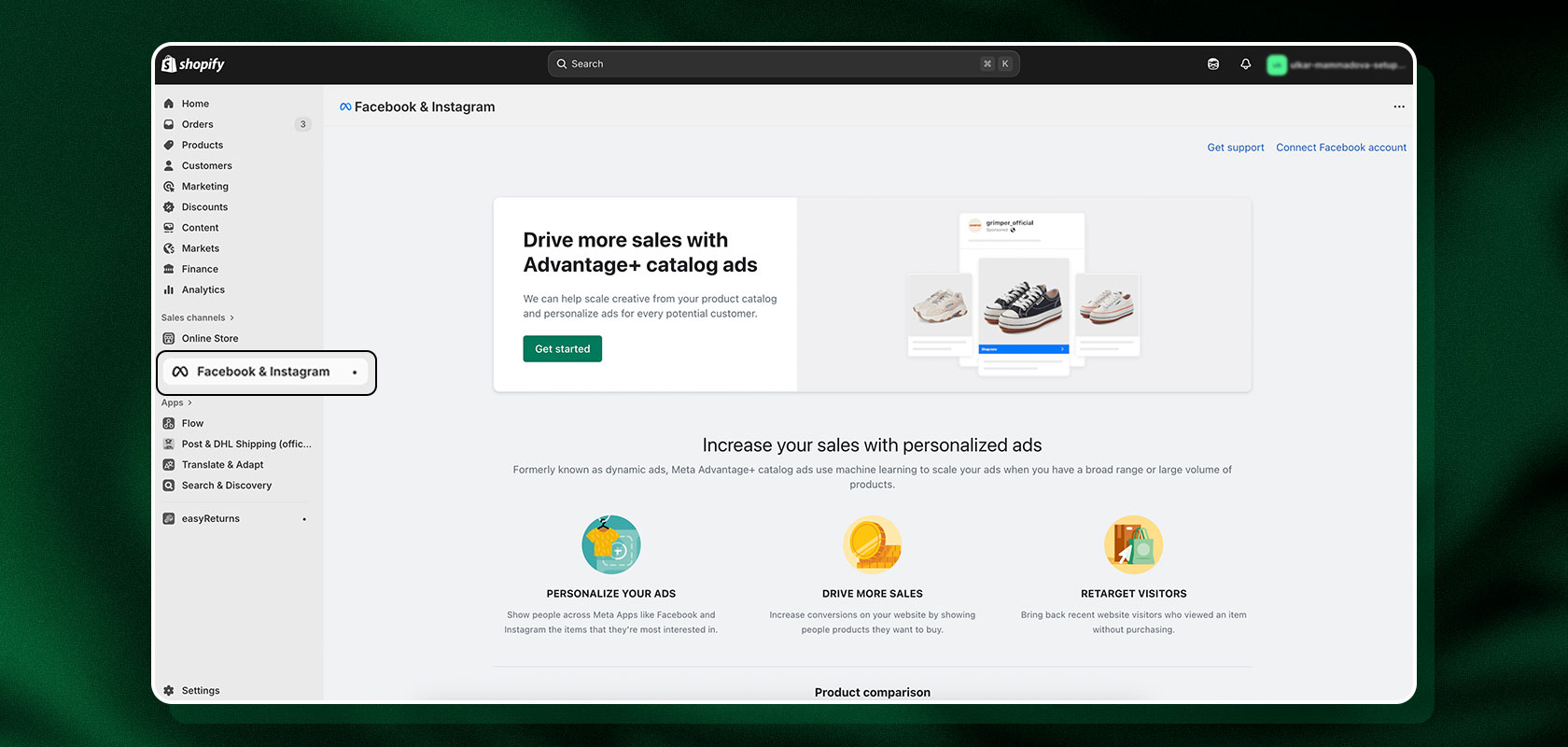
Shopify enables sales across multiple channels, including Facebook, Instagram, TikTok (including TikTok Shop), Pinterest, and marketplaces such as Amazon, eBay, and Google Shopping. Products can be presented directly in social media shops, allowing for fast, interactive sales and direct communication with customers. Shopify offers numerous ready-made apps for marketing automation, newsletters, SMS, push notifications, remarketing, upselling, and cross-selling. Integrated tools such as the AI-powered Sidekick assistant help with campaign optimization. Shopify also impresses in terms of SEO with clean code, structured URLs, maintainable meta fields, alt tags for images, and an integrated blog function for content marketing.
Shopware
Shopware focuses on flexibility and customization and is particularly suitable for tailor-made, content-driven shopping experiences. Social media integration (Facebook, Instagram) is possible via plugins; TikTok Shop requires individual connections. Products can be presented in an appealing way via “Shopping Experiences,” and storytelling and interactive layouts are possible.

Marketplace sales (e.g., Amazon) are supported but often less automated. Marketing features, newsletters, upselling, and remarketing are available via plugins or custom solutions. SEO and content management are intuitive: meta fields can be edited, alt tags can be set, and blogs or landing pages can be created without in-depth IT knowledge.
Reading tip: You want to migrate from Shopware to Shopify? We show you what you should consider.
Hosting
| Shopify | Shopware |
|---|---|
| No own server necessary | Own hosting and server are necessary |
| Automatic updates | High hardware costs |
| Takes care of hosting, operation and data backup | Some marketing campaigns require system administrators for scaling |
| Cloud-based, therefore almost 100% fail-safe | Dependent on own infrastructure |
| Scalable | Hardware and system administration are required for scaling. |
Shopify
A major advantage of Shopify over self-hosted systems such as Shopware is that online retailers do not have to worry about hosting, operation, or data backup. Updates are performed automatically, security gaps are closed promptly, and the entire system runs reliably in the cloud.
You do not need your own servers: Shopify takes care of hosting, storage of customer data, orders, payment methods, and other sensitive information—all securely and in compliance with GDPR. Risks such as server failures or hacker attacks are now a thing of the past.
Thanks to modern cloud architecture, load balancers, and content delivery networks (CDNs), your store remains fast, powerful, and highly available at all times, even during large traffic spikes caused by marketing campaigns or special promotions. Shopify is fully scalable, so your online store can grow with your business without any problems.
Shopware
Shopware does not provide hosting for merchants. Operating an online store requires dedicated servers or hosting solutions. This can involve high hardware and operating costs. During periods of high traffic, such as marketing campaigns, influencer promotions, or TV advertising, experienced system administrators are needed to ensure the scalability and stability of the store.
Price
| Shopify | Shopware |
|---|---|
| Shopify Starter: 5€/month | Free Community Edition |
| Shopify Basic: 33€/month | Rise: from €600/month |
| Shopify Grow: 88 €/month | Evolve: from €2,400/month |
| Shopify Advanced: 384€/month | Beyond: €6,500/month |
| Shopify Plus: individual, but at least about 2.400€/month | |
| Shopify Commerce Components: prices depending on requirements |
Shopify
The Shopify all-in-one solution offers different pricing plans for different sizes of businesses. Small to medium-sized businesses choose the standard plans and large companies usually opt for Shopify Plus. The cheapest plan at Shopify is available with Shopify Starter for €5 per month and is designed for sales on social media platforms. You can get the Shopify Basic plan for as little as 33€ a month and credit card fees of 2.1% (+ 0.30€) when using Shopify Payments. The mid-range plan is priced at 88€ per month and 1.8% credit card fees, and Advanced Shopify is priced at 384€ per month and 1.6% credit card fees. More information on Shopify pricing can be found here.
Customer support, by the way, is a given with Shopify and included for free in every plan in the form of a chat 24/7. Shopify Plus merchants additionally get a personal contact person.
Shopware
Shopware continues to offer the free Community Edition (open source, self-hosted) for beginners. For companies with growing or more complex requirements, the pricing model has been changed to monthly subscriptions tailored to the respective gross merchandise volume (GMV).
The paid subscriptions start with Shopware Rise (from around $600/month) for growing companies, followed by Shopware Evolve (from around $2,400/month), which includes B2B features, and the enterprise solution Shopware Beyond (from around $6,500/month). These monthly fees include advanced features and direct manufacturer support. Additional costs are incurred for hosting (for self-hosted) or paid plug-ins.
Reading tip: We show you 22 successful Shopify Plus examples.
B2B Commerce
| Shopify | Shopware |
|---|---|
| Very user-friendly, quick start | Technically more complex, higher learning curve |
| Basic functions with apps or Shopify Plus | Native B2B functions (pricing, CSV) |
| Centralized dashboard, easily expandable | Advanced functions such as quick order forms |
| Apps & integrations enable extensive customization | Open source: high flexibility, more effort |
| Cloud-based, very scalable | Scalable, but dependent on hosting |
| Suitable for fast-growing companies, B2B newcomers | Suitable for companies with complex, individual requirements |
Shopify
Shopify offers a number of options for companies that are active in the B2B sector and are looking for an uncomplicated way to get started. The platform is particularly impressive due to its user-friendliness and the ability to implement various B2B requirements quickly and easily. Functions such as individual pricing, customer group management and volume discounts can be easily integrated with additional apps or the Shopify Plus version. Shopify also offers a central dashboard for order management, which significantly simplifies the management of B2B and B2C orders.
A major advantage of Shopify is its scalability and performance. The platform is cloud-based, stable and suitable for both smaller B2B providers and companies that want to grow quickly and tap into new markets. Thanks to the large selection of apps and integrations, retailers can flexibly adapt their processes without the need for in-depth technical knowledge.
In summary, Shopify is particularly suitable for companies looking for a user-friendly and scalable entry into B2B commerce. The combination of simple processes, extensibility and low technical complexity makes Shopify the ideal solution for B2B merchants who value efficiency and speed.
Shopware
Shopware offers extensive B2B functions that are already natively integrated into the platform. These include advanced pricing for customer groups, individual price lists and specific offers. Especially for companies with complex requirements, Shopware also offers order management tools such as quick order forms, CSV orders and rights management for customer companies.
Thanks to its open source approach, Shopware is customizable and flexible. However, this flexibility also entails higher demands on technical know-how and resources, as individual customizations often require more development effort. This can be an obstacle for smaller companies or those who want to get started quickly.
Shopware is therefore particularly suitable for retailers who require extensive, customizable B2B processes and are willing to invest in technical expertise.
SEO
| Shopify | Shopware |
|---|---|
| Clean URL structure, search engine friendly; specific default paths defined | Fully customizable; complex URL structures are also possible |
| Meta Daten individuell für Produkte, Seiten, Blog-Beiträge anpassbar | Fully customizable metadata for products, categories, pages |
| Alt tags can be optimized manually or via apps | Alt tags can be optimized manually or automatically |
| Sitemap & Robots.txt automatically generated | Fully customizable sitemap & robots.txt |
| SSL & HTTPS automatisch integriert | SSL & HTTPS must be set up, often depending on the hosting provider |
| Canonical tags can only be used to a limited extent | Fully customizable canonical tags |
| Rich snippets / structured data expandable via apps or themes | Rich snippets/structured data natively possible and individually customizable |
| Wide selection available for advanced optimizations | Large number of plugins available, mostly from German providers |
| Technical SEO adjustments are limited, more suitable for beginners | Technical SEO adjustments are very flexible, requires technical expertise |
Shopify
Shopify offers a solid foundation for SEO that is easy to use, even for beginners. The URL structure is clean and search engine friendly, and pages, products, and blog posts can be individually assigned meta titles and meta descriptions. Images can be optimized with alt tags, and automatic sitemap generation and SSL encryption support visibility in search engines. Shopify also allows the integration of SEO apps to implement technical optimizations such as structured data, redirects, or page speed improvements. Restrictions exist primarily for more in-depth customizations of the URL structure, as the system specifies certain default paths.
Shopware
Shopware scores points for its greater flexibility in terms of SEO. URLs, meta tags, and canonical tags can be fully customized, allowing even complex SEO strategies to be implemented. Images can be optimized automatically or manually, and the platform offers extensive options for rich snippets and structured data. Thanks to the open-source approach, developers can deeply customize all SEO-relevant elements. However, this usually requires technical expertise, especially for larger stores with many products and categories.
Reading tip: Technical SEO for Shopify: How to optimize your online store.
Headless Commerce
| Shopify | Shopware |
|---|---|
| Storefront API for headless commerce | Shopware API & PWA for headless solutions |
| React, Vue.js, Next.js, other modern frameworks | React, Vue.js, Nuxt.js, proprietary front-end solutions |
| Integrated for web, mobile, POS, social media | Omnichannel possible via APIs, integration sometimes more complex |
| Flexible; limitations with complex backend logic | Highly flexible open-source architecture |
| Scalable, cloud-based | Speed depends on hosting and front-end implementation |
| Cloud hosting guarantees scalability | Flexible, but dependent on the chosen hosting and resources |
| API access included, project-dependent | Open source free of charge, but higher development costs |
Shopify
Shopify supports headless commerce via the Shopify Storefront API, which allows the front end to be designed completely independently of the back end. This enables companies to use modern front-end technologies such as React, Vue.js, or Next.js to create a high-performance and customized user experience. Headless solutions are particularly suitable for omnichannel strategies where content needs to be synchronized across different platforms (web, mobile, POS). Shopify Plus offers additional tools and integrations for scalable headless projects, but deeper technical knowledge is required.
Shopware
Shopware takes a clear API-first approach that natively supports headless commerce. Although “Shopware PWA” (Progressive Web App, often implemented with Vue Storefront) is a well-known option, the platform's comprehensive Store API allows for free choice of frontend. By decoupling the backend and frontend, companies can use state-of-the-art technologies such as React, Next.js, or Vue.js. The flexibility of the open-source approach provides the basis for deep, individual customization and the implementation of a composable commerce strategy, but it does involve higher development costs. Shopware is therefore ideal for demanding, complex projects that require maximum design freedom.
Reading tip: Headless commerce with Shopify: Headless architecture with Shopify Hydrogen and Oxygen.
Examples of successful migration from Shopware to Shopify
Hecht-und-barsch
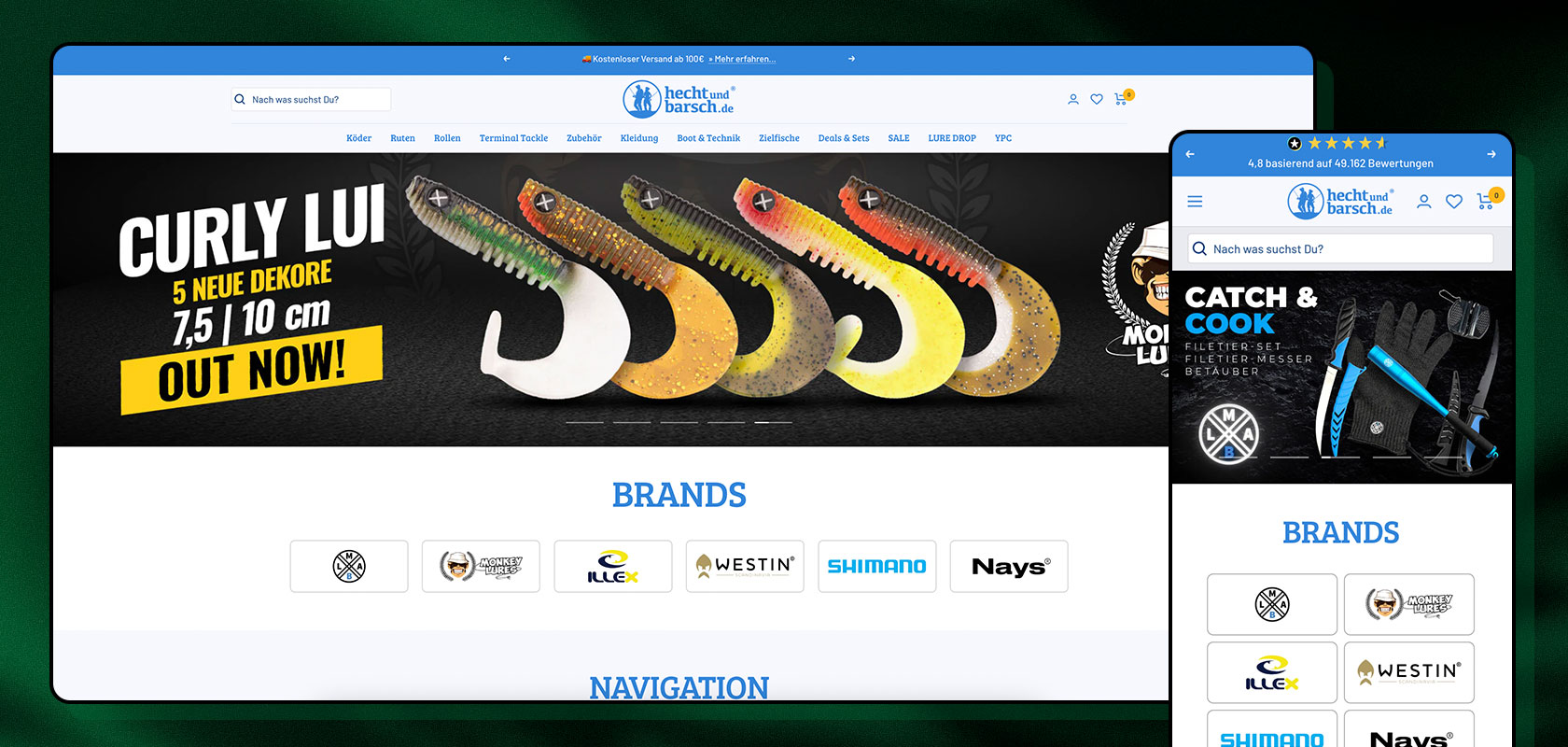
Hecht und Barsch, which specializes in a wide range of products for modern predator anglers, approached us to migrate their Shopware store to Shopify Plus in order to achieve better scalability and performance. We rebuilt the store on Shopify, redesigned the user interface, and completely migrated all product, customer, and order data.
In addition, we integrated key tools to ensure smooth operation, including Klaviyo, Descartes Pixi, 8 Returns, and Shipeasy. The result is a modern, scalable Shopify Plus store, optimized for high performance and ready to grow with the company.
Cosline
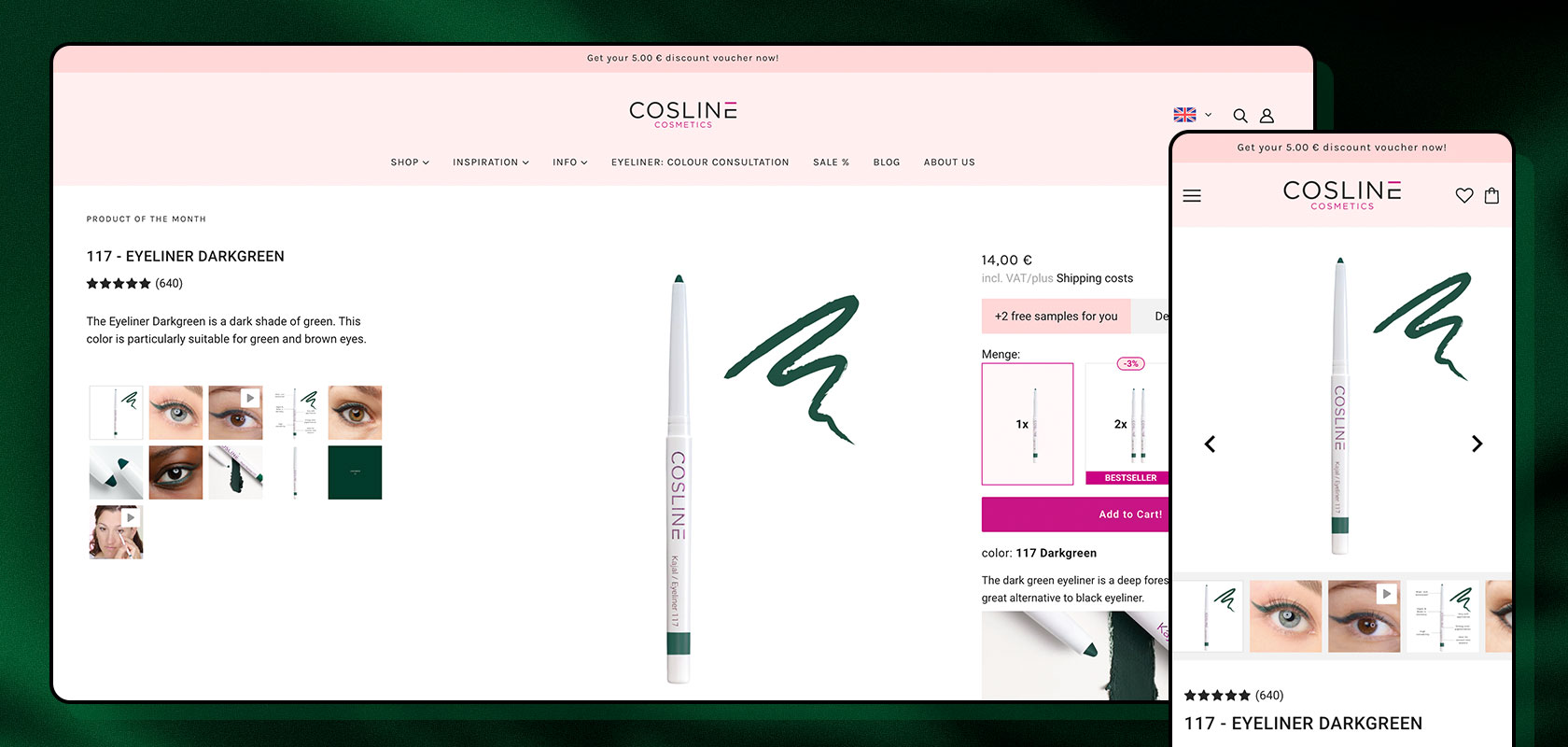
Cosline Cosmetics GmbH is a second-generation family-run cosmetics company. As part of the project, the online store was migrated from Shopware 5 to Shopify, the new Shopify store was set up, and the desired design was implemented. All existing data, including products, customers, and orders, was successfully synchronized.
In addition, various sales channels were integrated to increase reach, including Amazon, eBay, Google, and social media platforms such as TikTok, Pinterest, and Facebook, to ensure a seamless omnichannel experience.
Conclusion – Why Shopify is the winner
Both Shopify and Shopware are strong e-commerce platforms, but Shopify wins out with its cloud-based, fully hosted solution. No server administration, automatic updates, and an intuitive interface enable a quick start and easy maintenance.
With its large app ecosystem and seamless integration of payment providers, marketing tools, and sales channels, Shopify offers maximum flexibility – without any technical effort. For companies looking for speed, security, and scalability, Shopify is the optimal solution for sustainable growth.
We will be happy to advise you on the possibilities offered by the store system that best suits your situation. Just get in touch with us.
Frequently asked questions about Shopify vs. Shopware
Who is Shopware suitable for?
Shopware is suitable for e-commerce platforms of any kind. However, it should be noted that a certain technical know-how must be available in order to realize a store with Shopware.
Who is Shopify suitable for?
Shopify is suitable for e-commerce platforms of any type. Thanks to the wide range of different plans, there is the right version for everyone. No technical experience is necessary to start a store with Shopify.
What is the best store system?
Of course, this depends on the requirements that the store has to meet. However, Shopify is a system with which both e-commerce beginners and medium-sized businesses can easily manage a store.
Which companies use Shopify?
A common misconception is that Shopify is more suitable for small businesses and startups. Our well-known customers such as mymuesli, Cosline, Asphaltgold, Lamy, and many more also use Shopify.
