)
Expanding an online store usually leads to a familiar dilemma: either offer more products and risk being stuck with excess inventory, or keep the product lineup focused and thereby miss out on growth opportunities.
Shopify Collective offers another option. Eligible Shopify merchants can add products from other Shopify stores to their own product lineup without having to purchase that inventory first. The supplier retains control over inventory and fulfills the order; the merchant sells the product through their own storefront, under their own brand.
In this guide, Latori GmbH explains how Shopify Collective 2026 works, what it costs, and how merchants and suppliers can get started. Every specific requirement, restriction, or figure in this article is linked to Shopify’s own documentation so you can verify it directly.
Quick Insight: What is Shopify Collective?
A Shopify sales channel that allows eligible merchants to sell products from other Shopify stores without having to purchase that inventory first. The supplier retains control over inventory and fulfillment; the merchant sells the product through their own store under their own brand.
Table of contents
- How does Shopify Collective work?
- Shopify Collective vs. Dropshipping
- Requirements & Eligibility for Shopify Collective
- Shopify Collective Pricing: Is It Free?
- Shopify Collective for Merchants: How to Get Started
- Shopify Collective for Suppliers: How Does It Work?
- Shipping, Returns, Taxes & Customer Support
- Shopify Collective Review: Pros and Cons
- Alternatives to Shopify Collective
- Conclusion: Is Shopify Collective Worth It in 2026?
Do you need help setting up or integrating Shopify Collective into your store? Contact us, and we'll be happy to help!
How does Shopify Collective work?

The easiest way to understand this model is to separate the two roles. The retailer owns the storefront and the customer relationship. The supplier owns the product: inventory, fulfillment, and shipping.
Supplier → Shopify Collective → Retailer → Customer
A merchant finds a supplier, connects with them, and gains access to a selection of products via a Collective price list, which can then be imported into their own Shopify store. When a customer purchases one of these products, the order is forwarded to the supplier, who ships it directly. Inventory levels and prices are automatically synchronized between both stores, so the merchant doesn’t have to wonder whether an item is actually still available.
Since no capital is tied up in inventory, Collective is ideal for merchants who want to test new categories, add complementary products, or increase the average cart value before committing to a more extensive inventory investment.
Reading tip: Online Marketplaces: E-Commerce Opportunities and Risks — an overview of how additional sales channels, such as marketplaces and partner models, impact product assortment, margins, and customer relationships.
Shopify Collective vs. Dropshipping

The principle is similar to dropshipping in that the merchant never holds inventory themselves. However, that’s where the similarities end. Collective is specifically designed for relationships between Shopify merchants, not for a broad network of external suppliers.
The difference lies in sourcing. Traditional dropshipping often relies on external directories, sourcing platforms, marketplaces, or specialized dropshipping apps, whereas Collective is based on direct, verified connections between Shopify merchants.
This distinction should significantly influence your decision. Broad sourcing flexibility is a strong argument for traditional dropshipping. An existing Shopify business and an interest in partnering with other Shopify brands are strong arguments for Collective.
Quick Insight: What Is Dropshipping?
Dropshipping is an e-commerce business model in which you sell products without stocking them yourself. When a customer places an order in your store, you forward the order to a supplier, who ships the merchandise directly to the end customer. Your profit comes from the difference between your selling price and the supplier’s purchase price.

Latori Expert Tip
Don’t choose Collective just because it eliminates the need for inventory investment. First, ask yourself whether the supplier’s products truly complement your existing product lineup and customer base. The product fit matters more than the financing model.
Requirements & Eligibility for Shopify Collective
Before you plan to expand your product range using Collective, you should check whether your store and your desired partner’s store actually meet the platform’s requirements.
Contrary to what may still be stated in outdated documentation, there is no longer a minimum sales volume requirement for stores to use Shopify Collective. However, there are some technical and geographic rules that must be met.
Basic requirements for merchants and suppliers according to Shopify’s official eligibility documentation:
Active Shopify plan: Any active paid plan qualifies; stores on the Pause and Build plan cannot use Collective.
Supported country and currency: Your business must be based in one of the 36 supported countries (including Germany, Austria, Switzerland, most EU countries, the U.S., Canada, the U.K., Australia, New Zealand, Japan, Singapore, Hong Kong, and Mexico) and use one of the 18 supported currencies.
The “same country, same currency” rule. To actually connect, the merchant and supplier must be based in the same country and use the same store currency. A U.S. store in USD can connect with another U.S. store in USD, but a German store in EUR cannot connect with a French store in EUR. Collective does not process cross-currency settlements.
Shopify Payments must be fully set up with active payouts, and the payout currency must match the store currency.
Tax registration for Canada, the UK, and the EU: Businesses based in these regions must use Shopify Tax, Basic Tax, or an approved third-party tax app; manual tax setup does not qualify a store.
Network Intelligence must be enabled in the store’s privacy settings.
Identity verification: To use Shopify Collective, identity verification can be performed using an official ID document if it has not already been completed elsewhere (for example, during the setup of Shopify Payments).
Suppliers, in particular, must also maintain an active presence in the Shop app and comply with the Shop Merchant Guidelines, as this visibility is part of how merchants discover new suppliers.
What Collective Does Not Support
According to the same documentation, the sales channel is not compatible with Managed Markets, in-store pickup, subscriptions, product bundles (these are not synced from the supplier’s store, though a merchant can still use bundles in their own store), combined offers, or meta fields (these are also not synced). Digital products and gift cards are not supported at all.
Collective products can still appear in other sales channels, including Shopify POS; the only explicit exception is in-store pickup for orders fulfilled by the supplier.
Reading tip: Shopify Managed Markets & Shopify Markets: The ultimate solution for your international expansion—important if you want to sell across borders in parallel with Collective, since Managed Markets is not compatible with Collective.
Meeting the general Collective requirements does not automatically mean you can work with a specific supplier. Country and currency compatibility, as well as individual eligibility on both sides, must align.
Shopify Collective Pricing: Is It Free?
Yes, Shopify Collective is free. Eligible merchants pay neither a setup fee nor a platform commission for Collective. However, “free” refers only to the connection itself. Selling through Collective incurs the same costs as any other product line: Shopify subscription fees, Shopify Payments fees, the supplier’s product costs, shipping, advertising, discounts, returns, and customer service time.
So the key question isn’t necessarily whether Collective is free, but whether a specific product generates enough profit after all distribution costs to make selling it truly worthwhile.
How do margins work with Shopify Collective?

Shopify states that merchant margins typically range from 20% to 50%, depending on the supplier and product, and requires suppliers to maintain a minimum margin of 5% for public price lists (private price lists are not subject to this minimum).
| Selling Price | Supplier Costs | Dealer Markup |
|---|---|---|
| 100€ | 80€ | 20€ / 20% |
| 100€ | 70€ | 30€ / 30% |
| 100€ | 60€ | 40€ / 40% |
| 100€ | 50€ | 50€ / 50% |
For public price lists, suppliers must offer a minimum 5% retailer margin. However, actual profitability does not depend solely on the margin. Costs for marketing, shipping, returns, and customer service reduce the actual contribution margin.
A more meaningful calculation for each Collective product would therefore be this:
Contribution Margin = Selling Price − Supplier Costs − Distribution Costs
This formula provides a significantly better basis for product selection than the percentage margin alone.
Shopify Collective for Merchants: How to Get Started
The technical setup is simple for merchants. The real work lies in the decisions surrounding it: supplier selection, content review, and pricing strategy.
Step 1: Find the Right Suppliers
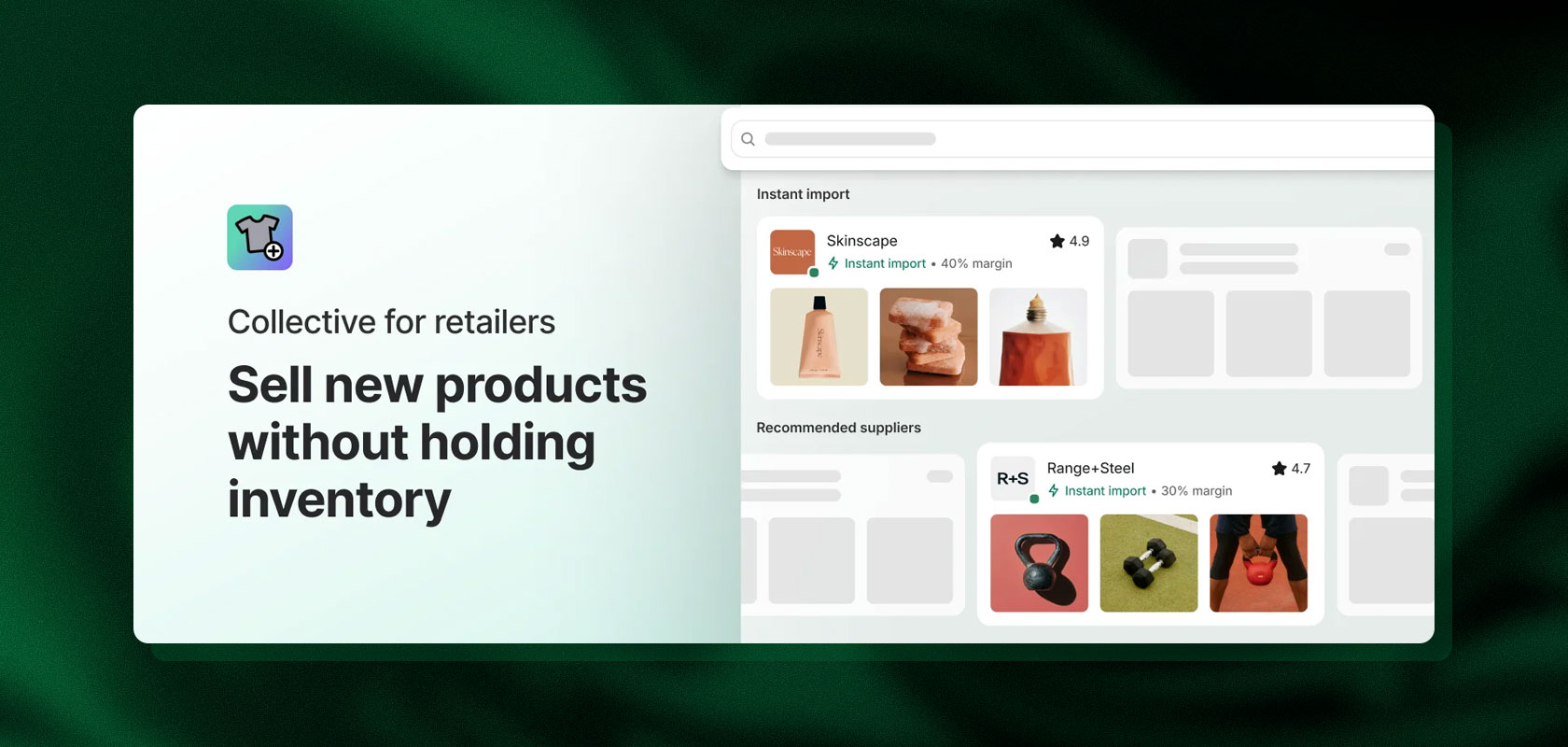
Retailers can discover suppliers and products through the Collective app, request quotes, invite suppliers they already know, or accept invitations from suppliers who reach out to them. Don’t limit yourself to just the product selection; a supplier with excellent products can still be a poor partner. Consider product quality, brand reputation, inventory reliability, shipping performance, return policies, pricing, communication, packaging, and customer support as part of the overall package.
Reading tip: The Best Shopify Apps: 25 Tools in the Shopify App Store to Boost Sales and Customer Satisfaction—useful for effectively supplementing your Collective product lineup with additional apps.
Step 2: Connect with the supplier
Suppliers make products available either through public price lists, which any authorized retailer in the same country and using the same currency can discover and import immediately, or through private price lists, where the supplier precisely controls which retailers have access and under what terms. This option is particularly relevant for brands that want to treat different retail partnerships differently.
Step 3: Import products

After connecting, merchants import selected products into their store, and details such as prices, variants, inventory, and supplier information are automatically synchronized. Cost price and inventory remain continuously synchronized thereafter.
However, importing is not the same as publishing. Before a product goes live, you should review the title, description, images, variants, retail price, SEO text, shipping information, and return policies with your own storefront in mind.
Supplier content may be accurate but still not reflect your brand at all.
Step 4: Start Selling
Once the product is live, customers make purchases through the retailer’s store, the order is sent to the supplier for fulfillment, and tracking information is synchronized back to keep the customer informed.
Quick Insight: How do Shopify Collective merchants find products?
Through the Collective app itself, by requesting quotes, by inviting existing suppliers, or by accepting invitations from suppliers. Public price lists allow authorized merchants to import products without having to wait for individual approval.
Latori Expert Tip
Start with a small number of suppliers and products. Five to ten SKUs make it much easier to identify issues with fulfillment, pricing, or service than a catalog with several hundred products.
Shopify Collective for Suppliers: How Does It Work?
Collective isn’t just a tool for merchants. For suppliers, it’s a sales channel that reaches other Shopify merchants without having to ship inventory individually to each partner.
Take, for example, a skincare brand that sells directly through its own store. Instead of relying solely on its own website traffic, it could allow select beauty retailers to offer its products as part of their own product lineup, while the brand continues to fulfill every order itself. Reach grows, but fulfillment efforts don’t.

Reading tip: Read more about effective fulfillment strategies here.
Step 1: Become a Shopify Collective Supplier
To become a supplier, the same basic requirements apply as for merchants. In addition, suppliers need an active presence in the Shop app and must comply with the Shop Merchant Guidelines, as this visibility is part of how merchants find new suppliers. Suppliers may also need to complete an identity verification process before their profile becomes visible to authorized merchants. All requirements: Requirements for suppliers.
Step 2: Create and manage price lists
Through the price list, a supplier determines what merchants actually see. Products can be organized into public price lists, which are discoverable by any authorized merchant, or into private price lists, which are visible only to selected, approved merchants. A supplier can use both at the same time: a public list for broad visibility and a smaller private list for closer partners who receive different terms or early access to new products.
Quick Insight: Why should a supplier use Shopify Collective?
It expands reach to additional merchants without having to set up separate warehouse logistics for each partner, while the supplier decides which products to share, what margin to offer, and how fulfillment is handled.
Step 3: Set Retailer Prices and Margins
For each product in a price list, the supplier sets the purchase price that retailers pay, which determines the available margin. Shopify requires a minimum margin of 5% for public price lists and cites typical margins in the range of 20–50%, but the actual amount is up to the supplier. A margin set too low can make a product unattractive relative to the retailer’s own distribution costs; a margin set too high may leave interested retailers with no room to adjust the price.
Step 4: Fulfill Orders and Manage Tracking

As soon as a retailer imports and lists a product, any resulting order is automatically forwarded to the supplier.
The supplier bears the same fulfillment responsibilities as in a direct sale: picking, packing, and shipping within the specified timeframe, as well as maintaining accurate inventory levels so that merchants don’t sell items that aren’t actually in stock. The tracking information entered by the supplier is synced back to the merchant’s store, allowing the merchant to keep the customer informed without the supplier having to communicate directly.
Shipping, Returns, Taxes & Customer Support
At this point, Collective goes beyond a simple Shopify feature and becomes a matter of business processes. While the technical connection between two stores can be automated, the business relationship still requires clear rules.
Shipping
There are two shipping perspectives to consider simultaneously: what the supplier charges the retailer for fulfillment, and what the retailer charges the customer at checkout.
Things get more complicated with a mixed shopping cart; if a customer buys one product from the merchant’s own inventory and another from a Collective supplier, this can result in two separate shipments with different delivery times and varying shipping costs.
Test this scenario before launch; even a technically functional checkout process can still appear to be faulty if the order arrives in multiple parts without explanation.
Returns
Clarify any questions regarding the returns process with each supplier before their products are listed.
Who pays for return shipping?
Where do returned items go?
Who handles damaged merchandise, and how are refunds processed?
The merchant may not handle the physical return themselves, but the customer still views your store as the point of sale.
Taxes

The tax treatment depends on the location of the parties involved, their registration status, and the structure of the transaction.
Companies based in Canada, the United Kingdom, or the EU need a connected tax app (Shopify Tax, Basic Tax, or a third-party app) as well as a verified GST/HST or VAT ID number just to qualify for Collective.
Customer Support
The supplier ships the product, while the merchant manages the customer relationship. If an item arrives late, damaged, or incorrect, the customer contacts the store where they made the purchase—not the store that caused the error. This is precisely why choosing a supplier is as much a matter of customer experience as it is a matter of procurement.
Shopify Collective Review: Pros and Cons
Is Shopify Collective worth it? For the right retailer: Yes, even if the value isn’t simply that it’s free.
Pros
Low inventory commitment: Add products without purchasing inventory upfront
Native Shopify integration: Product, inventory, order, and fulfillment data remain connected within a single ecosystem
Faster product line expansion: no wholesale ordering process and no warehouse space required to add a complementary product
Supplier discovery: find new brands or integrate existing suppliers
Low-risk product testing: a practical way to determine whether a category warrants further investment
Disadvantages
No control over fulfillment: Inventory availability, packaging quality, and shipping speed are determined by the supplier, not by you
Inaccurate supplier inventory, which can make a product appear available even when it is not
Fulfillment delays beyond the merchant’s control
Complicated returns, especially when responsibilities for shipping and refunds aren’t clarified in advance
Multiple shipments per order when a shopping cart mixes Collective and non-Collective products
Country or currency restrictions that limit which suppliers a merchant can work with at all
Tight margins that may not cover paid customer acquisition costs once actual distribution costs are factored in
Partnerships can end abruptly. A supplier can terminate a merchant’s access without any required notice period, causing active products to disappear from the storefront without warning.
What Merchants Say
A look at Shopify’s own App Store reviews for Collective reveals some recurring, legitimate complaints that you should keep in mind:
Supplier prices that include VAT may be calculated incorrectly. A British merchant documented—with confirmation from Shopify Support—that Collective treats all supplier prices as net, even if a supplier’s listed price already includes VAT. As a result, what appeared to be a 10% margin on each sale turned into an actual loss.
No mandatory notice period. One merchant review called for a mandatory 48-hour notice period before a supplier is allowed to terminate the connection and described how an immediate termination can disrupt product pages and collections without warning.
Missing purchase invoices can complicate EU tax reporting. An EU-based merchant reported that Collective does not generate a purchase invoice for the cost of goods sold for each sale, which, under the rules of some tax authorities, can result in the full selling price—rather than the net margin—being treated as taxable revenue.
Alternatives to Shopify Collective
Traditional dropshipping makes more sense if you need suppliers outside the Shopify ecosystem or want to work with established dropshipping platforms rather than individual supplier relationships.
Wholesale remains the right choice when demand is predictable and you want more control over inventory and fulfillment, in exchange for higher upfront capital and greater inventory risk.
Direct supplier partnerships negotiated outside of any platform offer more control over pricing, exclusivity, packaging, minimum order quantities, and delivery terms, but require more manual effort in return.
Shopify B2B is the right tool if your primary goal is to sell to business customers rather than expand a consumer product line.
Reading tip: In this guide, we explain how to set up a B2B online store using Shopify.
Conclusion: Is Shopify Collective Worth It in 2026?
Shopify Collective is particularly worthwhile when used strategically. Instead of importing products indiscriminately, you should carefully assess whether an item meaningfully complements your existing product lineup. If you actively manage aspects such as authorization, margins, logistics, returns, taxes, and support, Collective offers a low-risk way to test new products. If successful, well-performing items can be easily scaled up or later transitioned to traditional wholesale.
Do you need help setting up Shopify Collective in your online store? Whether it's technical integration, price list setup, or selecting the right suppliers, we're here to help. Contact us today for a no-obligation consultation.
Frequently Asked Questions about Shopify Collective
What margin should a merchant aim for with Shopify Collective?
Typical margins range from 20% to 50%, with a minimum of 5% for public price lists. However, the contribution margin is what truly matters, not just the percentage. A lower-margin product that sells consistently often outperforms a higher-margin product with poor sales performance.
Who handles customer support for Collective orders?
The merchant, as the primary point of contact. Issues regarding the supplier’s inventory, fulfillment, or product quality must still be resolved directly with the supplier. This makes supplier reliability a critical factor for the merchant's customer experience.
Can an order contain products from multiple suppliers?
Yes, and each supplier fulfills their portion separately. This impacts shipping costs, delivery times, customer communication, and returns. The more suppliers involved, the more essential a clear operational process becomes.
Does Collective work for international sales?
Only within Shopify’s 36 supported countries, and only between a merchant and a supplier located in the same country using the same currency. Cross-border connections are not supported.
Can Collective products be sold in-store or picked up locally?
No. Local pickup is explicitly incompatible with Collective, as the supplier fulfills every order via direct drop-shipping to the customer.
What is the biggest risk for merchants?
The loss of control over fulfillment, combined with the margin trap described in Section 3: A healthy-looking merchant margin on paper can shrink quickly once real distribution costs—and in some cases, incorrect VAT calculations—are taken into account.
Is Collective better than dropshipping?
Neither is inherently better. The advantage of Collective is that product selection, import, order routing, and tracking are fully integrated natively within Shopify.
Is Collective worth it for a small store?
Shopify Collective is often worthwhile for smaller stores for the exact same reason as larger merchants: it allows them to flexibly expand their product range without taking on inventory risk. The only caveat is avoiding the temptation to import products simply because it is easy to do so.
