)
Today, customers expect more than just general newsletters or standardized product recommendations. They want to receive content, offers, and services that are precisely tailored to their individual situation—at the right time and through their preferred channel. At the same time, e-commerce companies face the challenge of profitably analyzing ever-growing volumes of customer, product, and behavioral data.
This is where artificial intelligence (AI) comes into play in customer relationship management (CRM). AI enhances CRM systems with capabilities to analyze customer data, predict behavioral patterns, and support personalized initiatives.
Quick Insight: What Is AI in CRM?
AI in CRM refers to the targeted use of artificial intelligence (machine learning, NLP, predictive analytics) to analyze customer data, predict user behavior, and automate and personalize marketing, sales, and service processes.
Table of contents
- What Does AI Mean in CRM?
- What advantages does AI offer for CRM?
- What roles do Shopify, first-party data, and CRM play?
- AI-Driven Personalization Throughout the Customer Journey
- Automation: From Campaigns to Customer Service
- Predictive CRM: Purchase Probability, Churn, and Customer Lifetime Value
- Using AI in CRM Successfully and Responsibly
- How to Get Started with AI-Powered CRM
- Conclusion: AI as a Strategic Addition to CRM
Do you need help optimizing your CRM? Contact us for a no-obligation consultation.
What Does AI Mean in CRM?
A customer relationship management (CRM) system collects and organizes information about customers. This includes contact information, orders, interactions, communication histories, and service contacts.
Artificial intelligence enhances these systems with additional features. Depending on the solution used, AI can, for example, analyze customer data, generate content, calculate forecasts, or support employees in decision-making and customer interactions.
It’s important to make a clear distinction: AI in CRM is not the same as traditional marketing automation.
Rule-based automation can work like this:
When a customer purchases a product, an email with relevant usage tips is sent seven days later.
The logic was defined in advance. AI, on the other hand, can help determine—based on available data—which content or products might be particularly relevant to a specific customer group.
| Dimension | Classic CRM | AI-Powered Features |
|---|---|---|
| Data Processing | Stores and structures customer data | Analyzes data and recognizes patterns |
| Segmentation | Rule-based segments | Predictive and behavior-based segments |
| Analytics | Evaluation of past activities | Forecasts and probabilities |
| Automation | Predefined triggers and workflows | AI-supported recommendations for content or actions |
| Decision-Making | Rules and manual assessment | Support through forecasts and recommendations |
Latori Expert Tip:
AI should not be viewed as a standalone software feature in CRM. What matters is which specific business decisions can be made better, faster, or more scalably with AI.
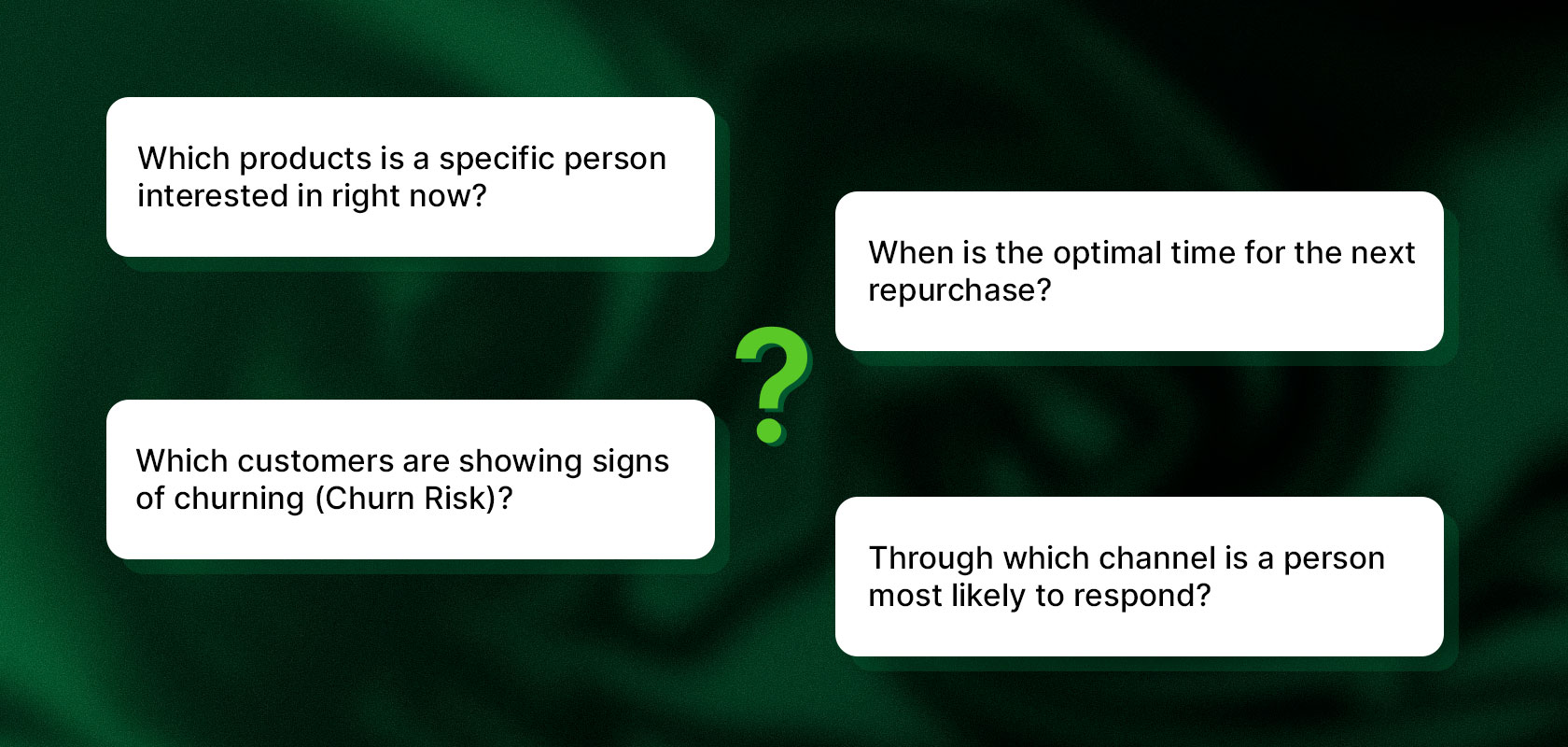
An intelligent CRM provides concrete answers to operational questions:
Which products is a specific person interested in right now?
When is the optimal time for the next repeat purchase?
Which customers show signs of churn?
Through which channel is a person most likely to respond?
Reading Tip: To learn how AI tools and messaging channels work together at the tool level, check out our article “Klaviyo AI & WhatsApp: Intelligent Marketing Automation.” While that article focuses on specific features like K:AI, this guide explores the overarching CRM strategy.
What advantages does AI offer for CRM?
The key advantage of AI in CRM lies not only in the automation of individual tasks, but also in its ability to analyze large volumes of customer and behavioral data, identify patterns, and derive forecasts or recommendations for action from them. This allows for more targeted management of customer relationships and enables measures to be better tailored to specific target groups or customer situations.
E-commerce, in particular, generates a large number of data points: orders, shopping carts, website interactions, email clicks, and customer service contacts. It is virtually impossible for teams to continuously analyze this information manually. With the help of AI, relevant patterns can be identified to derive concrete recommendations for marketing, sales, or customer service.
The key benefits at a glance
Personalization:
AI can combine various customer and behavioral data to enable more nuanced segmentation and personalized recommendations.
Efficiency:
Recurring analyses and tasks can be automated. This allows teams to focus more on strategic tasks and the development of customer relationships.
Better Decision-Making:
Predictive analytics can provide probabilities and forecasts regarding repurchase likelihood, expected customer lifetime value (CLV), or churn risk. These forecasts do not replace decisions, but they can support them.
Scalability:
The larger the customer base and the more extensive the available data, the more time-consuming a manual analysis becomes. With the help of AI, you can efficiently carry out analyses and implement personalized measures even with a large number of customers.
What roles do Shopify, first-party data, and CRM play?
For Shopify merchants, customer data is generated in numerous places.
Shopify serves as a central source for commerce data. This includes, for example:
Customer information
Orders
Products
Product variants
Shopping carts
Transactions
Store activities
This data can be combined with additional information from marketing, customer service, loyalty programs, ERP, PIM, or other systems.
This leads to an important distinction:
Shopify ≠ CRM ≠ CDP
Shopify is the commerce platform. A CRM focuses on managing and shaping customer relationships. A Customer Data Platform (CDP) can consolidate data from various sources and make it available for further applications.
The most appropriate architecture depends on the business model, the size of the store, the existing systems, and the specific use cases.
Reading tip: Read more about CRM systems for Shopify here.
First-Party Data as the Foundation for AI in CRM
For e-commerce companies, their own commerce and customer data are particularly relevant.
This allows the following information to be consolidated:
Commerce Data
Purchases
Products
Shopping carts
Order frequency
Order value
Marketing Data
Email opens
Clicks
Campaign interactions
Subscriptions
Customer Journeys
Service Data
Support Requests
Returns
Complaints
Previous Communication
Depending on the use case, different insights can be derived from this data.
For example, a model for sales forecasting requires different information than an AI system that answers customer service inquiries.
Data quality is crucial
More data does not automatically lead to better AI results.
Duplicate customer profiles, missing events, inconsistent product information, or incorrect mappings can compromise the quality of analyses and forecasts.
For Shopify merchants in particular, a clean data architecture is therefore an important prerequisite for AI-powered CRM processes.
Latori Expert Tip:
Before starting an AI project, check what data is actually available and how reliably it is collected. A small, well-structured dataset can be more valuable for a specific use case than a large amount of unstructured information.
Real-World Example
A customer regularly purchases products from a specific category on Shopify. At the same time, they frequently interact with emails about this category and ask customer service questions.
When this information is linked together, an AI system can, for example, help better understand the customer’s interests and suggest relevant content or products.
Subsequent communication can still take place via traditional marketing automation.
Data → Analysis → Recommendation → Automation
For many e-commerce companies, this combination is more relevant than attempting to fully automate all CRM processes.
AI-Driven Personalization Throughout the Customer Journey

Today, personalization in e-commerce goes beyond simply addressing customers by their first names. Companies can use various types of information about customers and their interactions to tailor content, product recommendations, and the timing of communications more precisely to each specific situation.
Depending on the data set and system architecture, factors such as purchase history, click behavior, interactions with campaigns, or other behavioral data can be taken into account. This allows for a more nuanced approach to customer segments and enables more targeted measures throughout the customer journey.
Examples of AI-powered personalization
New customers: Initial interactions and purchasing behavior can be analyzed to select relevant products or content for the rest of the customer journey.
Shopping cart abandoners: Depending on previous interactions, relevant product information, selling points, or accessory recommendations can be displayed.
Existing customers: Purchase history and usage data can be used to identify suitable cross-selling and upselling offers.
Inactive customers: Models can help identify customers at increased risk of churn and determine appropriate reactivation measures.
VIP customers: Customer segments with a high projected customer lifetime value can be targeted with exclusive offers or early-access campaigns.
Quick Insight: What is hyper-personalization?
Hyper-personalization is a form of personalization that goes beyond simply considering static customer data such as age or purchase history. Instead—provided it is available and can be used in compliance with data protection regulations—it also incorporates recent interactions and behavioral data into the selection of content, products, or communication timing.
AI can help analyze this diverse information and derive personalized actions for individual customers or smaller segments.
Reading tip: Two apps for personalization are Nosto and trbo. We've compared the two tools.
Automation: From Campaigns to Customer Service
AI-powered CRM automation refers to the integration of machine learning and generative language models into rule-based marketing and service workflows.
While traditional marketing automation follows a rigid logic (trigger → condition → action), the use of AI enables dynamic decisions within existing customer journeys. The goal is not to replace workflows, but to optimize individual decisions (e.g., send time, content selection, or ticket routing).
Rule-Based Automation vs. AI-Powered Workflows vs. AI Agents
For practical implementation in e-commerce, a distinction must be made between three levels of automation:
Rule-Based Automation: Fixed if-then logic (e.g., “Send an email requesting a review 3 days after the order is placed”). Standard in systems such as Klaviyo or Mailchimp.
AI-powered optimization: Dynamic adjustment of parameters within rule-based flows (e.g., Smart Send Time to individually determine the shipping time or automatic product selection based on previous click history).
AI Agents (autonomous systems): Software agents capable of performing tasks across different contexts. An AI agent in customer service (e.g., Gorgias AI) can independently check order statuses in Shopify, generate return labels, or forward inquiries to support if it lacks the necessary authorization.
Typical use cases in the Shopify ecosystem

1. Marketing & Email Automation (e.g., with Klaviyo):
Content Creation: Generative AI assists in creating subject lines, email preheaders, and text variations for A/B testing.
Delivery Time Optimization: Algorithms calculate the time when the probability of interaction is highest for a given profile.
Dynamic Content Blocks: Automatic display of product recommendations based on the purchase and search behavior of similar user groups.
2. Customer Service & Conversational Commerce (e.g., with Gorgias):
Automated Intent & Sentiment Analysis: AI categorizes incoming messages by urgency and topic (e.g., returns, delivery delays, complaints).
First-Level Support: Routine inquiries (e.g., “Where is my package?”) are answered by directly querying the Shopify API without human intervention.
Hybrid Escalation: Complex or emotional inquiries are automatically forwarded to human customer service along with the relevant context (Human in the Loop).
Reading tip: Our guide, “Email Marketing with Klaviyo: The Most Important Flows for Shopify,” shows you how to set up and optimize high-performing automated email journeys in Shopify.
Real-World Example: Customer Service & Commerce:
If a customer asks in chat, “Which jacket is suitable for 5 °C and heavy rain?”, the AI cross-references the product data with inventory levels and the customer’s preferences and immediately provides precise product recommendations, including availability.
Predictive CRM: Purchase Probability, Churn, and Customer Lifetime Value

An important area of application for AI in CRM is predictive analytics. Predictive CRM refers to the use of historical transaction and behavioral data to statistically predict future customer behavior using machine learning.
Typical questions include:
How likely is another purchase?
Which customers are at increased risk of churn?
How might the customer lifetime value evolve?
Instead of merely analyzing past activities, predictive models calculate mathematical probabilities for future events. The quality of these forecasts depends largely on the volume and consistency of the data. Systems like Klaviyo require a minimum number of historical orders (typically at least 500 orders) to generate reliable predictive values.
The Three Key Metrics of Predictive CRM
| Predictive KPI | Definition & How It Works | E-Commerce Use Case |
|---|---|---|
| Predictive Customer Lifetime Value (pCLV) | Estimates the total value (revenue or contribution margin) a customer will generate within a defined future period (e.g., 140 or 365 days). | Budget Allocation: Allocate higher marketing budgets to customer profiles with a high pCLV; run more targeted loyalty programs. |
| Churn Prediction | Calculates the probability that a customer will transition to "inactive" status or stop making further purchases. | Retention Marketing: Automatically trigger reactivation flows (win-back campaigns) when a defined threshold is reached. |
| Expected Date of Next Order | Forecasts the time window for the next logical repeat purchase based on individual and aggregated buying cycles. | Campaign Timing: Deliver precise reminders for consumable goods or complementary products (cross-selling). |
Predictive Analytics Is Not Predictive Prevention
In practice, a clear distinction must be made between prediction and intervention:
Prediction: AI identifies behavioral patterns (e.g., declining open rates, longer intervals between store visits) and flags an increased risk of churn.
Prevention: Identifying a risk does not prevent churn. Actual customer retention is achieved through the subsequent action (e.g., a tailored product offer, a personalized customer service outreach, or a strategy to switch communication channels to WhatsApp).
Latori Expert Tip:
Statistical forecasts are decision-making tools, not guarantees. Use predictive analytics to focus your budgets and marketing efforts on the most profitable customer segments—not to force inappropriate automation.
Using AI in CRM Successfully and Responsibly

AI must not become an uncontrolled end in itself in CRM. Without a strategic framework, there is a risk of legal issues, a loss of trust due to excessive automation (the “creep factor”), and frustrated customers. Successful AI implementation requires clear ethical, legal, and quality guidelines, as well as the right balance between machine efficiency and human oversight in the following four areas:
Data Quality & Governance: Only clean, consolidated datasets can produce valid AI predictions.
Data Protection (GDPR): The legal basis, purpose limitation, data minimization, transparency, and—where necessary—legally compliant data processing agreements must be reviewed and implemented for each specific use case.
Transparency & Control: AI decision-making logic must remain traceable.
Brand Safety: AI-generated content requires clear tone-of-voice and brand guidelines.
Quick Insight: What Does “Human in the Loop” Mean?
“Human in the Loop” refers to a process design in which AI processes data, generates suggestions, or handles routine tasks, while complex or critical decisions are reviewed and approved by human experts.
How to Get Started with AI-Powered CRM
The transition to AI-powered CRM doesn’t have to be a radical, complete overhaul. A pragmatic, step-by-step approach (piecemeal approach) reduces risks, delivers quick results, and builds trust within the team. A structured roadmap helps ensure a controlled process:
Step 1: Status Quo Analysis & Audit of the Data Landscape
Before algorithms are deployed, the existing IT and data infrastructure must be put to the test. Analyze all data silos between the e-commerce platform (e.g., Shopify), email marketing tool, customer service software (e.g., Gorgias, Zendesk), and ERP.
Where is customer data lying dormant, and is there a clear identity management system (identity resolution) in place?
Verify that consent (opt-ins) is in compliance with data protection regulations.
Step 2: Define and Prioritize Specific Use Cases
Address specific business bottlenecks:
Are there a lack of repeat buyers after the first order? Do high-value customers churn after 90 days? Is the manual effort involved in segmentation too high?
Prioritize use cases according to the “high impact, low complexity” principle. An automated predictive win-back flow for first-time buyers often yields results faster than immediately orchestrating all touchpoints.
Step 3: Optimize the data foundation and interfaces
AI requires structured and consistent data. Clean up your data:
Standardize event names and tracking parameters across all channels (e.g., consistent IDs for “Product Viewed,” “Added to Cart,” and “Order Completed”).
Clean up duplicates in the customer database.
Set up high-performance interfaces (APIs) or a Customer Data Platform (CDP) so that data can flow in real time between the online store, CRM, and AI engine.
Step 4: Launch a pilot project with a controlled scope
Implement the selected use case in a test environment or with a defined customer segment.
Example: Implement AI-powered shipping time optimization or a predictive churn model initially for only 20% of subscribers or as part of a clean A/B test against the existing standard automation.
Adhere to the “human-in-the-loop” principle: Have your marketing team manually review and approve AI-generated segments, product recommendations, or subject lines before they are sent out.
Step 5: Measure Performance Using KPIs & Scale Results
Evaluate success based on financial (e.g., conversion rate, CLV) and operational KPIs compared to a control group.
After a successful evaluation, refine the algorithms, roll out the model to the entire customer base, and gradually integrate additional channels.
Reading tip: For a comprehensive overview of strategic technology trends in online retail, see our guide, “AI in E-Commerce: Potential, Tools, and Strategies.”
Conclusion: AI as a Strategic Addition to CRM
AI offers a new way to expand CRM in e-commerce: Instead of merely documenting customer data and reacting to past behavior, companies can analyze data, calculate probabilities, and derive more targeted actions from them.
For you as a Shopify merchant, the greatest benefit arises especially when commerce, marketing, and service data are meaningfully combined. This allows you to incorporate purchasing behavior, customer interactions, and service contacts into your analysis and use them for personalized recommendations, forecasts, or automated processes.
The key is not to use as many AI features as possible. Rather, it depends on a clean data foundation, clearly defined use cases, and measurable goals. AI should be used where it creates concrete added value for customers and the company.
Anyone who wants to successfully implement AI in CRM should therefore proceed step by step: analyze the data and system landscape, select a suitable use case, test it in a controlled manner, and evaluate the results based on relevant KPIs. On this basis, you can decide which applications can be scaled effectively.
Would you like to use AI in your CRM in a targeted way? We can help you identify suitable use cases, analyze your data and system landscape, and effectively implement AI-powered CRM processes. Contact us for a no-obligation consultation.
Frequently Asked Questions about CRM in E-Commerce
What can AI actually achieve in CRM?
AI can, among other things, analyze customer data, recognize patterns, generate content, create forecasts, support product recommendations, and assist customer service teams in handling inquiries.
How can Shopify data be used for AI in CRM?
Shopify provides customer, product, and order data, among other things. Depending on technical integrations and the specific purpose, this data can be linked with CRM, marketing, or service data and used for segmentation, personalization, or predictive analytics.
What role does Klaviyo play in AI for CRM?
In e-commerce, Klaviyo can be used for customer segmentation, marketing automation, and predictive analytics, among other features. Available predictive analytics metrics include customer lifetime value, expected next order date, and churn risk.
What role does Gorgias play in AI for CRM?
Gorgias utilizes AI primarily in customer service and conversational commerce. The AI Agent can be connected to Shopify and leverage product, order, and customer information for support and shopping interactions.
What is Shopify Magic?
Shopify Magic is a suite of AI features within Shopify. It assists with product descriptions, email content, media, and other shop workflows.
What is Shopify Sidekick?
Shopify Sidekick is an AI-powered commerce assistant in the Shopify admin. It can answer questions about the shop, analyze data, create content, and support daily tasks. Sidekick can also build customer segments using natural language.
Can AI predict Customer Lifetime Value?
Yes. Predictive analytics models can forecast future customer lifetime value based on suitable historical data. However, the result is a predictive estimate, not a guaranteed outcome of future customer behavior.
Can AI prevent churn?
AI cannot prevent churn directly. However, it can analyze behavioral patterns and predict an increased risk of churn. Companies can then use this information to trigger reactivation or customer retention campaigns.
Is AI in CRM GDPR-compliant?
It depends on the specific use case, processed data, legal basis, and service providers involved. The GDPR provides several possible legal bases for processing personal data; consent is not required in every single case. Companies should therefore evaluate each specific data processing activity from a privacy standpoint.
What role does the EU AI Act play in AI for CRM?
Depending on the AI system used and the specific application, requirements under the EU AI Act may be relevant. Additional provisions of the AI Act apply (such as transparency requirements for specific AI systems).
How should companies start with AI in CRM?
A step-by-step approach is best. Companies should first analyze their data and system landscape, select a specific use case, and verify whether AI is genuinely required. Afterwards, the use case can be tested within a defined segment and evaluated using suitable KPIs.
