)
At the beginning of every online shop is the choice of shop system, which entrepreneurs should not take lightly. Anyone looking for a suitable solution for their online shop will almost inevitably come into contact with WooCommerce or Shopify. Both systems are very popular with online retailers of all sizes and industries. The question may therefore rightly be asked: WooCommerce vs. Shopify, which of the two systems is the better one? In order to answer this question, we have compared the systems according to 9 criteria.
Table of contents
- Shopify vs WooCommerce: What is What?
- #1 Hosting: Scalable cloud meets self-hosting
- #2 Price: Self-management can pay off
- #3 GDPR compliance: WooCommerce only becomes legally compliant in a roundabout way
- #4 Apps: Both systems are flexible
- #5: Performance and stability: the bigger, the slower
- #6 Payment methods
- #7 Future trends
- Conclusion
You want to open a store or change your store system? Then we are happy to help you. Contact us
Shopify vs WooCommerce: What is What?
Before we take a closer look at the strengths and weaknesses of Shopify and WooCommerce, or their differences, let's first introduce the rivals.
Shopify is distributed by the Canadian company of the same name and was founded by German expatriate Tobias Lütke. From its adopted home of Canada, Shopify has expanded into numerous countries and is now one of the largest shop systems in the world, trusted by millions of retailers worldwide. The e-commerce platform is characterized by its simplicity and addresses both small and medium-sized retailers as well as enterprise customers, who receive a comprehensive shop solution thanks to Shopify Plus.
Unlike Shopify, WooCommerce is not a standalone shop system. Rather, it is a plugin of the WordPress content management system. The system was developed by WooThemes and emerged in 2011 from the then quite popular system Jigoshop.
According to Builtwith, WooCommerce and Shopify are the two most commonly used platforms for online shops among the top 1,000,000 websites (based on traffic rank). Shopify has a market share of around 21.75% among the “Top 1 Million Sites,” while WooCommerce has 8.51%.
NEW: Shopify integration in WordPress
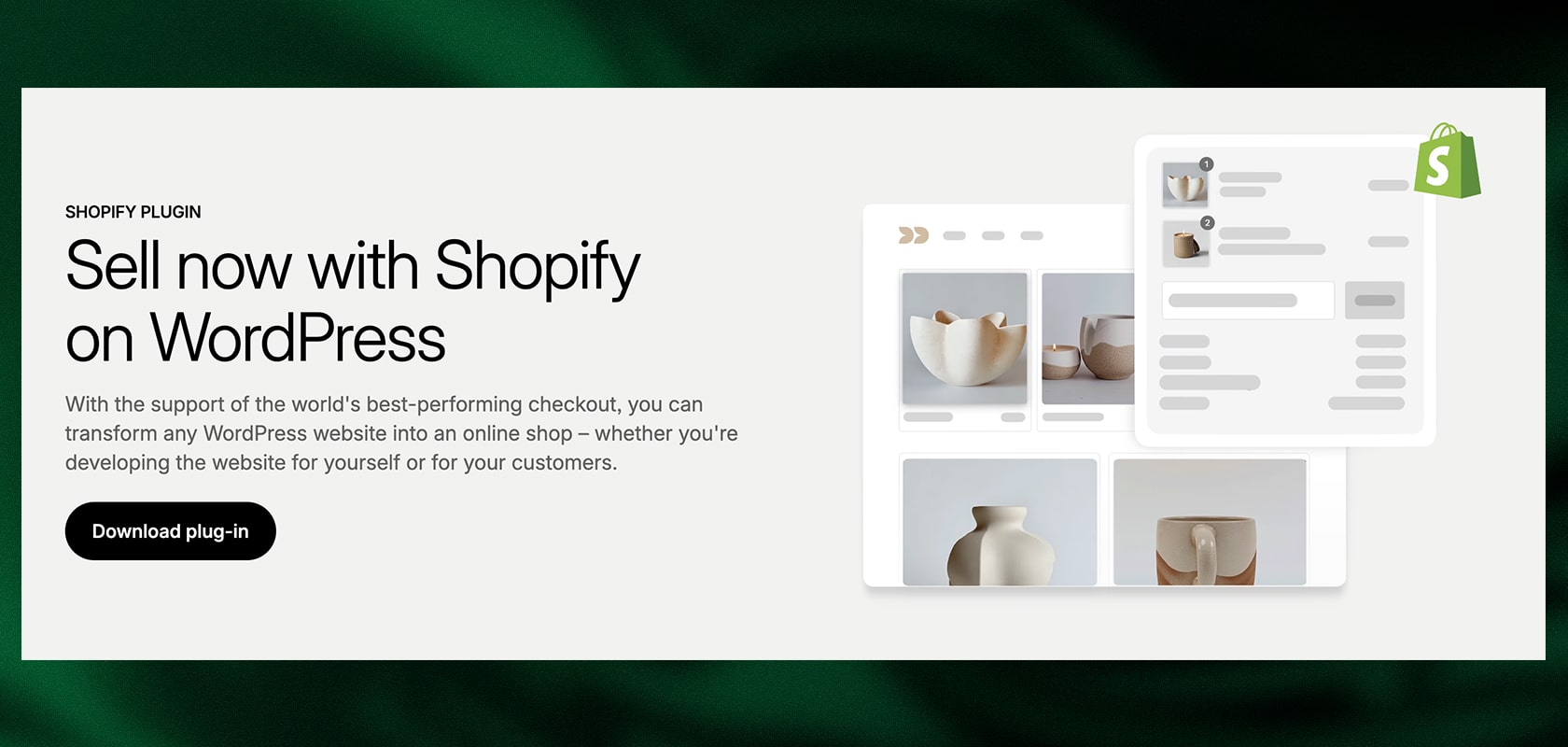
Does it always have to be one or the other? Shopify says no and is upgrading: a new Shopify plugin quickly transforms any WordPress website into a fully-fledged online store without any programming. This allows merchants to combine two worlds and equip their WordPress website with Shopify e-commerce features.
Products are created in Shopify and can be inserted directly into the WordPress editor as blocks. The Shopify checkout stands out for its performance. According to reports, the conversion rate is 17% higher than WooCommerce. WordPress site owners can sell immediately, securely, and reliably with Shopify, as the system includes built-in encryption and fraud protection.
The free Shopify plugin for WordPress is compatible with any Shopify plan, which is available from $1/month for the first three months.
Is an interim solution like this not enough for you, and are you still wondering whether WooCommerce or Shopify is the right system for you? Don't worry, we'll take a look at which system comes out on top based on 9 different criteria.
Planning your Shopify Plus launch? Our checklist will help you make sure you don't overlook anything.
Download checklist#1 Hosting: Scalable cloud meets self-hosting
WooCommerce and Shopify already differ from each other when it comes to hosting. As part of WordPress, WooCommerce is self-hosted. This means that you have to take care of the corresponding web space yourself when setting up your online shop. This requires either your own server or a third-party provider in the form of a hoster.
The situation is different with Shopify. The system is cloud-based, which means that hosting is included in the monthly costs and is taken care of by Shopify. Not only is this the more relaxed approach for the user, the cloud-based system is also scalable and automatically adapts the available resources to the demand. This ensures that there are no delays in the event of peak loads. Many companies that present themselves in TV shows such as "Die Höhle der Löwen" (The Lion's Den) therefore rely on Shopify in order to be able to cushion the immense rush of traffic to their own website or shop in a fail-safe manner. No matter how many people access a shop at the same time, the Shopify shop will absorb the load and remain stable. Although there are cloud hosting providers for WordPress, and thus for WooCommerce, the corresponding packages are usually more expensive than conventional hosting.
Our verdict
In terms of hosting, Shopify is clearly ahead: The scalable cloud beats self-sufficiency in terms of convenience. Although you are free to choose your hoster with WooCommerce, this is not exactly easy in view of the large variety of providers. Setting up and maintaining a store also requires additional effort compared to Shopify's integrated and secure cloud solution.
Reading tip: Magento or Shopify? We have also looked at this in detail!
#2 Price: Self-management can pay off
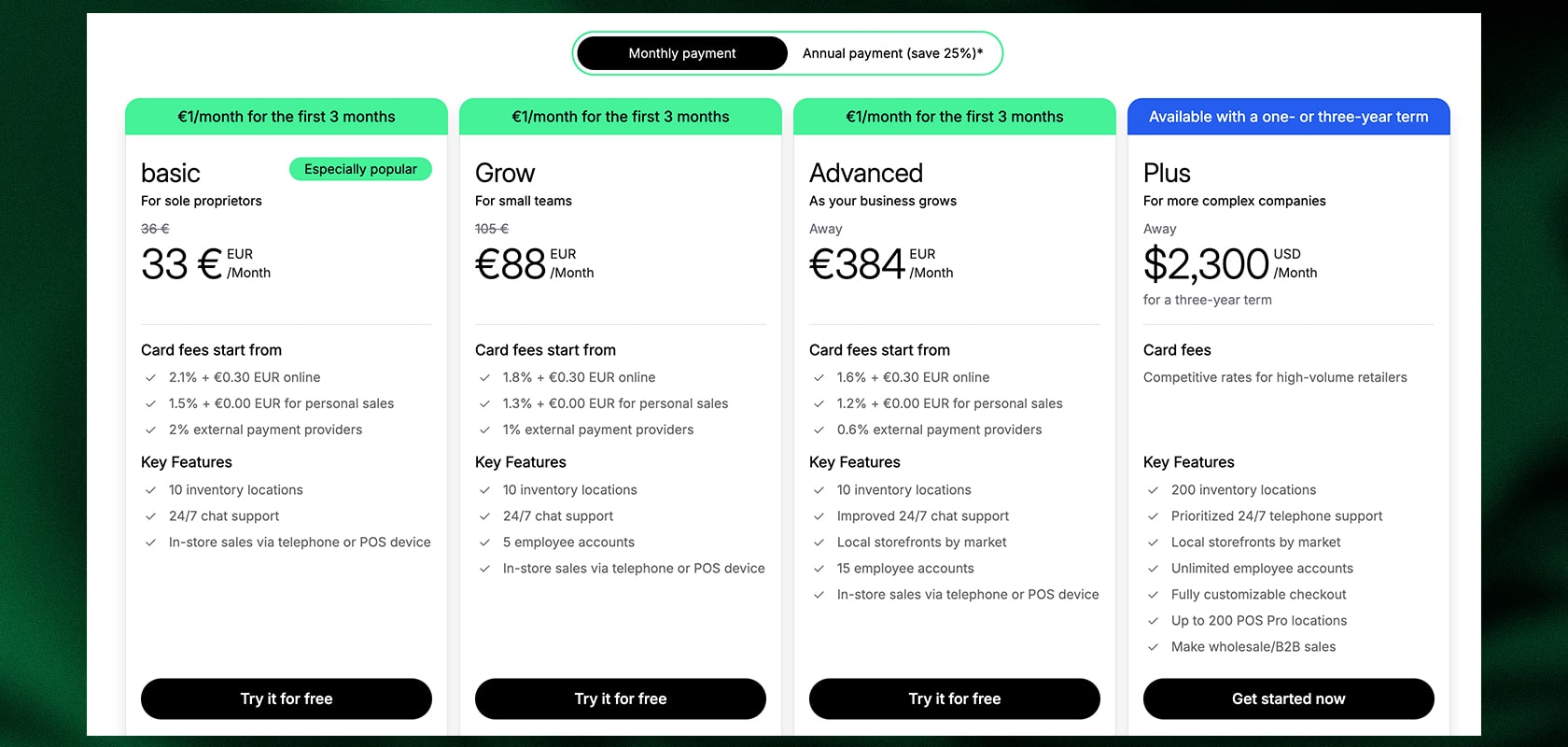
Shopify follows a plan-based pricing model with fixed monthly costs. The three plans, Basic, Shopify, and Advanced, cost $33/month, $88/month, and $384/month, respectively. For merchants with high business volumes, Shopify Plus offers another plan with variable costs based on the company's requirements (minimum $2,300/month).
Wordpress and Woocommerce are free open source platforms, meaning you can install them on your website completely free of charge and get in cheaper that way. Within Woocommerce, hundreds of payment providers are integrated and the only fees you have to pay are those charged by the respective provider. Things you may have to pay for with Woocommerce include additional integrations and plugins. Most importantly, you are responsible for the hosting and security of your customers.
Due to the fact that hosting prices vary depending on the provider, the cost of WooCommerce is difficult to quantify. However, with a medium hosting package for 10 - 15 euros per month, they are lower than the price of Shopify's Basic plan.
For both WooCommerce and Shopify, apart from the costs of the respective plan or hosting, you may incur further expenses for paid apps.
The price differences at a glance:
| Shopify | WooCommerce |
|---|---|
| Shopify Starter: 5€ / month | Free installation |
| Shopify Basic: 33€ / month | Additional costs for integration, plugins and hosting (medium hosting package e.g. for 10-20€ / month). |
| Shopify: 88€ / month | |
| Shopify Advanced: 384€ / month | |
| Shopify Plus: from about 2400€ / month | |
| Commerce Components by Shopify: depending on the requirements of the merchant |
Our verdict
As you can see, Shopify and WooCommerce are difficult to compare in terms of cost. Here, you should be clear about what you are being offered. WooCommerce is only the software for providing e-commerce functions and does not include hosting, security or integrations as standard. As an e-commerce newcomer, you may still be able to get started here more cheaply, unless you go for additional plugins. Shopify is only available with a monthly fee, but it is still positive that hosting, security and updates are already included. In terms of price, we therefore see a neck-and-neck race.
Reading tip: We have summarized everything else about Shopify prices for you here.
#3 GDPR compliance: WooCommerce only becomes legally compliant in a roundabout way
Since the GDPR came into force in 2018, legal certainty has been a key issue when setting up an online store—because violations can be expensive. Shopify supports merchants in working in compliance with data protection regulations: The platform provides a GDPR-compliant Data Processing Addendum (DPA), integrated security features such as SSL encryption, and PCI DSS Level 1 certification for secure payment processing.
In addition, Shopify automatically takes care of updates and security-related improvements. However, to ensure that your shop is actually GDPR-compliant, it remains important to implement your own legal requirements—such as a complete privacy policy, correct cookie consent, and the data protection-compliant configuration of all apps and tracking tools used. Shopify offers suitable settings and tools for this so that you can easily meet the legal requirements.
WooCommerce is not designed out of the box for selling in the European legal area and is only legally secure in a roundabout way. This requires additional plugins, such as the WooCommerce Germanzied, which is specially adapted to the legal situation in Germany. However, in order to be able to create and send legally compliant invoices via this plugin, the paid pro version is required. WooCommerce also gets the short end of the stick when it comes to SSL certificates, because these are not offered automatically. You have to find a hosting provider yourself who offers such a certificate. WooCommerce also does not automatically comply with the legal requirements when it comes to PCI-DSS compliance. You have to take measures yourself to ensure that you sell securely to your customers.
Reading tip: Shopify and GDPR: How to use Shopify in a legally compliant way.
Our verdict
Shopify has dealt intensively with the topic of legal security in Europe and can therefore score points in this area. WooCommerce itself does not offer a solution here. If you want to make your shop legally compliant, you are therefore dependent on third-party plugins, which are only free of charge to a limited extent. When it comes to GDPR compliance, the Shopify vs. WooCommerce comparison is therefore quite clearly in favour of the Canadian shop system.
Reading tip: Want more comparisons? Read here how Shopify compares to Shopware.
#4 Apps: Both systems are flexible
"There's an app for everything" - No less a person than Steve Jobs advertised the first iPhone with this slogan in 2008 - as we all know, extremely successfully. Both Shopify and WooCommerce are dedicated to the same principle of offering program extensions for the most diverse areas and thus creating a customizable system. However, with WordPress, the apps are called plugins. In connection with WooCommerce, there is often talk of extensions.
What already worked for the smartphone also works for the two shop systems. Their flexibility is probably the strongest trump card of WooCommerce and Shopify over the competition. Shopify claims to offer over 15,000 apps in its own app store. Since WooCommerce itself is a plugin from WordPress, the number of plugins is difficult to ascertain. However, of the more than 55,000 entries in WordPress's Plugin Dictionary, a wide range of extensions designed specifically for the shop plugin can be found. The bottom line is that both systems leave almost nothing to be desired in terms of customisation. Whether for shop design, checkout, filter function, payment provider or similar: both Shopify and WooCommerce usually offer several solutions for one and the same purpose. Thereby, an app/plugin can be free and functional at the same time.
Since Shopify is a closed platform, all apps that appear in the App Store have to be controlled and reviewed - unlike the open source solution of WooCommerce.
In any case, we recommend that you keep the number of apps you choose to a minimum. Too many plugins and apps in a shop can increase the loading time of the page.
Our verdict
When it comes to extensibility, we cannot identify a clear winner. Both Shopify and WooCommerce offer the possibility to choose from a wealth of apps or plugins and to integrate new functions without much effort. The amount of apps should meet the needs of online businesses of all sizes.
Reading tip: If you want to read more comparisons, we've summarized another one here: Shopify vs Shopware.
#5: Performance and stability: the bigger, the slower
When it comes to performance and stability, the demands of online shopping have clearly risen in the recent past: fast loading times and constant accessibility are hygiene factors that can no longer convince undecided shoppers. On the other hand, it is directly noticeable in the bounce rates if the (shop) page takes longer to load.
Im Shopify-WooCommerce-Vergleich lässt sich die Frage, welches System das schnellere von beiden ist, nicht eindeutig beantworten. Die Geschwindigkeit von WooCommerce wird maßgeblich durch das Hosting-Paket bestimmt. Bei besonders günstigen Angeboten kommt es oft zu langen Verzögerungen. Außerdem ist WooCommerce von Haus aus nicht gerade ein Rennpferd. Die meisten Features, die die Ladezeit verkürzen, z.B. HTML-, CSS- und JavaScript-Komprimierung, müssen erst aktiviert werden. Zu diesem Zweck gibt es eine ganze Reihe von sogenannten Cache-Enabler-Plugins. Wer über die entsprechenden Kenntnisse verfügt, kann die Funktionen auch selbst in der htaccess-Datei von WordPress aktivieren, für Laien sollte dies aber keine Option sein.
The cloud-based Shopify already has these features on board, saving you a lot of effort. Shopify also provides themes that are optimized for loading speed.
With both systems, the variety of apps/plugins is very large, but the number of extensions actually used should be kept as low as possible, as these tend to slow down the shop systems.
In terms of stability, Shopify can once again score points with its cloud-based hosting. Updates are applied automatically without you noticing anything. WooCommerce or WordPress, on the other hand, must be provided with updates manually, which is why the system requires more maintenance and becomes more susceptible to attacks and errors if this is not done for a while.
Our verdict
Shopify once again impresses with its performance and stability. Thanks to cloud hosting, the system takes care of administration and maintenance for you and is also significantly faster thanks to optimized themes. Although WordPress can also be significantly accelerated with a little effort, the fact that extensions or programming knowledge are required to activate important functions is a disadvantage.
#6 Payment methods
Shopify Payments, the official payment gateway of Shopify, is seamlessly integrated with all Shopify stores. It provides a centralized platform to manage all payments. With this integrated solution, customers can pay safely and securely using various payment methods, including purchase on account with Shopify Payments, Klarna, PayPal, Amazon Pay, Facebook Pay, Sofortüberweisung, credit card payments, eps transfers, Google Pay, Apple Pay, and Shop Pay. But external payment methods can also be used here, such as manual payment methods with credit cards or SEPA direct debit. The amount of the credit card fees varies depending on the selected plan. For example, these are 2.1% for the Shopify Basic plan, but 1.6% for the Shopify Advanced plan. When using external payment providers, a transaction fee of up to 2% is due, depending on the plan.
Reading tip: We have summarized all information about Shopify Payments here.
WooCommerce, as a WordPress plugin, supports both the usual payment methods, such as credit cards via the payment service provider Stripe (1.4 percent of sales and 0.25€ per transaction) or Paypal. It also offers a wide range of payment services and providers, both domestic and international, including Bitcoin and other currencies integration.
Our verdict
Both platforms, Shopify and WooCommerce, offer an impressive variety of payment options to meet the needs of a wide range of e-commerce businesses. However, it's worth noting that Shopify comes with an added advantage here. The platform allows merchants to benefit from a tiered fee structure depending on their chosen plan. This means that when a higher Shopify plan is selected, transaction fees tend to be lower, making it an attractive option for businesses with growing sales. This approach enables store operators to optimize their costs in line with their business growth and free up financial resources for other business activities.
#7 Future trends
The e-commerce market is evolving extremely rapidly. Modern requirements such as headless commerce, comprehensive AI integration, and fully automated processes will no longer be optional extras in 2025, but decisive factors for competitiveness.
WooCommerce
Thanks to its open-source nature, WooCommerce benefits from maximum flexibility. Headless architectures can be implemented via the REST API, and the sheer number of plugins allows the use of the latest AI tools, automations, or progressive web apps (PWAs). In addition, the platform itself has worked hard on its core: many features that previously required additional plugins are now directly integrated to reduce dependence on third parties and increase performance. The downside: such high-end solutions usually require experienced developers and a dedicated maintenance team to keep the multitude of components stable.
Shopify
Shopify has invested heavily in future-proof infrastructure in recent years and is clearly setting the standard for integrated modernity in 2025.
Headless: With Shopify Hydrogen (framework) and Shopify Oxygen (hosting for headless front ends), the platform offers a powerful, modern setup that has been specially developed for high-performance headless shops and provides developers with a highly optimized environment.
AI and automation: Features such as Shopify Magic are deeply integrated into the workflow. AI-powered tools not only help with creating product descriptions and email copy, but also automate more complex tasks in logistics and customer support. Connecting to marketplaces and social commerce (Meta, TikTok, Google) is also easier and more stable than ever thanks to native apps and APIs.
Our verdict
Both systems are fundamentally future-proof and can be adapted to modern requirements such as headless commerce, API-first integrations, and AI-supported automation.
WooCommerce offers maximum freedom and opens up almost unlimited design possibilities for tech-savvy retailers. Those who have the necessary IT resources and need a highly customized solution can build their dream store here.
Shopify, on the other hand, provides a modern, ready-to-use infrastructure that supports many of the latest e-commerce trends directly and out-of-the-box. With its strong integration of AI functions and easy handling of headless technologies, Shopify is the clearly more pragmatic and efficient choice for the majority of merchants who value fast implementation, stable performance, and future-proof, low-maintenance functions.
Reading tip: Shopify & AI: What the platform's AI tools can do.
#8 Conversion optimization and checkout/UX
A fast, intuitive checkout experience often determines whether a visitor becomes a customer or leaves the store.
This is where Shopify comes in. The Shopify checkout is considered one of the most powerful and reliable on the market. Features such as Shop Pay, Apple Pay, and Google Pay are directly integrated and ensure high conversion rates, especially on mobile devices. Mobile performance is also one of the platform's strengths.
WooCommerce can also be optimized, but requires additional plugins and possibly development work. While it is possible to build a very powerful checkout, the process is more complex and prone to errors.
Our verdict
Shopify impresses with a ready-made, optimized checkout that works excellently on both desktop and mobile devices. The integration of payment methods such as Shop Pay, Apple Pay, and Google Pay is seamless and ensures fast processing, which can significantly increase the conversion rate. Features such as automatic tax calculation, simplified shipping options, and standardized, legally compliant input forms are also included, allowing merchants to offer a professional checkout right away.
WooCommerce offers the same flexibility for designing a customized checkout, but requires significantly more adjustments. Plugins and additional extensions must be carefully selected and correctly configured to ensure security, performance, and legal compliance. For merchants, this means more time, technical expertise, or external support.
#9 Internationalization & Multilingualism
Sooner or later, retailers in Europe in particular are confronted with the issue of internationalization. Languages, currencies, local tax regulations, and different shipping options are crucial factors if a shop is to be successful beyond national borders.
WooCommerce offers a great deal of flexibility. Plugins such as WPML, Polylang, or Weglot allow shops to be set up in multiple languages and adapted to specific countries. Numerous extensions are also available for international tax rates, different currencies, or shipping logic. However, this requires careful selection of plugins and regular maintenance to ensure that all systems work together smoothly.
Shopify takes a different approach and comes with many international features built in. With Shopify Markets, country-specific domains, ad prices, currencies, taxes, and even individual content variants can be managed centrally. Translations can also be implemented directly using Shopify's own tools or verified apps. The setup is much less technical and therefore quicker to complete. Markets is a fully developed and frequently used feature that significantly reduces the complexity of global expansion.
Our verdict
WooCommerce is very flexible and allows you to customize international stores according to your own requirements. Plugins can be used to map languages, currencies, taxes, and country-specific shipping options, so that virtually any global requirement can be implemented. However, this freedom comes at a price: setup requires time, technical know-how, and careful selection of compatible plugins. For merchants without IT resources, configuration can be complex and labor-intensive, and updates or changes must be actively maintained to ensure stability and legal compliance.
Shopify, on the other hand, offers clearly structured, ready-made tools for international shops. With features such as Shopify Markets, countries, currencies, taxes, translations, and country-specific domains can be managed centrally. This allows merchants to serve multiple markets without having to install additional plugins or configure complex systems. The platform automatically ensures scalability, performance, and compatibility, making international expansion significantly faster and easier to achieve. For stores that want to efficiently reach multiple countries, Shopify is therefore the more convenient solution.
Conclusion
Our comparison WooCommerce vs. Shopify has shown that Shopify dominates over WooCommerce in five out of six points. The system's cloud hosting offers a number of advantages, which can be seen in various areas.
We can't deny that we might be a bit biased, since as a Shopify agency we've been specializing in web development for this solution for years. However, the clients who regularly come to us to switch from WooCommerce to Shopify prove us right when we say that Shopify offers a complete package for businesses of any size. Programmers, like us at Latori, can customize the system any way they want and ensure an optimal experience.
If you're looking for a platform that doesn't require monthly fees, WooCommerce is your first choice. However, be extra critical here when choosing your plugins and look for a suitable hosting provider to ensure security and legal compliance.
You want to switch from an existing system to Shopify? We have already supported many customers with this.
Contact us today for an individual and non-binding consultation!
Frequently asked questions about Shopify vs. WooCommerce comparison
Shopify vs. WooCommerce - Which is better?
That depends entirely on your requirements. However, if you look at how easy it is to create and set up a standalone store with Shopify, Shopify is probably the clear standout here. With WooCommerce, you first need to build a website using WordPress if you don't already have one.
Who is WooCommerce suitable for?
WooCommerce is suitable for businesses of any size. In addition, products of any kind can be offered. However, users should have a certain know-how, since a website must be created with WordPress in advance, if no website exists. In addition, costs for servers and web hosting have to be accepted.
Who is Shopify suitable for?
Shopify is aimed at companies of all sizes, thanks to different models. It should be emphasized here that no technical knowledge is required and Shopify is therefore a store system that is also suitable for newcomers to e-commerce. Thanks to Shopify Plus, even large and medium-sized companies can find a stable and high-performance system here for B2B, headless commerce, D2C and other concerns.
Which store system is the best?
This decision always depends on the requirements you want the system to meet and the costs you want to invest. In our blog you will find comparisons of different store systems to help you decide.
How much does a WooCommerce store cost?
Wordpress costs can vary depending on the individual requirements and needs of your business. Aspects such as hosting, plug-ins and extensions, design or maintenance and support play a role here.
Does Shopify has a future?
Yes, Shopify has a promising future and remains one of the leading e-commerce platforms in the world. There are several reasons why Shopify will be successful in the foreseeable future, including e-commerce growth, ease of use, constant innovation or flexibility.
