)
Shopify is one of the largest e-commerce platforms in the world and is used by millions of merchants. Shopify statistics show how strongly the platform is growing, how successfully shops are performing, and what role Shopify plays in global online retail. But how strong is Shopify really? What role does the platform play in global e-commerce, and what key figures should you as a merchant know and understand?
In our blog, we show you the most important Shopify statistics. We explain how many shops there are, how high sales are, how successful shops are performing, and which trends are currently shaping the market.
Are you using Shopify or Shopify Plus and need support? We're happy to help! Simply get in touch with us and we'll discuss your requirements.
What are Shopify statistics and why are they important?
Shopify statistics are key figures and data that show how successful Shopify is as a platform and how well individual stores are performing.
Shopify statistics are much more than just dry numbers. For you as a retailer, this information is worth its weight in gold, because it helps you make decisions based on solid data.
With Shopify statistics, you can see what benchmarks are common in your industry, how much revenue average stores generate, and what tools and strategies other merchants use to be successful. This allows you to identify weaknesses in your own store early on and optimize them in a targeted manner. Knowing the numbers not only helps you understand the platform, but also gives you a better understanding of the entire e-commerce market. This includes, for example:
Number of active stores worldwide
Revenue and sales figures (GMV/Revenues)
Market share in e-commerce
Conversion rates, average shopping carts, repurchase rates
Data on app usage in the Shopify App Store
Reading tip: We answer the most frequently asked questions about Shopify in our Shopify FAQ.
Shopify in global comparison: market share, growth, and international distribution
Shopify continues to grow strongly and has become an integral part of global e-commerce.
There are over 6.5 million active Shopify stores worldwide (as of November 2025).
Shopify is represented in more than 175 countries, making it one of the most international platforms around.
Shopify's market share in global e-commerce is around 10.3%, measured by the number of stores operated. In the US market, its share is even higher, at around 30%.
These figures illustrate that Shopify plays an important role not only in North America, but increasingly also globally, especially for growing merchants.
Shopify Sales & Revenue: How much revenue does Shopify generate?
Shopify itself is a billion-dollar company experiencing strong growth.
Shopify's annual sales in 2024 were around $8.88 billion, a growth of around 26% compared to the previous year.
Shopify also achieved over $1 trillion in cumulative GMV (gross merchandise volume – total sales value of all orders processed via Shopify).
The platform continues to grow rapidly financially, with double-digit growth rates in 2025 and strong international momentum.
These figures show that Shopify is not only important for merchants, but also a key player in global e-commerce as a growing technology company.
Reading tip: E-commerce systems compared – we compare Shopify with other platforms such as Shopware.
A look behind the numbers: How successful Shopify stores perform

Shopify is one of the most dynamic e-commerce platforms worldwide. According to its own figures, a new shop receives its first order every few seconds. This shows how low the barriers to entry are and how quickly retailers can generate their first sales. At the same time, this figure underscores the enormous activity on the platform and the high demand in online retail.
A key performance indicator is the conversion rate. On average, it is around 1.4 percent. Stores that consistently achieve values of over 3 percent are already considered to be very high-performing providers. These differences are usually the result of optimizations in loading times, user guidance, product presentation, and checkout processes. Even small improvements can have a noticeable impact on sales.
Reading tip: Conversion rate optimization: More sales and a better user experience—we show you how it's done.
The average shopping cart also provides important insights into the profitability of a shop. Depending on the industry and target market, order values usually range from low to mid three digits. Retailers who specifically use product bundles, cross-selling, or limited-time offers can significantly increase this value and improve their margins in the long term.
Another success factor is customer loyalty. The average repurchase rate is around 27 percent. This means that more than one in four customers place a repeat order. Successful shops therefore invest not only in acquiring new customers, but also in email marketing, service quality, and brand building.
Overall, the figures show that Shopify offers a solid basis for economic success. However, if you want to grow above the market average in the long term, you need a clear strategy, consistent mobile optimization, and a structured marketing concept.
Why the Shopify App Store is a real competitive advantage
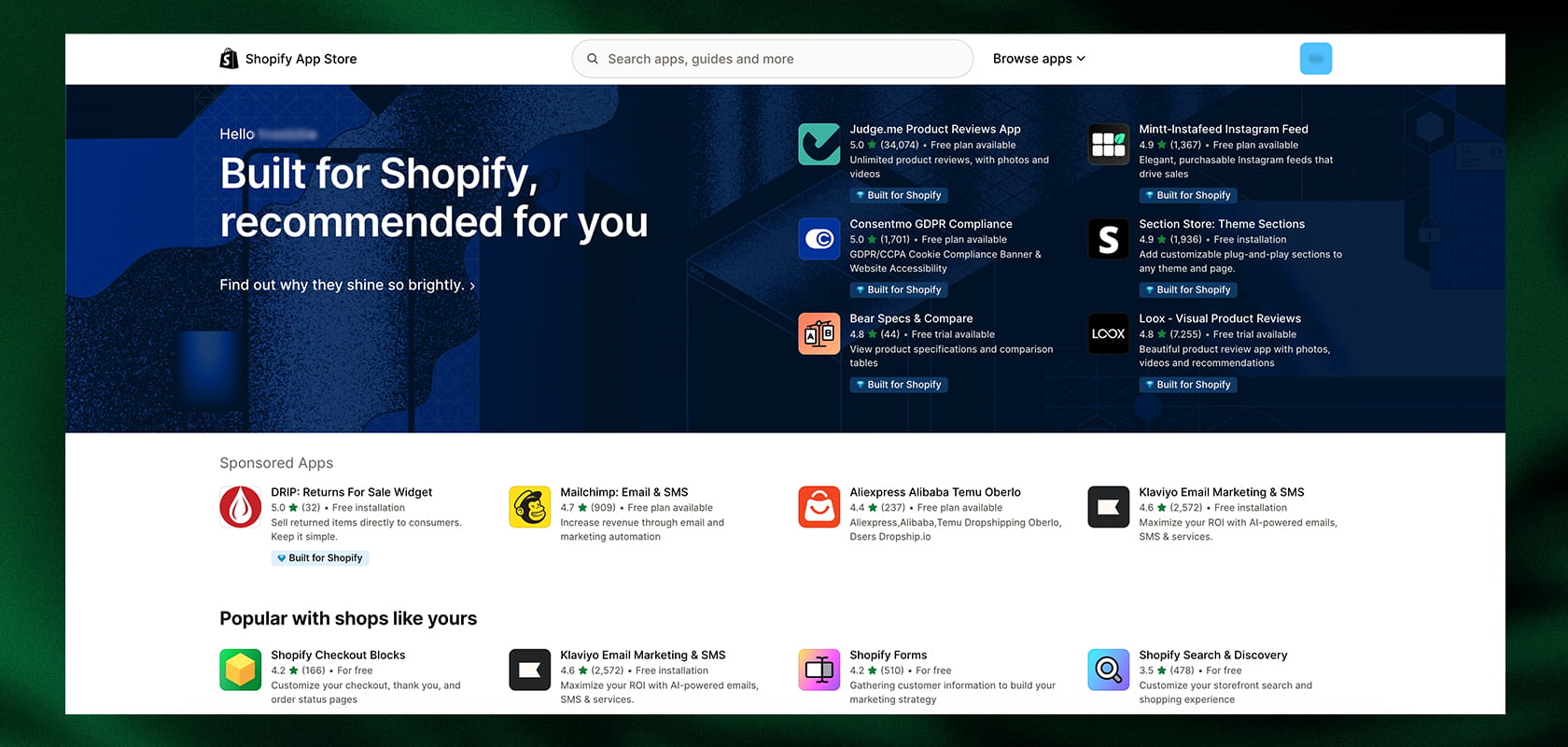
The Shopify App Store gives merchants a clear competitive advantage because, with over 13,000 apps, it covers almost every function needed for growth, automation, and conversion optimization. A key success factor for Shopify is its extensive app ecosystem.
There are over 13,000 Shopify apps in the official Shopify App Store that merchants can use to expand their stores.
On average, a merchant installs six apps to expand their store's functionality.
Over 3,800 developers create apps that together enable more than 16,000 applications and integrations—an ecosystem several times larger than that of many competitors.
These figures show how flexible and expandable Shopify stores are. A large number of apps help merchants automate and improve marketing, shipping, analytics, and conversion optimization.
Shopify user and customer statistics
Shopify appeals to a wide range of merchants, from newcomers to established brands.
Shopify Plus, the enterprise version, has over 76,000 businesses, including major international brands.
A total of 875 million people have made at least one purchase from a Shopify merchant (2024 data).
Shopify has a strong market share in many markets, particularly in US e-commerce, but the platform is also growing significantly in the UK, Germany, and Australia.
This makes Shopify a relevant sales channel for both smaller direct sellers and larger brands.
Shopify Facts & Trends
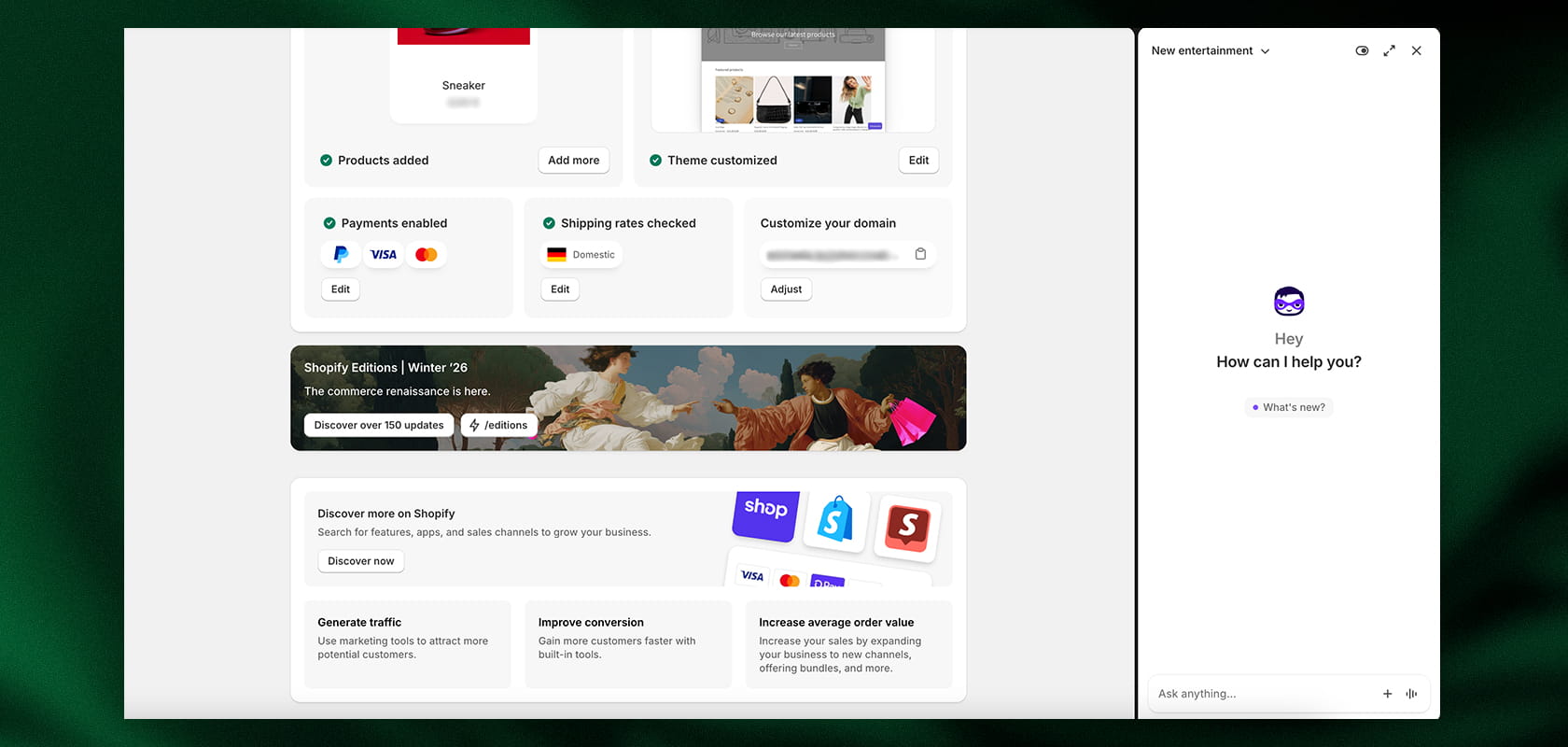
Shopify is one of the most innovative platforms in e-commerce and continuously invests in new technologies to keep merchants competitive. Two developments in particular are currently shaping the platform's strategic direction: the rise of mobile commerce, greater integration with social media, and the targeted use of artificial intelligence.
Artificial intelligence and automation are changing shop operations
Another key trend is the increasing integration of artificial intelligence. Shopify is increasingly focusing on automation, intelligent product recommendations, personalized content, and data-based decision support to relieve retailers of operational and strategic decisions. Developments in the area of so-called agentic commerce are particularly exciting. AI-supported systems independently take on operational tasks, for example in customer service, campaign management, or product placement optimization.
With the new SymGym app, you can also simulate buyer behavior using AI agents. These agents draw on data from billions of real purchasing processes and enable you to test different scenarios in a realistic way. On this basis, you receive concrete, actionable recommendations for optimizing your product range, pricing, conversion, and customer experience.
Reading tip: Shopify Winter Editions 2026: All updates at a glance.
Social commerce continues to grow in importance
Social networks are increasingly becoming direct sales channels. Platforms such as Instagram, Facebook, and TikTok no longer function solely as marketing channels, but as fully-fledged touchpoints along the customer journey. Shopify facilitates the connection of these networks through native integrations, product catalog synchronization, and simplified tracking options. Retailers can present their products directly in social feeds and significantly shorten purchasing processes. Social commerce is playing an increasingly important role, especially for brand building, reach, and impulse purchases.
Conclusion
The figures confirm that Shopify is a key player in global e-commerce. The platform is growing not only in terms of the number of stores, but also in terms of financial performance and usage by customers worldwide. Merchants who use Shopify benefit from a large ecosystem of apps, a growing international customer base, and continuous technological development.
If you want your store to be successful, it's worth knowing, understanding, and continuously improving these metrics.
We are happy to assist you in creating and optimizing your Shopify store! As a Shopify Platinum Partner, we have the expertise needed to implement even complex requirements. Simply get in touch with us.
Frequently asked questions about Shopify statistics
How many stores does Shopify have worldwide?
Around 6.5 million active stores (as of November 2025).
How much revenue does Shopify generate per year?
Shopify generated around $8.88 billion in revenue in 2024.
How successful are Shopify stores compared to other platforms?
Conversion rates are often around 1.4%, with values above 3% considered very good.
What role does the Shopify App Store play in the success of stores?
The App Store is a huge advantage, with over 13,000 apps and numerous features for store optimization.
Is Shopify better suited for small businesses or large retailers?
Both: Shopify is suitable for beginners and smaller stores as well as for large brands via Shopify Plus.
Which Shopify statistics are most important for retailers?
Meaningful figures include: conversion rate, GMV, average shopping cart, repurchase rate, and app usage.
Sources:
