)
In today's digital world, establishing a successful e-commerce presence is crucial. If you want to change your shop system, there are a variety of options available. Spryker positions itself as a flexible, composable commerce framework (PaaS) designed for demanding B2B and marketplace business models, offering full code access for maximum customization.
In contrast, Shopify is a world-leading, intuitive all-in-one SaaS platform used by small businesses to enterprise customers (Shopify Plus). It enables you to achieve up to 33% lower total cost of ownership (TCO) and benefit from up to 40% faster time-to-market compared to complex framework solutions.
In this article, we'll show you what alternatives to Spryker are available and take a detailed look at how Spryker and Shopify compare. This will help you decide whether Shopify is the right solution for your business and what advantages migration offers.
Table of contents
Do you need support with the migration of your store? As Shopify Plus experts, we will be happy to assist you and help you customize your store to meet your requirements. Get in touch with us.
What is Spryker?

Founded in Berlin in 2014, Spryker has evolved from a conventional e-commerce solution into a specialized, cloud-native composable commerce platform designed for modern, global companies and particularly well positioned in B2B commerce and marketplaces. The API-first, headless architecture allows companies to quickly create and customize complex transaction models. To do this, they can flexibly select and combine pre-built business functions (Packaged Business Capabilities, PBCs) and third-party solutions. This ensures maximum flexibility and avoids the rigid limitations of monolithic systems.
This robust architecture supports many advanced features. These include sophisticated PIM (product information management), dynamic order and inventory management, and B2B-specific functions such as CPQ. At the same time, Spryker offers the scalability and reduced total cost of ownership of a modern Platform as a Service (PaaS) offering. However, the complexity is still primarily aimed at large and medium-sized companies with significant technical and financial resources.
Key challenges driving the switch from Spryker to Shopify Plus

Retailers are migrating from the highly flexible but resource-intensive Spryker platform to Shopify Plus because they are looking for simplified business processing and better cost control. The switch is directly triggered by the inherent challenges of the Spryker framework:
High technical overhead
Complex implementation and maintenance: Spryker is designed as a framework that requires constant reliance on experienced in-house developers or expensive agencies.
Time-consuming and costly updates: The responsibility for regular updates and upgrades as well as ongoing maintenance lies with the merchant, resulting in significant time and cost expenditures.
High and unclear total costs
Difficult to plan TCO (total cost of ownership): The costs for development, hosting, and complex integrations are high and difficult to calculate in advance.
Developer-dependent license costs: Spryker license costs are often tied to the number of developers, resulting in a complex and expensive pricing structure.
Shift in focus away from commerce
Focus on operations rather than sales: Retailers spend a disproportionate amount of time on the technical administration of the platform instead of focusing on marketing and sales growth.
Integration hurdles: Due to the architecture, linking to backend systems (such as ERP or CRM) can be a complex technical hurdle.
What alternatives are there to Spryker?

If you're thinking about migrating and looking for Spryker alternatives, there are several platforms to choose from that offer similar features and benefits. Here are some Spryker alternatives to include in your software research:
Shopify
Shopify is a popular e-commerce platform that offers a wide range of features for businesses looking to run an online store. With Shopify, you can quickly and easily create and manage a store, process payments, manage products, run marketing campaigns and much more. The platform is user-friendly and offers a variety of integrated tools to run your online store successfully.
Reading tip: Find out what you need to consider if you want to switch to Shopify Plus.
Adobe Commerce
Formerly known as Magento, Adobe Commerce offers an e-commerce solution for businesses of all sizes. The platform supports B2B transactions and offers a variety of features to increase operational efficiency, customer satisfaction and revenue growth. With Adobe Commerce, you can create a customized online store that fits your business goals.
Reading tip: You can find more information about the Spryker alternatives in our store system comparison Shopify vs Magento.
Sana Commerce
Sana Commerce integrates seamlessly with existing ERP systems, enabling businesses to increase efficiency and growth by seamlessly connecting ERP and e-commerce. The platform offers a range of features, including powerful order and inventory management, to help you run your online store efficiently.
Shopware
Shopware is one of the leading out-of-the-box store systems. It is characterized by a user-friendly interface that is equipped with a variety of useful functions. The software has a modular structure and can be supplemented with many extensions or plugins to add the desired functions or adapted to individual requirements.
Reading tip: What you should consider if you want to migrate from Shopware to Shopify.
These Spryker alternatives offer a wide range of features and can be a good choice depending on your specific requirements. It's worth looking at each platform in more detail to find the best solution for your needs. Let's take a look at the differences between Spryker vs Shopify.
Comparison: Spryker vs Shopify

Having just looked at a selection of Spryker alternatives, we now want to compare Spryker and Shopify in a store system comparison. Both platforms offer a wide range of functions and options for companies that want to sell online. However, there are some key differences:
Focus: Spryker is primarily specialized in B2B business and marketplaces. Shopify, on the other hand, is aimed at online retailers of all kinds and can be used optimally in the D2C and B2B sectors.
Reading tip: How to set up a B2B store with Shopify.
Ease of use: Shopify is known for its user-friendliness and ease of use. With an intuitive interface and a variety of ready-made templates, even people without technical know-how can create an appealing online store quickly and effortlessly. In contrast, using Spryker often requires a certain amount of technical expertise and, due to its complexity, high development costs. Setting up and customizing a store can be more complex and take more time, which can be a hurdle especially for smaller companies or sole traders and usually makes the use of a Spryker agency unavoidable.
API architecture and integration: Shopify offers a comprehensive REST API and a user-friendly interface that makes it easy for developers to integrate external systems and develop custom applications. This seamless integration allows companies to easily connect their e-commerce presence with other business applications and ensure smooth data exchange between different systems.
In contrast, Spryker is based on a modular architecture built on an API stack. This flexible and scalable environment allows developers to create innovative solutions and integrate with existing systems to increase the efficiency and performance of their e-commerce business.
Reading tip: Find out what you need to know about the Shopify API in this article.
Availability of apps and extensions: Shopify offers an extensive app store with thousands of apps and extensions that allow store owners to customize and extend their store. This variety of extension options allows businesses to customize and scale their e-commerce presence to their specific needs. While Spryker also offers certain customization options, the options available are not as numerous and varied as Shopify.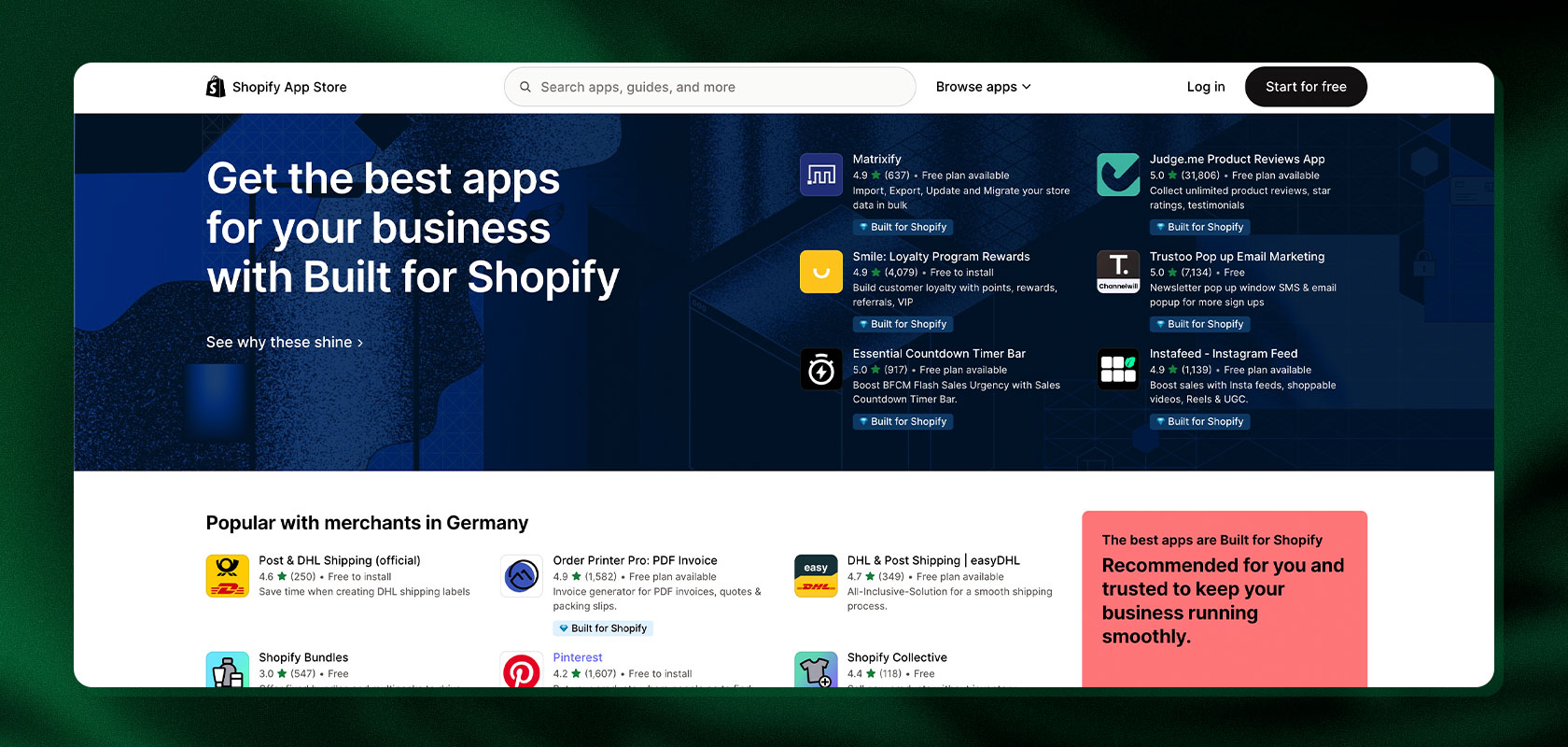
Reading tip: We introduce you to the best Shopify apps.
Functionalities: Shopify offers a comprehensive set of integrated functions that includes inventory management, payment gateway integration, SEO optimization and marketing tools. These functions are already part of the platform and can be used directly without the need for additional configurations.
Spryker, on the other hand, takes a modular approach, allowing companies to select and configure the desired functionalities according to their specific requirements.
Customer support and community: Shopify offers outstanding customer support and a vibrant community of users and developers. The platform has a wealth of resources such as online tutorials, forums and training courses to help store owners with questions and problems. In addition, Shopify merchants benefit from support that is available 24/7. While Spryker's support is available in the form of a helpdesk and via email, it is not as comprehensive as Shopify's.
Pricing: Spryker vs. Shopify
The pricing models clearly reflect the fundamental architectural differences: Spryker requires an investment in the development and maintenance of customized software (PaaS), while Shopify Plus is a subscription to a service (SaaS).
Spryker's pricing model: In contrast, Spryker takes an individual approach to pricing. It offers a customized pricing model tailored to specific business requirements, reflecting the modular and customer-specific nature of the platform.
Cost insight: Experience with former Spryker customers has shown that a license from Spryker costs at least €100,000, depending on the number of developers. Project costs can quickly rise to at least €300,000.
Shopify plans: Shopify offers a wide range of pricing plans, ranging from low-cost options for small businesses to advanced plans for larger companies. The pricing structure is transparent and is based primarily on the plan selected, as well as any additional add-ons or features that may be added.
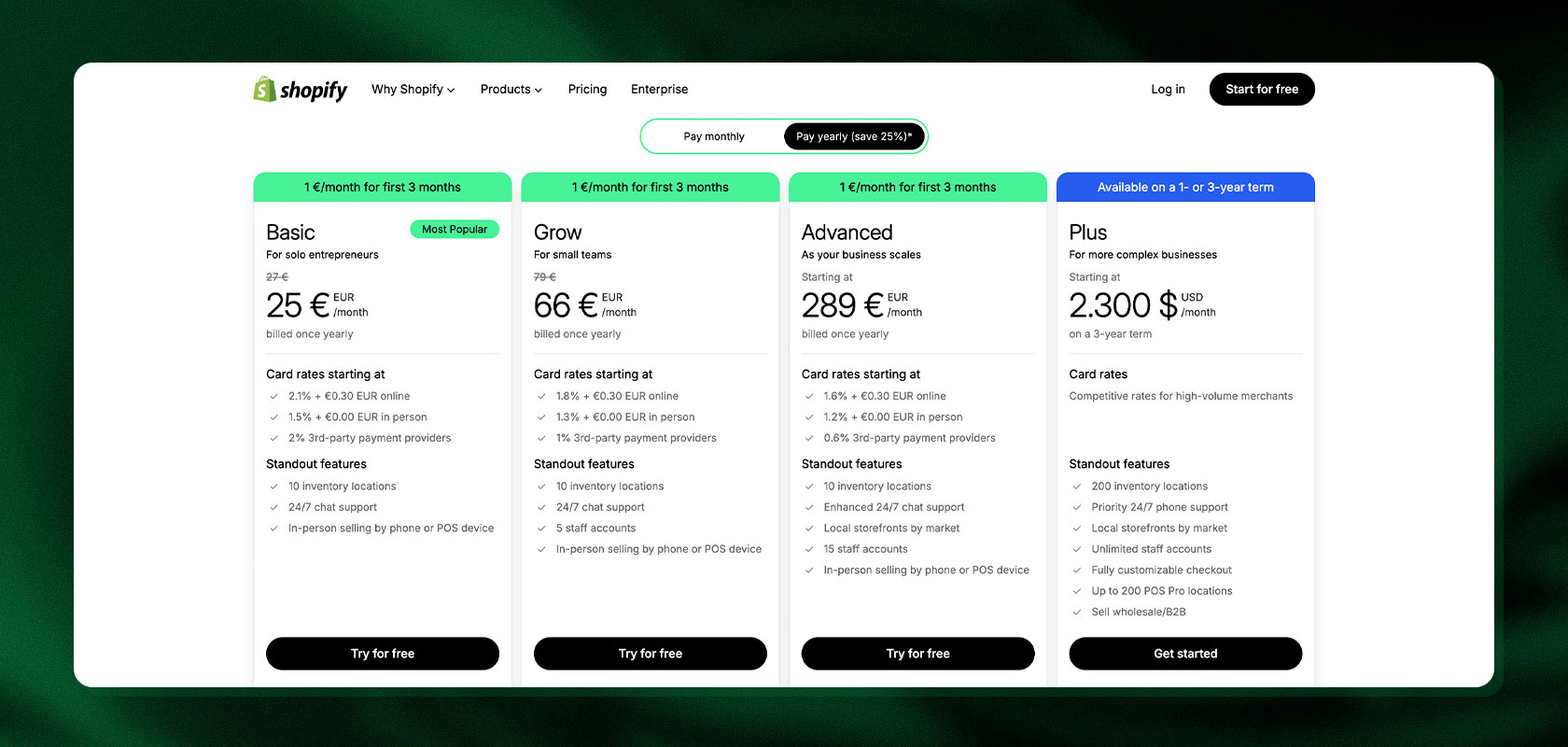
Shopify Plus: This is an enterprise plan aimed at large businesses and has custom pricing. Shopify Plus offers a highly customizable e-commerce solution with additional features such as dedicated support, advanced API capabilities, and greater scalability.
Reading tip: You can find all information about Shopify prices in this article.
Key insight
While Shopify offers a predictable, subscription-based model with transparent costs and reduced infrastructure overhead, Spryker requires a higher, customized initial and ongoing investment—suitable for companies where maximum technical control and customized business logic are more important than cost efficiency.
Overall, Shopify offers a user-friendly, comprehensive and scalable e-commerce solution that is suitable for businesses of all sizes. With a wide range of features, easy customization options and excellent customer support, Shopify is the perfect choice for businesses looking to run a successful online store.
Migration from Spryker to Shopify: Overkill took the plunge
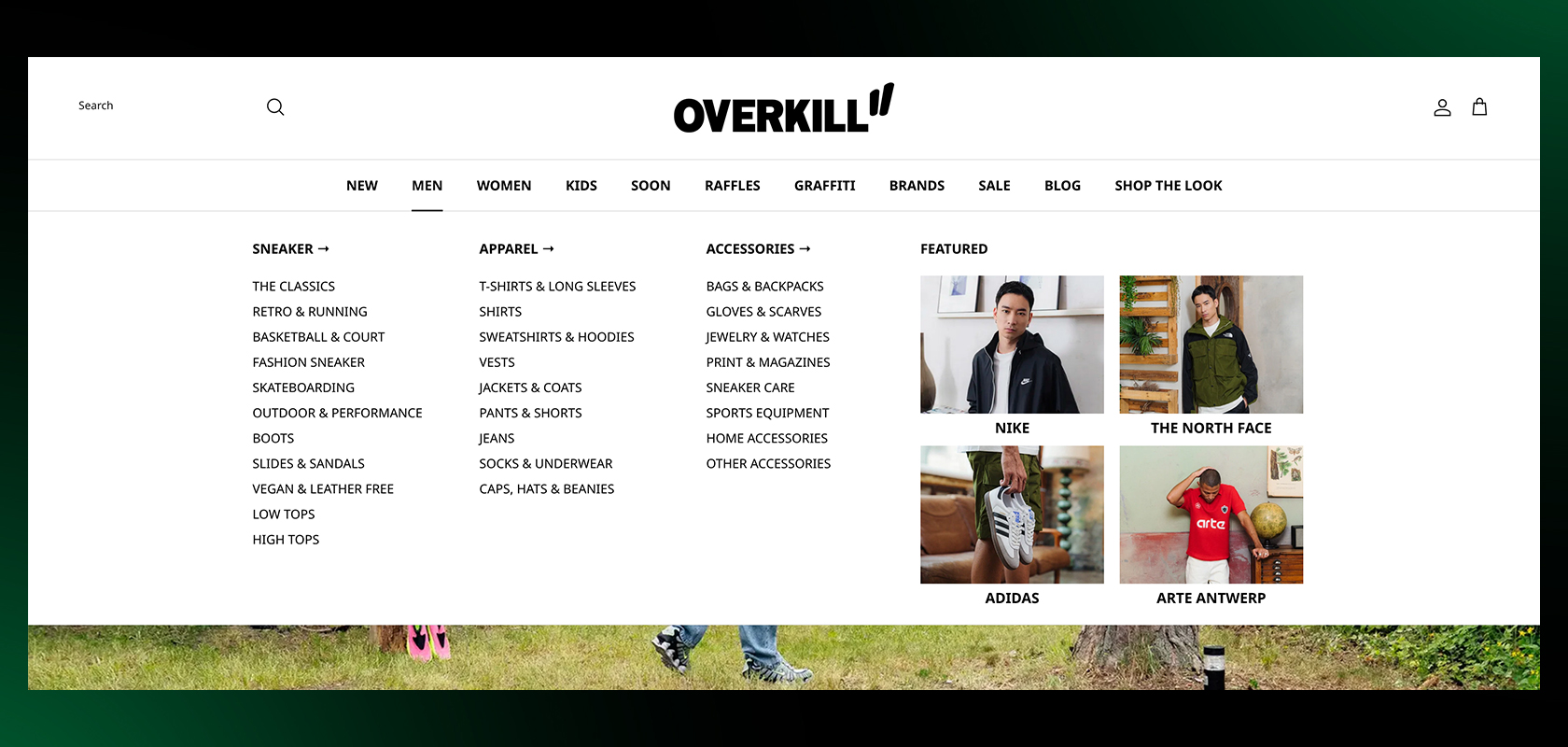
The decision by Berlin streetwear icon Overkill—originally an operator of a Spryker shop—to switch to Shopify Plus is a prime example of how moving from a technical framework to an enterprise SaaS solution can create added value for the core business.
Overkill's experience reflects the key challenges of complex in-house developments: operating the Spryker shop required constant reliance on external developers, and the Overkill team had to spend a disproportionate amount of time on technical maintenance instead of focusing on the brand, community, and sales growth. By consolidating both brands (Overkill and GATE) on Shopify Plus, the company was able to simplify its business logic in a way that directly addresses the criticisms of the Spryker framework: By moving both brands (Overkill and GATE) to Shopify Plus, the company was able to simplify its business logic and thus directly address the criticisms of the Spryker framework: Instead of high TCO due to custom code, the focus is now on predictable costs and internal usability. Overkill is more agile thanks to the new e-commerce platform in the background and has since demonstrated that Shopify Plus delivers the necessary performance and control even with complex setups with extremely high traffic peaks.
Reading tip: Read the complete Overkill case study here.
Conclusion: Why is it worth migrating to Shopify?

With its focus on B2B and marketplaces and its cloud-based headless platform, Spryker offers companies the ability to customize their e-commerce presence according to their specific requirements. This flexibility allows companies to support different business models and customize their online store experience. However, it should be noted that using Spryker often requires some technical expertise and may offer fewer available apps and extensions.
Shopify is an excellent option for businesses looking for a user-friendly, scalable and accessible e-commerce solution. With its intuitive interface, extensive app store and excellent customer support, Shopify offers a wide range of features and capabilities for store owners.
Migrating to Shopify offers businesses a variety of benefits. By switching to Shopify, companies can improve their e-commerce presence and benefit from a wide range of features and capabilities.
As Shopify Plus experts, we can support you with the Spryker migration to Shopify and provide you with advice and assistance. Get in touch with us.
Frequently asked questions: Spryker vs. Shopify Plus
What is the fundamental difference in architecture between Spryker and Shopify Plus?
Shopify Plus is a SaaS solution (centrally managed rental). Spryker is a composable commerce framework (PaaS) that requires full code access and maximum customization.
For whom is Spryker the better choice?
For large companies with highly complex, unique B2B processes and specialized marketplace models that require full backend control.
For whom is Shopify Plus the better choice?
For fast-growing D2C brands and B2B companies that prioritize predictable costs, minimal maintenance, and fast time-to-market.
How do the cost models differ?
Shopify Plus has a transparent subscription (fixed monthly fee). Spryker has an individual license and requires high, variable project and personnel costs (TCO).
Can I run headless commerce with Shopify Plus?
Yes. Shopify Plus offers a fast, low-maintenance headless solution via APIs and Hydrogen. Spryker natively supports headless for any backend logic.
Is Shopify Plus also suitable for B2B?
Yes. It offers dedicated B2B features. It is suitable for most B2B requirements, but Spryker is superior when it comes to extremely complex, custom logic.
