)
In recent years, Temu has become one of the fastest-growing online marketplaces, causing both uncertainty and interest among Shopify merchants. The key question many online retailers are currently asking themselves is: Can and should they connect their store to Temu in order to increase their reach, visibility, and sales? What are the pros and cons?
Many merchants are looking for authentic Temu experiences to assess the platform's credibility and find out to what extent integration would actually be worthwhile for their own online store. The search intentions “Temu experiences” and “Temu risks” play a central role here.
In this article, we show you how to technically integrate Temu into your Shopify store, what you need to pay attention to, and what opportunities and economic risks selling on the marketplace entails. This article is explicitly aimed at D2C (direct-to-consumer) retailers who are considering an additional presence on Temu alongside their established Shopify store and well-known marketplaces such as Amazon or eBay. We are not concerned here with the dropshipping business model, but with brand manufacturers and their own product lines.
Table of contents
- What is Temu? Business model, users, and typical product categories
- Advantages of Temu for Shopify merchants
- Amazon vs. Temu: A brief comparison
- Technical integration: Connecting Temu with Shopify – step by step
- Becoming a Temu seller: Requirements, fees, and processes
- Critical consideration: Risks, problems & ongoing concerns
- Margin pressure and competition
- Differentiating between types of retailers: Who is Temu suitable for?
- Shopify & Temu working together: How you can really benefit
- Should you use Temu as a sales channel?
- Conclusion
Do you need assistance connecting your marketplace? We are happy to help—get in touch with us now.
What is Temu? Business model, users, and typical product categories
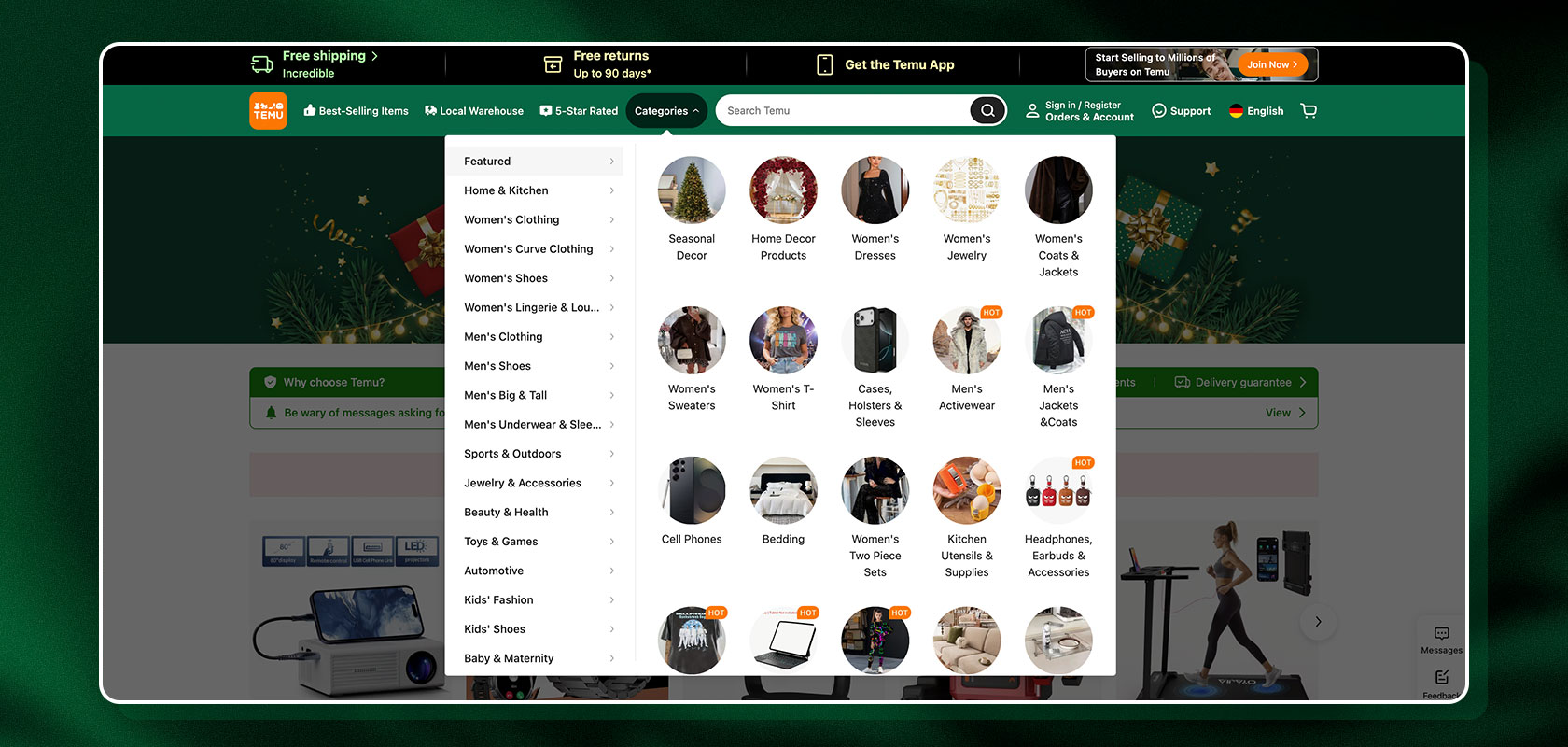
Temu is a global online marketplace based in China that primarily offers customers extremely low-priced products. Temu is backed by manufacturers who sell directly to end customers, which means prices are often well below the market average.
Temu covers a wide range of categories:
Electronics accessories and gadgets
Fashion and accessories
Household goods and lifestyle products
Cosmetics and health
The typical buyer is very price-conscious and willing to accept longer delivery times. Ratings and reviews play a major role in the purchasing decision and are a central part of the marketplace logic.
Advantages of Temu for Shopify merchants
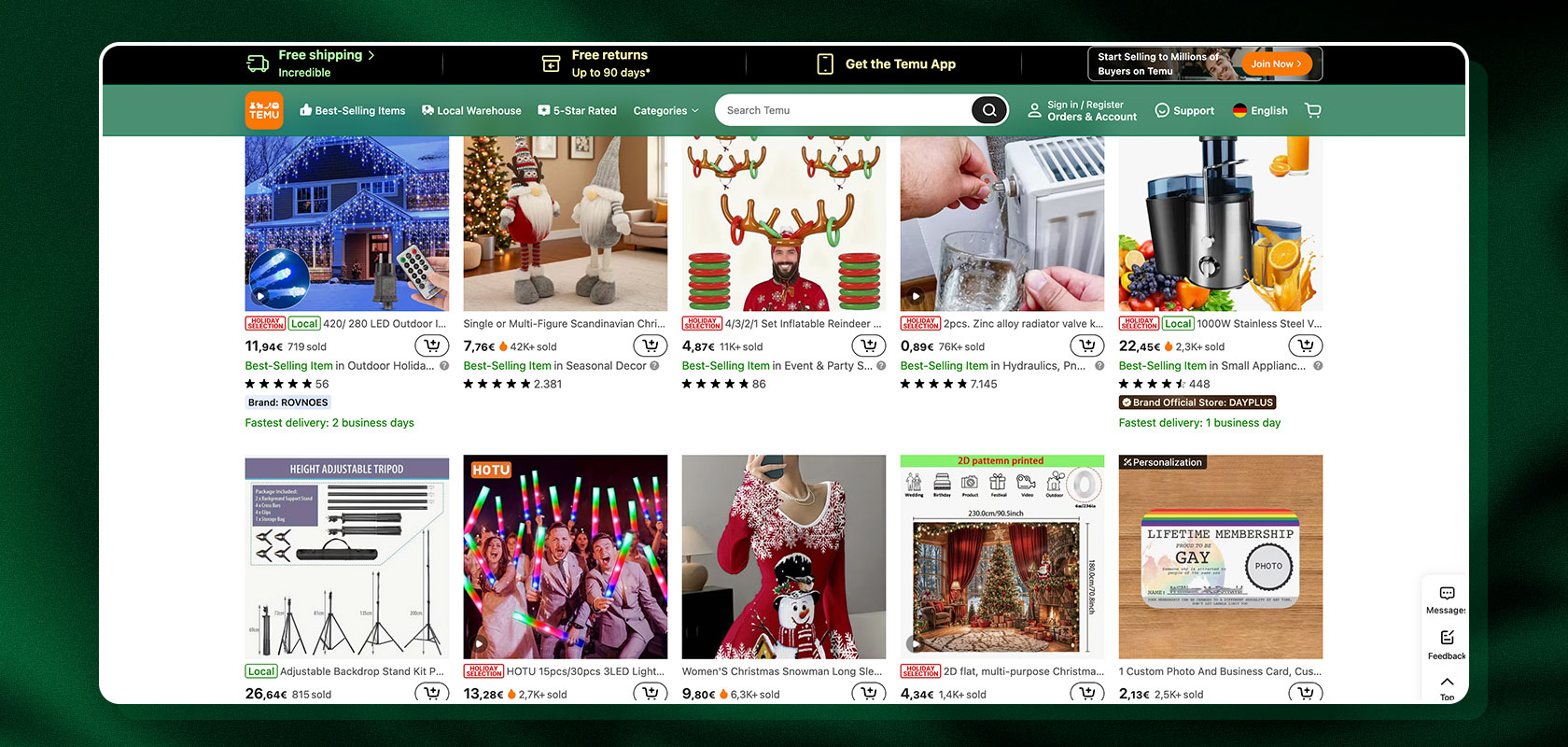
If you are considering becoming a Temu seller, this opens up several opportunities:
Expanded reach: Temu has millions of users worldwide and can bring additional visibility.
Scaling potential: Products that are particularly price-competitive can perform better there.
New customer segments: Users who have not previously shopped on Shopify stores may become aware of you here.
However, success depends on process reliability, product quality, and clear communication.
Amazon vs. Temu: A brief comparison
Temu is often referred to as the “Chinese Amazon.” But what is the basis for this categorization? To better assess Temu's position, it helps to take a comparative look at the established marketplace:
| Aspect | Temu | Amazon (Seller Central) |
|---|---|---|
| Buyer target group | Strongly price-conscious, impulse-driven | Service-oriented, brand-conscious, higher purchasing power |
| Fee model | 5–15% sales commission (no monthly base fee) | 8–15% commission + monthly base fee (~€39) |
| Price control | Low: Temu often sets the end customer price (reverse auction) | High: Retailer determines the price (within the guidelines) |
| Competition | Growing strongly, often in direct competition with manufacturers | Very high, saturated market |
| Logistics | Mostly full-service model through Temu (fulfillment) | Flexible: FBA (Amazon Fulfillment) or own shipping |
Although Temu is often referred to as the “Chinese Amazon” due to its wide range of products and market power, a comparison reveals clear differences, particularly in terms of strategic orientation. Temu clearly positions itself as a marketplace for extremely price-conscious and impulse-driven buyers, with a focus on almost complete control over pricing and logistics (full service). The business model resembles a reverse auction, which leaves retailers with little control over pricing.
Amazon (Seller Central), on the other hand, targets a service-oriented, brand-conscious clientele with higher purchasing power and offers retailers significantly more flexibility in pricing and logistics options (FBA or own shipping).
Temu is not a direct copy of Amazon, but a competitive Chinese e-commerce platform. It relies on extremely low prices and its own logistics to shake up the market. Temu targets different customers and has a different relationship with retailers than the market leader Amazon.
Technical integration: Connecting Temu with Shopify – step by step
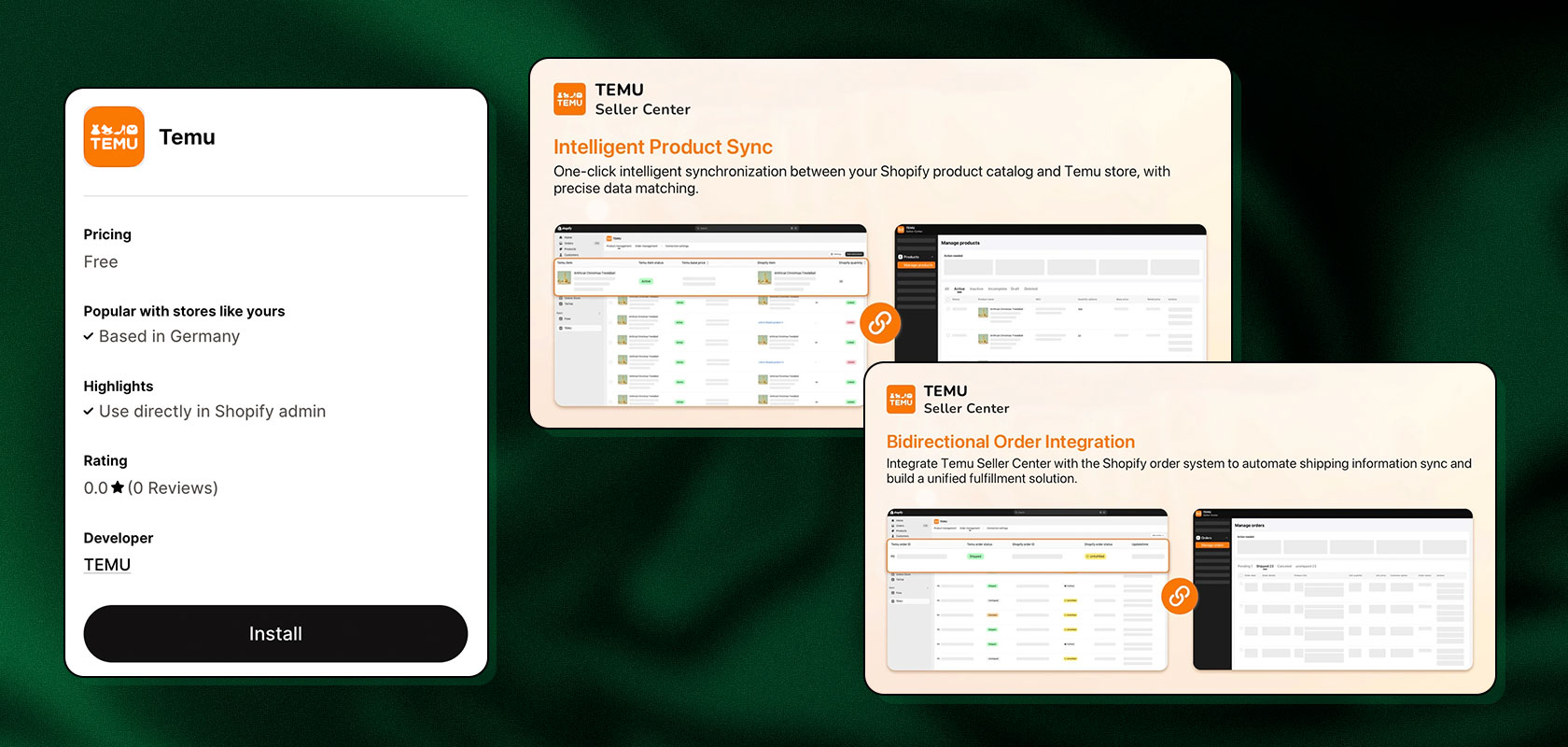
If you want to connect Temu to Shopify, there are several options available today. The most convenient is to use an app or a dedicated API connection via middleware.
Integration options in detail:
| Option | Advantage | Disadvantage |
|---|---|---|
| Default app | Easy installation, quick setup, low start-up costs (e.g., M2E Temu Connect) | Limited functionality, greater dependence on the app provider |
| API/Middleware | Maximum customizability (custom mapping), scalability for large catalogs | Higher implementation costs, longer setup time, technical expertise required |
Here's how to proceed:
1. Create a Temu seller account. Ensure that all information is complete and verified.
2. Select an integration option:
Install a Temu Shopify app such as M2E Temu Connect (from the Shopify App Store) or
use an API-based solution to synchronize products, inventory, and orders.
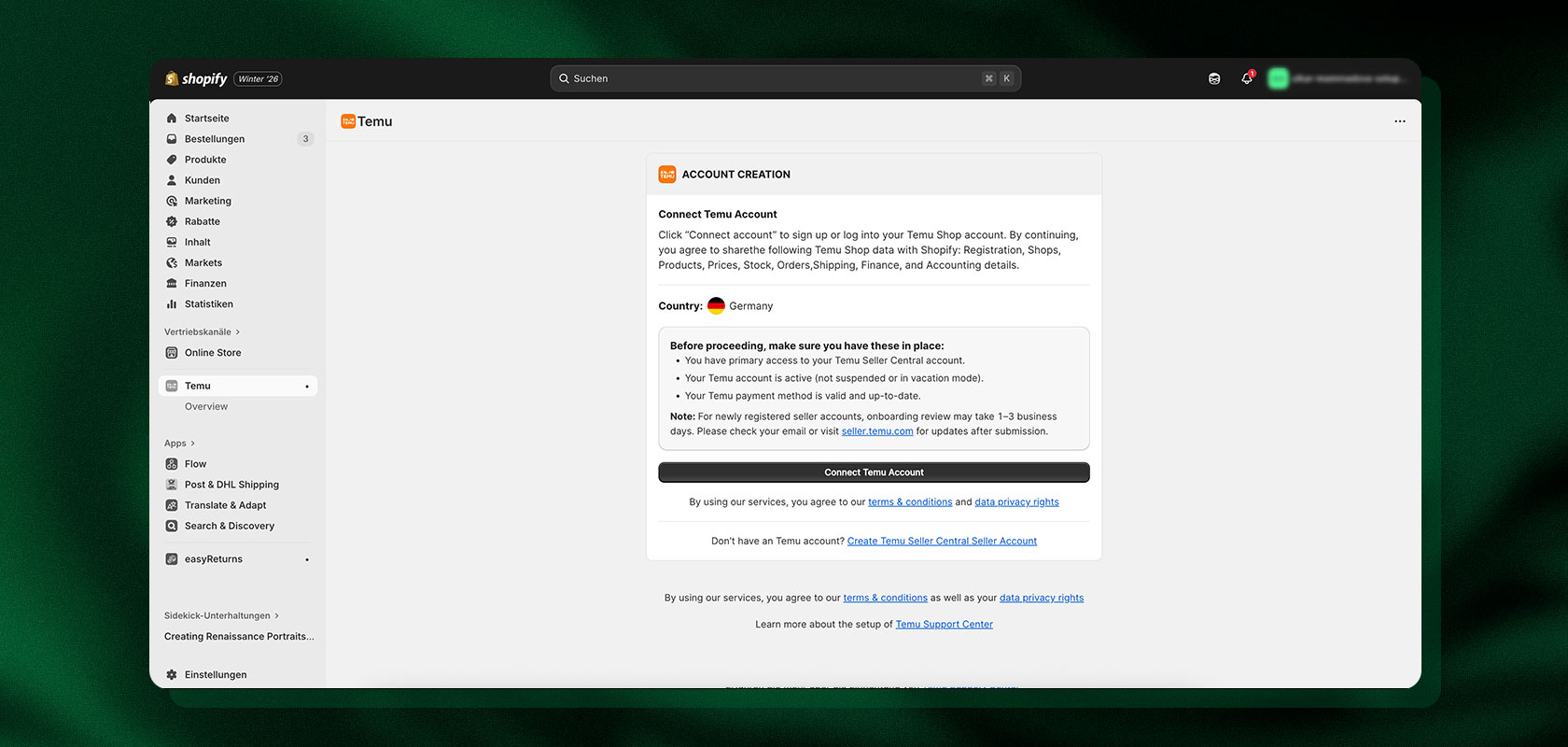
3. Import products: Connect your Shopify products to Temu and correctly assign variants, prices, and descriptions.
4. Automate workflows:
Order and inventory synchronization
Tracking information for customers
Returns management
Common pitfalls from a retailer's perspective
Integrating your Shopify store with Temu offers attractive growth opportunities, but also presents specific challenges. Retailers who avoid these common mistakes lay the foundation for smooth and successful sales on the platform:
Incorrect attribute mapping: Temu categories and product attributes (color, size, material) must match your Shopify variants exactly. Inconsistent mapping leads to errors in listings or incorrect orders for customers.
Currency and pricing errors: Check that the price transmission correctly reflects the currency and that your net price calculation (see margin pressure) is correctly displayed on Temu.
Outdated delivery times: Since Temu customers are often accustomed to longer delivery times from cross-border retailers, deviating (long) delivery times from local sellers can cause irritation. Ensure that your actual delivery times from the DACH region are communicated correctly and transparently.
Missing variant assignments: If not all product variants (e.g., “Red/Size M”) are synchronized correctly, this can lead to overselling or manual rework.
Reading tip: How to build a multichannel strategy with Shopify.
Becoming a Temu seller: Requirements, fees, and processes
Requirements
To sell on Temu, you need:
A verified business license
Complete tax information
Valid bank account details
Fee structure and margin calculation
Temu does not charge local merchants a monthly fixed fee. Instead, the model is primarily based on a sales commission, which is usually between 5% and 15% of the sales price, depending on the product category. For example, commissions for fashion items are often on the higher end (approx. 10–15%), while electronics accessories may be priced lower (approx. 5–8%).
The critical element is the business model: Temu often acts as a “reverse auction” and determines the actual retail price based on the net price you propose. The goal is to achieve the lowest market price. You must therefore calculate your costs extremely carefully and include all cost factors (purchasing, shipping to the Temu warehouse/customers, fees, return rate, marketing) in order to remain profitable even after commissions have been deducted. A target margin of at least 30–40% before Temu costs is usually necessary to cushion the price pressure.
Logistics & legal requirements: Own shipping vs. Temu logistics
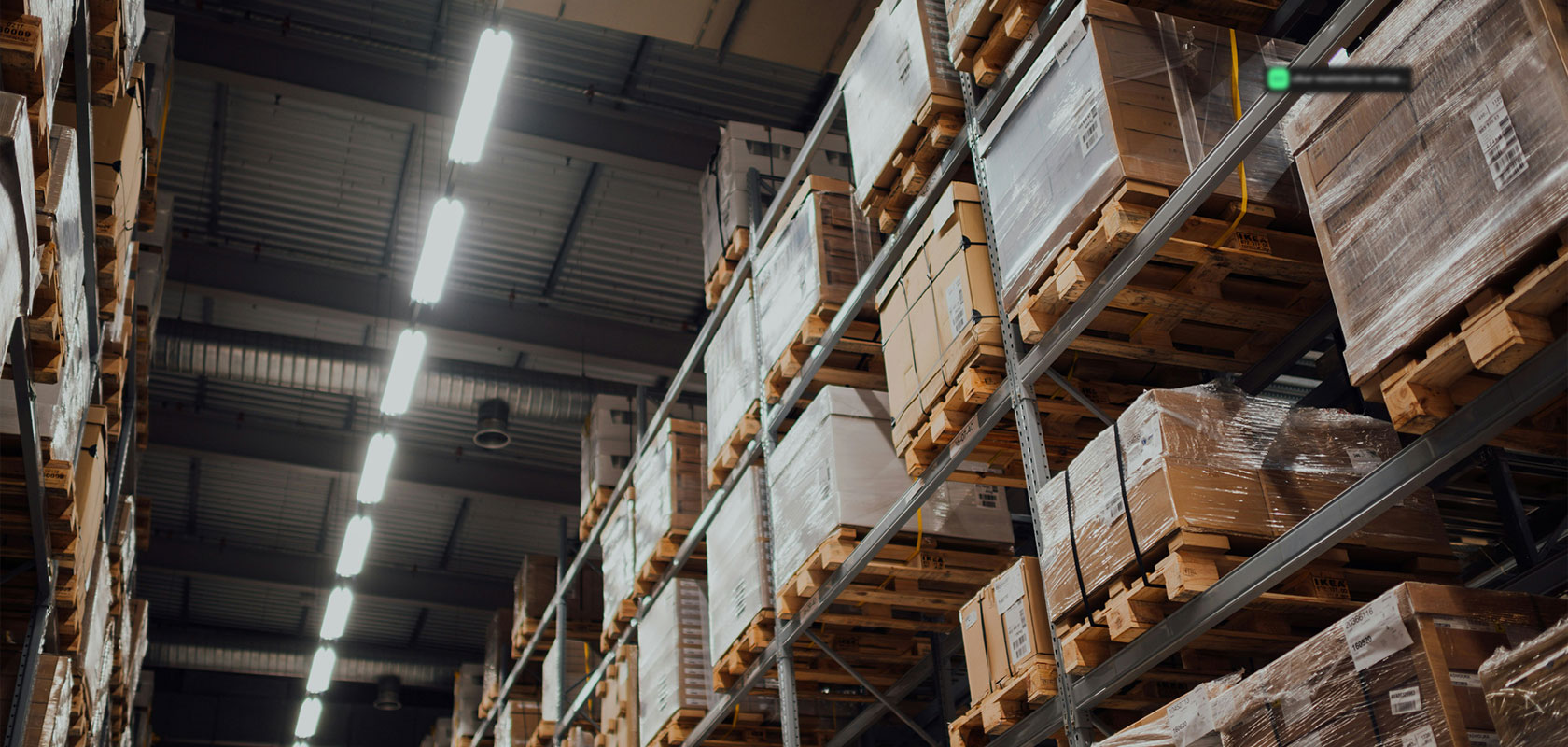
In the current model for local D2C retailers (similar to FBA), shipping to the end customer is often not carried out by the retailer themselves. Instead, you deliver your goods to a Temu logistics center (or partner) in the EU. Temu then takes care of storage, fulfillment, and shipping to the end customer (full-service model).
| Model | Control | Expenses for retailers | DACH availability |
|---|---|---|---|
| Temu Full-Service | Low | Low (no shipping to end customers) | Common model for local trade |
| Own shipping | High | High (end customer shipping managed in-house) | Less common so far; Temu usually pushes for full service |
From a legal perspective, particular attention must be paid to sales tax, product liability, and CE conformity. Tax obligations remain with the seller, even if Temu handles the transaction. Accurate invoicing and recording of sales in accordance with local regulations is essential.
EU regulations & market surveillance: Obligations for retailers remain in place

Even when selling through Temu, key EU legal obligations remain entirely with the retailer, regardless of whether Temu handles logistics, fulfillment, or payment processing.
The following are particularly relevant:
Product safety (GPSR / Product Safety Regulation)
CE marking & declarations of conformity
Digital Services Act (DSA)
Market surveillance & liability
Sales tax & tax obligations
Important: Temu is not a “shield” against EU regulation. Retailers continue to bear full responsibility for legal certainty and compliance.
Critical consideration: Risks, problems & ongoing concerns

Is Temu reputable? There is no blanket answer to this question. The marketplace is real, growing rapidly, and offers enormous reach. At the same time, many experiences and poor reviews of Temu, especially for electrical goods, show that selling on the platform involves specific risks for retailers, which should be realistically assessed in advance.
A key area of tension arises from customer expectations. Temu users are very price-conscious, but increasingly expect service standards similar to those they are familiar with from European online shops. For Shopify retailers, this can lead to increased support costs, complaints, and negative reviews if delivery times or product quality are not clearly communicated.
Margin pressure and competition
The constant price pressure created by direct sellers from China is immense. EU merchants often cannot compete without reducing their margins to unprofitable levels. The Temu model favors the cheapest offer and makes it difficult for premium or niche providers to differentiate themselves.
Discrepancies between product presentation and actual goods often lead to returns and dissatisfaction. Without consistent quality control and precise product descriptions, costs and administrative effort quickly increase.

Platform dependency and lack of transparency
Added to this is the dependency on the platform itself. Temu guidelines, fees, or performance requirements can change at short notice. Violations—even unintentional ones—can result in visibility restrictions or account suspensions and pose an operational risk.
Legally, despite the marketplace structure, much of the responsibility remains with the seller. Tax obligations, product safety, and correct labeling must be complied with and require appropriate processes.
Lack of references
It is currently still difficult to find publicly successful, non-Chinese D2C brands that use Temu as their primary and sustainably profitable sales channel. This makes it difficult to seriously assess its long-term potential.
Damage to image
Last but not least, brand image plays a role. Temu has come under criticism for its pricing and delivery models. Retailers with a high-quality or sustainably positioned Shopify store should consider whether a connection fits their own brand strategy in the long term.
Differentiating between types of retailers: Who is Temu suitable for?
Not every product is suitable for sale via Temu. The marketplace is primarily suitable for certain types of retailers. Who should avoid Temu and who can benefit from it?
| Dealer type | Suitability | Justification |
|---|---|---|
| Volume and bulk goods trader | High | You can work with low margins and benefit from the high reach, and you have established processes for high volumes. |
| Premium brands/niche products | Low | Price pressure and the environment are not in line with the brand positioning, which poses a risk of damage to the brand image. |
| Innovative gadget providers (low-cost niche) | Medium to high | If the product is unique but competitively priced, it can function as a “price hit.” |
| Sustainably positioned shops | Low | Temu's logistics and production standards often conflict with sustainability requirements. |
Shopify & Temu working together: How you can really benefit

Not every product is suitable for sale on Temu. Please note the following points:
Quality assurance: Ensure correct product presentation and data quality.
Pricing strategy: Low prices alone are not enough – calculate your prices so that you remain profitable even after fees.
SEO & product texts: Optimize titles, descriptions, and images for both Shopify and the Temu marketplace.
Transparent communication: Clearly state the delivery times and return conditions that apply.
Should you use Temu as a sales channel?
If you are still wondering whether Temu is the right sales channel for you, ask yourself the following questions:
Can I offer my product profitably in the long term if Temu sets the end customer price and I pay a commission of 5–15%?
Is my product a mass-market item, or do I need a high margin to cover my overhead costs?
Can my brand withstand the environment of an extremely price-oriented marketplace?
Do I have the processes and technical setup to keep inventory levels synchronized in real time (keyword: variant mapping)?
Can I ensure compliance with legal and tax requirements within the Temu logistics model?
If you answer “yes” to most of these questions, Temu may be an opportunity for you. Otherwise, you should consider alternatives.
Conclusion
The combination of Shopify and Temu can be an additional sales channel for you as a retailer, generating new customers and revenue. At the same time, it is not a sure-fire success: it requires clean processes, legal protection, and a clear product strategy. Those who are aware of these requirements and take them seriously can benefit from such an integration.
If you need support with your multichannel strategy, we are happy to advise you – from the initial vision to technical integration. Contact us now.
Frequently asked questions about Shopify & Temu
Is Temu reputable?
Temu is a real marketplace, but it is the subject of debate due to varying user experiences.
How do I connect Temu to Shopify?
Via official apps or API-based integration solutions, with product and inventory synchronization.
What fees are charged?
Usually sales commissions and payment processing fees.
What are the risks?
Quality issues, returns, delivery times, and policy dependencies.
How fast does Temu deliver?
Delivery times vary depending on the product and logistics model.
Is selling through Temu legal?
Yes, as long as tax and product safety requirements are met.
How does the returns process work?
Depending on the model, either through you or through Temu-designated processes.
