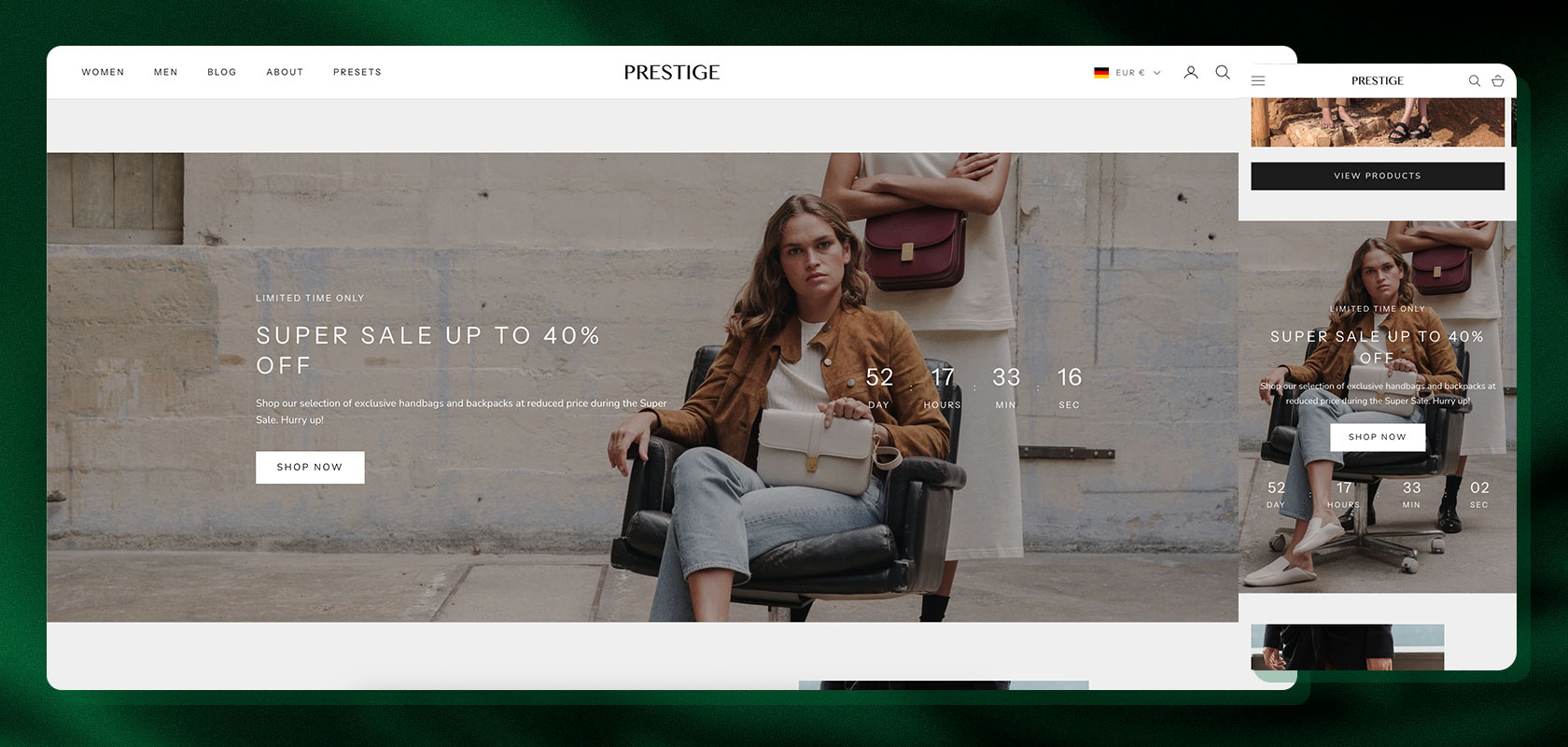
A Deep Dive into the Shopify Prestige Theme: Features, SEO, and User Experiences
A Shopify theme forms the foundation for the design, user experience, and numerous features of an online store. For premium and lifestyle brands in particular, it’s not just the technical foundation that matters: the visual presentation of products, brand impact, and a customer journey that’s as seamless as possible are also crucial.
Maestrooo’s Prestige theme has been one of the established premium themes in the Shopify Theme Store for years. It is specifically designed for brands that want to combine a high-quality, visually striking, and editorial-style look with extensive merchandising and conversion features. Currently, Prestige offers, among other things, more than 30 configurable sections, five preconfigured designs, and features for product search, cross-selling, product presentation, and conversion.
But how well-suited is the Prestige Theme for a modern Shopify store? What features does it offer, what are its limitations, and how does it fare in terms of SEO, performance, and customization?
In this deep dive, we’ll take a closer look at the Shopify Prestige Theme.
Quick Insight: What is the Shopify Prestige Theme?
The Prestige Theme is a premium Shopify theme from Maestrooo. It provides a ready-made technical and design foundation for online stores and can be customized to meet a brand’s specific needs using sections, theme settings, and custom code adjustments.
Do you need help with your Shopify store? As Shopify Plus experts, we're here to assist you and help you customize your store to meet your needs. Contact us.
Prestige Theme at a Glance: Development and Positioning
Prestige has been established in the Shopify marketplace for more than eight years and has made a name for itself, particularly among brands with high standards for design and product presentation. While the requirements for modern online stores have changed significantly during this time, the theme has been continuously refined and adapted to the capabilities of the Shopify ecosystem.
The Prestige Theme is updated regularly; the version currently listed in the Shopify Theme Store is 11.4.0, dated July 3, 2026.
The price for the Prestige Theme is $400 USD.
Today, Prestige combines a highly visual design language with extensive features for merchandising, navigation, and conversion. Rather than serving solely as a design template, the theme thus provides a comparatively comprehensive framework for designing a modern Shopify store.
The Shopify Theme Store offers various presets tailored to different brand identities. At the same time, the base can be further customized through individual sections, settings, and code modifications. For store owners, the question is therefore not so much whether Prestige looks good in general, but rather how well the theme adapts to their own brand.
Design and Brand Presentation
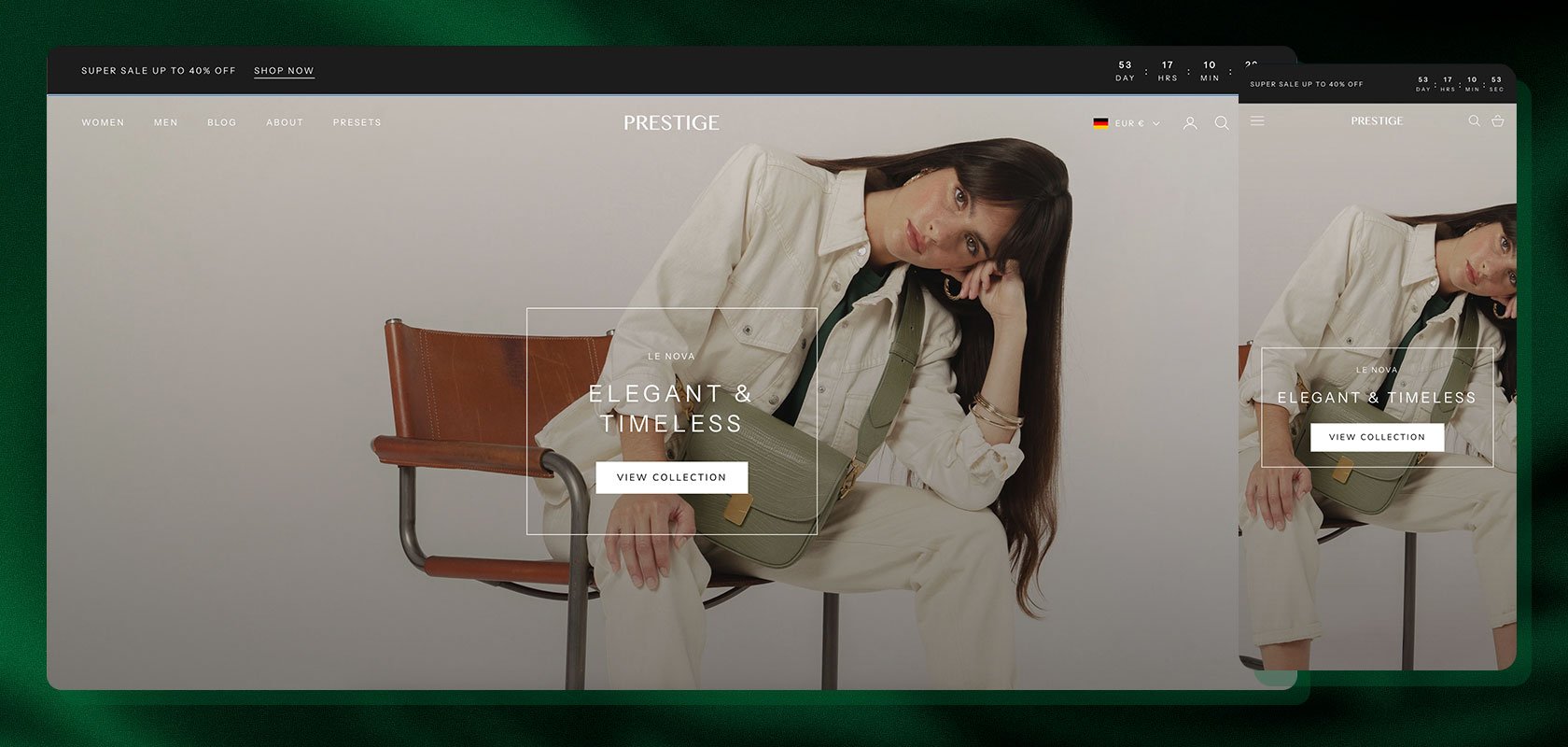
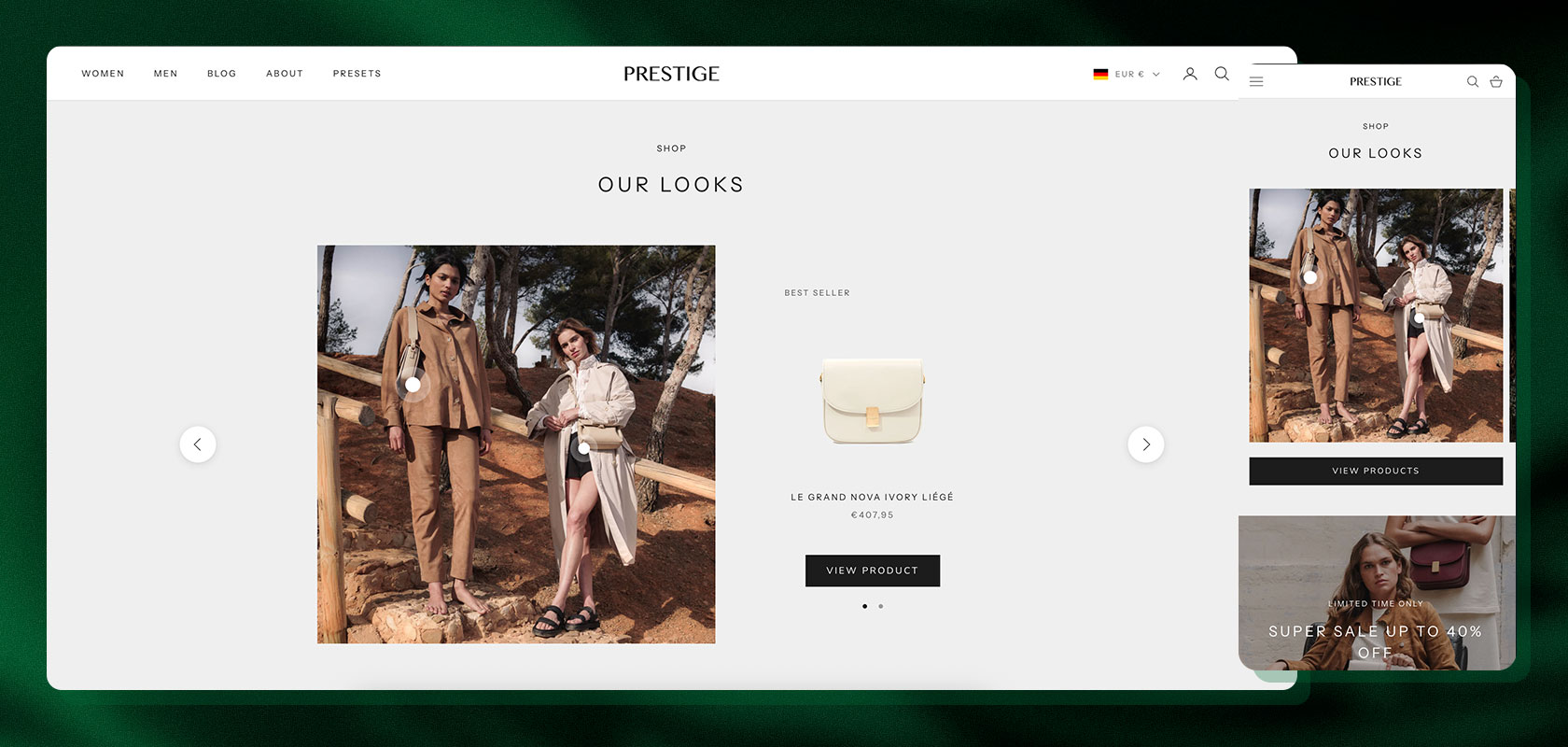
One of Prestige’s greatest strengths is its visual presentation. Large image areas, lookbooks, galleries, product videos, image zooms, hotspots, and various animations make it possible to present products in a way that really grabs the viewer’s attention.
This makes Prestige particularly appealing for brands where brand experience and product aesthetics play a key role. Fashion, beauty, jewelry, lifestyle, and premium consumer brands can benefit from its strong visual focus.
At the same time, this is precisely where the challenge lies: The more a store relies on visual effects, the more important it is to implement them in a controlled manner. Not every available animation or design element should be used automatically.
The Prestige Problem: When a Theme Looks Too Distinctive
A premium theme is meant to support a brand—not replace the brand with the theme. If the theme is adopted virtually unchanged, the store can quickly come across as a standard installation.
Our CEO, Jan Laußmann, is particularly critical of one well-known effect in this regard:
Jan Laußmann
CEO at Latori
“The Prestige Theme has been around for more than eight years now. My personal opinion: Back then, the iconic hover effect on buttons was really cool. Today, I find this effect rather outdated, and it practically screams ‘unmodified Prestige Theme’—which quickly comes across as cheap. So, if I were working on a project using the Prestige Theme, removing this effect would be the first thing I’d do.”
The underlying point is more fundamental: A theme should be viewed as a technical and design foundation. Customizations can prevent different stores from using the same visual patterns despite having different brand identities.
Reading tip: Find out what you should keep in mind when planning a redesign in this blog post.
Overview of the Prestige Theme's Features
The Prestige Theme offers numerous features that can be applied to various areas of e-commerce. As a result, the theme can already meet many requirements without the need to use an additional app for each feature.
Editorial content · Image-text sections · Galleries · Storytelling elements · Various banner and media layouts
Internationalization
Translations · Multi-language support · Features for international stores
Shopify Plus
Combined Listings support · Quantity pricing / Volume pricing
Note: Which features are actually available and useful may vary depending on your Shopify plan, theme version, and individual configuration.
Latori Expert Tip:
A wide range of features isn’t automatically an advantage. What matters is which elements actually support your customer journey. Before activating a feature, check whether it offers concrete added value for users and conversion—and whether it places an unnecessary technical burden on your store.
Reading tip: Want to use cross-selling and upselling strategically for your Shopify store? In our guide, you’ll learn which strategies work best and what to keep in mind when implementing them.
Product Presentation and Navigation
In addition to visual design, Prestige places a strong emphasis on product discovery—that is, how users find, compare, and discover products.
Among other features, the theme supports
an advanced search,
mega menus,
product filters and sorting,
category page navigation,
swatch filters,
recommendations, and
recently viewed products.
This is particularly relevant for stores with many variants or a larger product range.
The product detail page also offers various options for presenting information in a structured way. These include, for example, product tabs, size information, color swatches, and high-resolution product images.
For internationally oriented stores, Prestige also offers translations for several EU languages. Shopify Plus-specific features such as volume pricing and combined listings are also supported.
Why Information Architecture Remains Crucial Anyway
A theme can provide good navigation features, but it cannot replace a well-thought-out information architecture.
Categories, filters, product attributes, and internal links should be structured so that users can quickly understand:
What product categories are available?
Which features are relevant?
Which products meet my needs?
How do variants differ?
Which products can be combined with one another?
This isn’t just important for usability. A clear information architecture also creates a better foundation for SEO, AEO, and Generative Engine Optimization (GEO).
DACH-Specific Considerations: Legal Requirements and High-End Design
Anyone using the Prestige Theme for a store in the DACH region should consider not only design and conversion but also the specific requirements of German e-commerce law. The internationally oriented theme provides a technical and design foundation for this, but it does not replace an individual legal review and configuration.
Especially with a highly design-oriented theme, it is important to integrate mandatory information in such a way that it remains clear, legible, and accessible without unnecessarily impairing the visual user experience.
Base prices in product overviews:
For goods for which a base price must be displayed in accordance with § 4 PAngV, the base price must be clearly visible and legible alongside the total price. This applies in particular to certain goods sold by weight, volume, length, or area. When designing product cards and category pages, sufficient space should therefore be allocated for additional price information. Depending on the layout, it may be advisable to customize the product cards accordingly.
)
)