
If you operate your Shopify store in Germany as a business, you must provide the provider information required under Section 5 of the German Data Protection Act (DDG). This information must be easily identifiable, directly accessible, and permanently available.
For Shopify merchants, this means that you not only need the correct information, but you must also integrate the legal notice into your store in such a way that visitors can easily find it.
In this article, you’ll learn how to create a Shopify legal notice, what information may be required, where to post it in Shopify, and what mistakes to avoid.
Quick Insight: Does a Shopify store need a legal notice?
Yes. If you operate your Shopify store in Germany as a business, you must provide the provider information required under Section 5 of the German Digital Services Act (DDG). The legal notice must be easily recognizable, directly accessible, and permanently available.
In Shopify, for example, you can create the legal notice as a separate page and include a permanent link to it in the footer, or you can enter your contact information under Settings → Policies.
Table of contents
- Where should the legal notice be placed?
- What is an imprint?
- Creating a Legal Notice on Shopify: Step by Step
- The necessary mandatory information in the imprint
- Displaying the Shopify Legal Notice During Checkout
- Create an imprint with the Shopify imprint generator
- Common Mistakes in Shopify Legal Notices
- What happens if the legal notice is incorrect?
- Conclusion: Does a Shopify store need a legal notice?
Do you need help with your Shopify store?
Then contact us now without any obligation and we will help you with words and deeds. Contact us
Where should the legal notice be placed?

The law does not generally require that a legal notice be, for example, “no more than two clicks away.” What matters is that the required information is easily identifiable, immediately accessible, and always available.
In practice, a permanently visible link in the footer of a Shopify store is a suitable way to make the legal notice easily accessible.
Check the following:
Is the legal notice accessible from the main store pages?
Does the link work on mobile devices?
Is the link clearly identifiable as “Legal Notice” or “Contact Information”?
Does it lead to the current version?
Is the company information complete?
How quickly must the legal notice be accessible?
The law does not specify a fixed number of clicks, such as “a maximum of two clicks.” According to Section 5 of the DDG, the information must be easily identifiable, directly accessible, and constantly available.
A permanently visible link in the Shopify footer is therefore a practical way to meet this requirement.
Latori Tip: Don’t just test the legal notice on the homepage. Also open product pages, the shopping cart, and—if applicable—the checkout page. Links can change, especially after making changes to the theme or navigation.
What is an imprint?
A legal notice—often referred to in legal terms as “provider identification”—informs visitors about who is behind a commercial digital offering.
Section 5 of the German Digital Services Act (DDG) requires providers of commercial digital services—typically offered for a fee—to make certain information easily recognizable, directly accessible, and permanently available.
This may include, among other things:
Name or business name of the provider
Full address
Legal form
Persons authorized to represent the provider
Email address
A means of quickly establishing electronic contact and direct communication
Commercial register and registration number, if applicable
Competent supervisory authority, if official authorization is required
Certain professional licensing information, if relevant
VAT ID number, if applicable
Tax ID number, if applicable
Information regarding liquidation for certain companies
Note: The specific information required depends on your company and your business activities. Important: A general disclaimer is not a mandatory disclosure under Section 5 of the German Data Protection Act (DDG) and should therefore not be included as part of every legal notice.
Creating a Legal Notice on Shopify: Step by Step
Shopify offers several ways to include legal information in a store. For merchants in Germany, for example, you can create the legal notice as a separate page or include it under Settings → Policies.
Step 1: Create a Legal Notice as a Shopify Page
First, log in to your Shopify admin
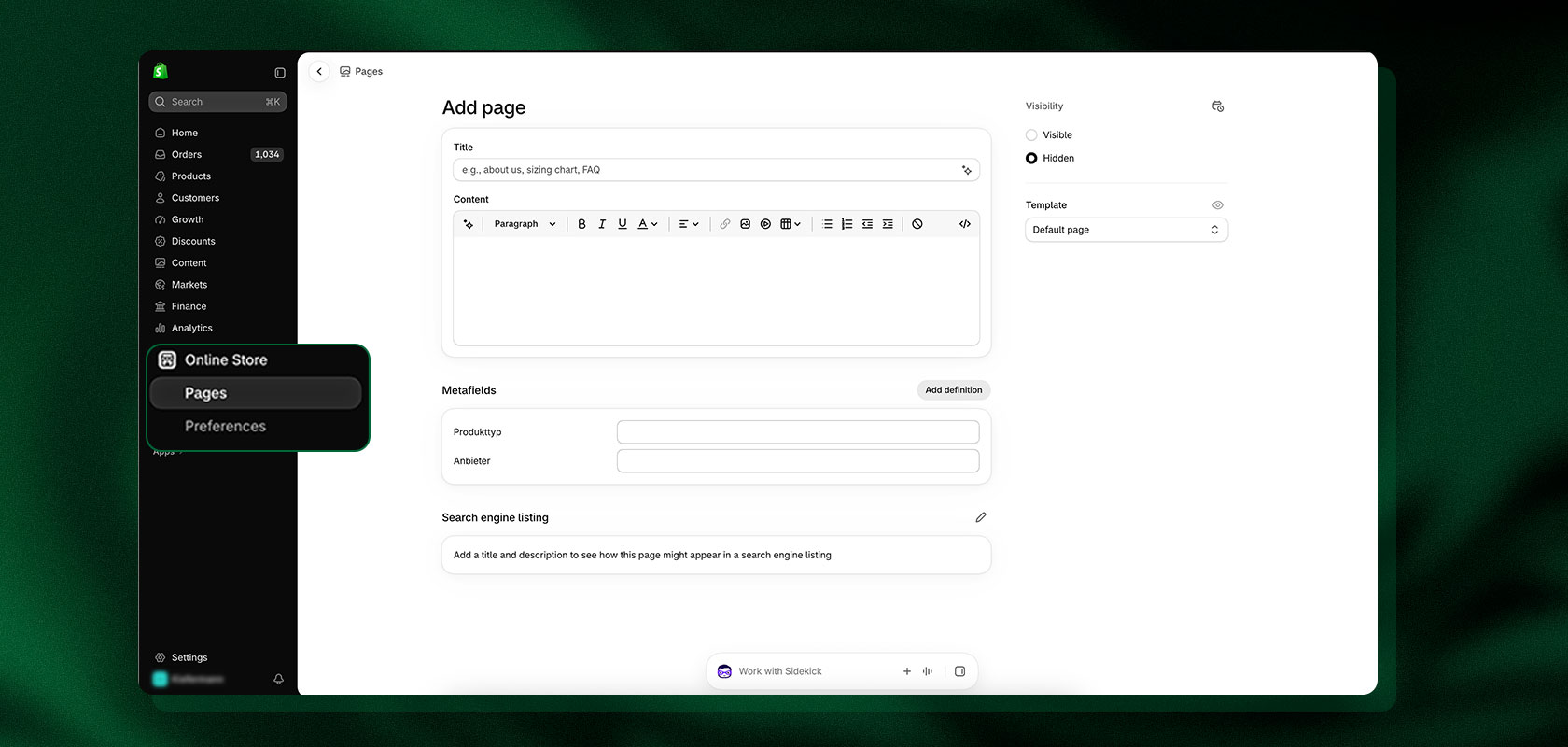
Now create the page as follows:
Click on "Online Store" and...
...in the drop-down menu below, under “Pages.”
Here you'll see an overview of the existing pages.
Click “Add Page” in the upper-right corner.
You'll now be taken to the “Page” view.
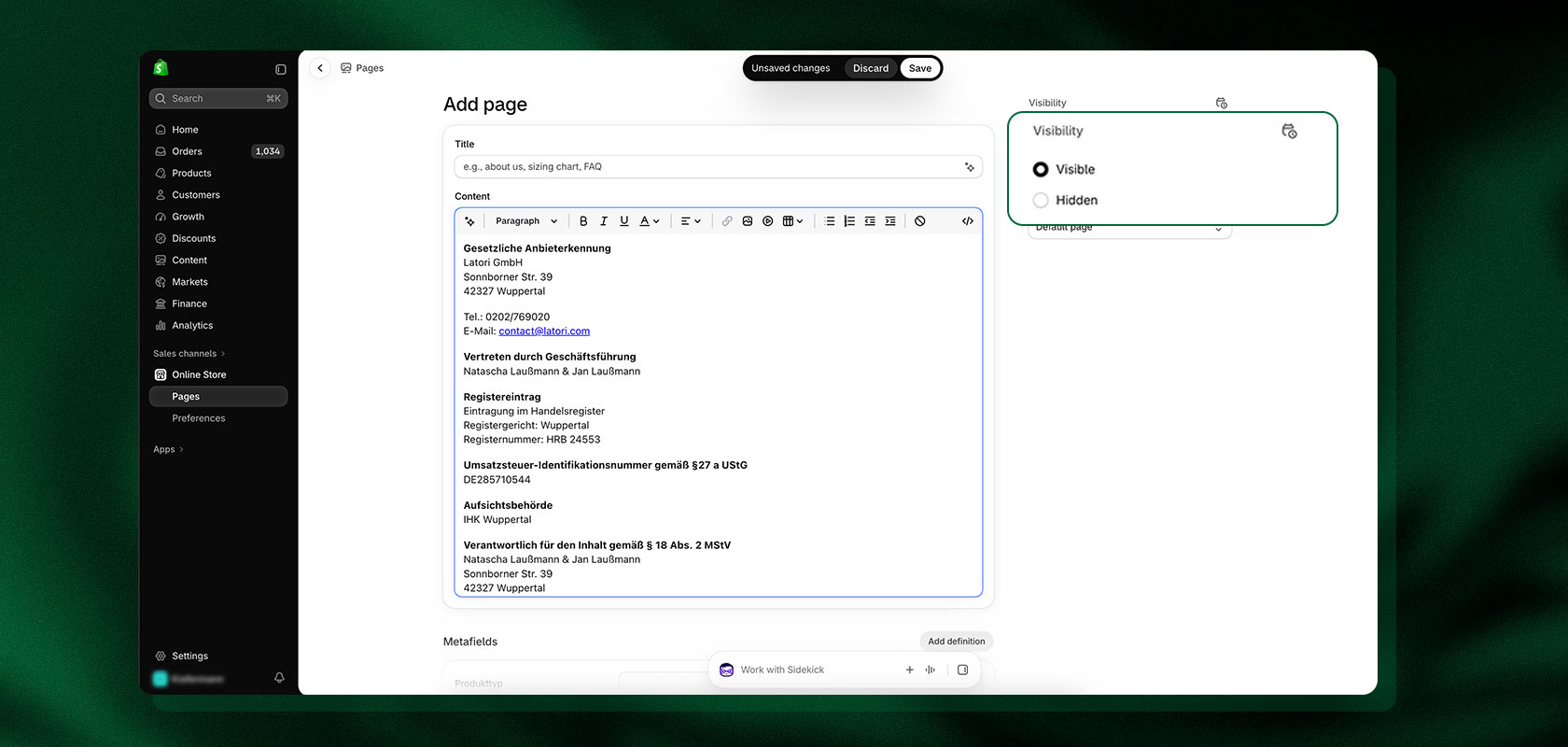
Enter the desired data here.
Title -> The page title, e.g., “Legal Notice.”
Content -> The page content. You can enter this as HTML or as plain text. You can format this text in the editor. Be sure not to use a “Header 1” heading, as in most Shopify themes the page title is already set as an H1 heading, and there should only be one H1 heading per page.
Visibility → visible/hidden. Selecting “Hidden” allows you to create a page that isn’t yet visible, so you can finish it at your own pace and publish it later.
Click “Save” to save your page.
Important: A page that is initially hidden can be useful for preparing the legal notice. However, as soon as your store is operating as a business, the legal notice must be accessible in accordance with legal requirements.
The legal notice must be easily recognizable, immediately accessible, and constantly available. There is no legally specified number of clicks required.
Reading tip: Do you already know these Shopify hacks?
Step 2: Link the Legal Notice in the Shopify Footer
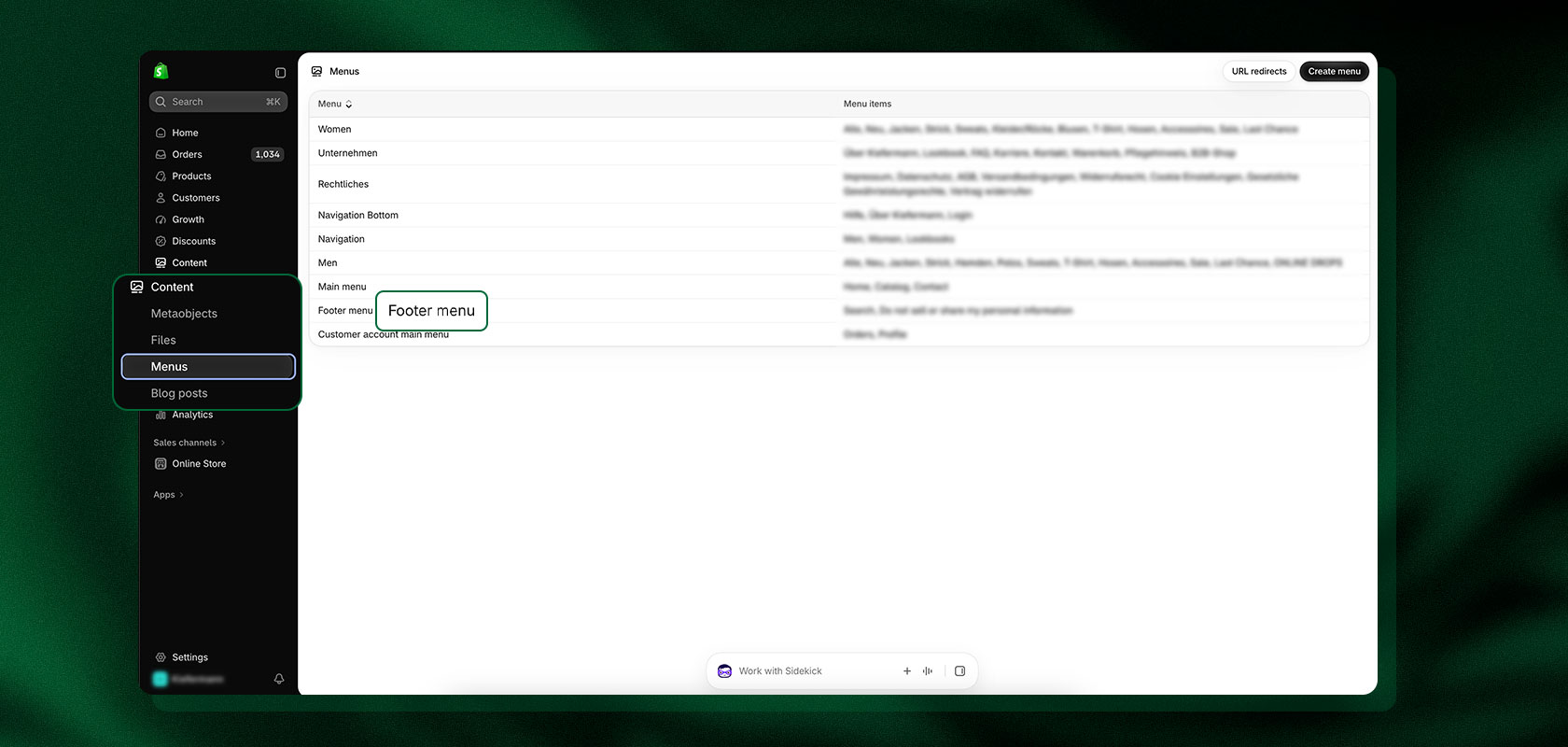
This is how you get to the menu:
Click on "Online Store"..
..and in the submenu on Navigation
Click on the desired menu item. The footer is usually the best place to put it so that customers can find the legal notice without having to search too hard.
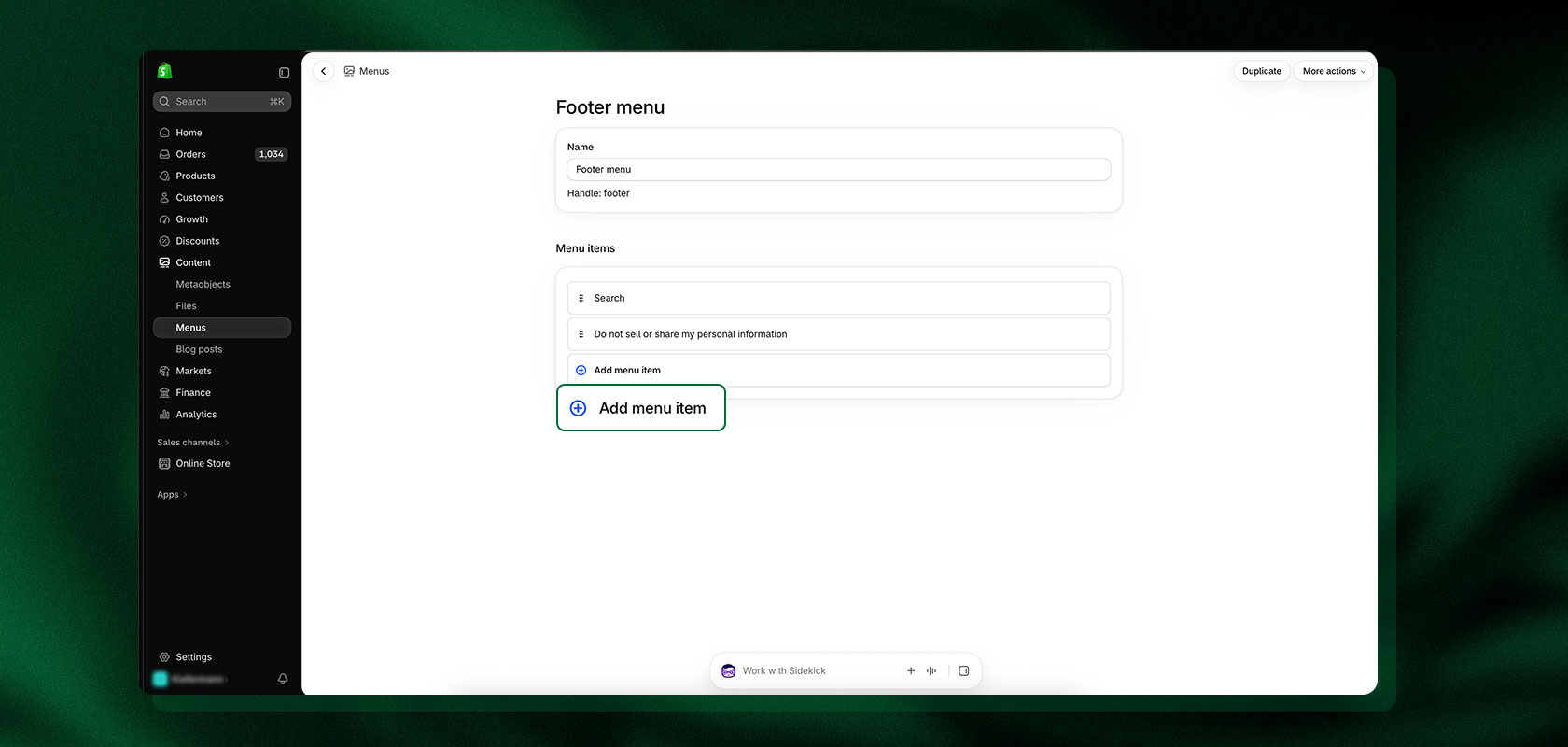
Click "Add menu item" to add a menu item.
In the popup that appears, select the page you just created. Shopify will assign the name of the link for you. If you want to use a different term, you can of course do so. Confirm your change by clicking on "Add".
You will now see your added menu item and only need to save it by clicking on "Save".
Reading tip: Want to sell to wholesale customers? Then we have useful information on the Shopify Wholesale Channel here.
Step 3: Add your legal notice under “Settings → Policies”
Shopify also provides a dedicated field for legal information under Settings → Policies.
There, merchants can enter content for the following sections, among others:
Legal notice or contact information
Privacy policy
Terms and conditions
Shipping policies
Return and refund policies
Shopify confirms that saved policies can be automatically linked in the checkout footer. In the German Shopify documentation, the “Contact Information” field is referred to as the legal notice.
Important: Shopify provides the technical infrastructure. The merchant remains responsible for the accuracy and completeness of the legal content.
Step 4: Recheck the Shopify legal notice after making changes to your store
You’ve already checked whether the legal notice is accessible at all in the section above titled “Where should the legal notice be located?” Additionally, it’s always worth performing a targeted recheck whenever something changes in your store—since theme and navigation changes can break existing links without you noticing.
Check the link again after:
Theme changes or major theme updates.
Changes to navigation or the footer.
Adjustments to checkout, e.g., after changes under Settings → Policies.
Changes to your company information (e.g., new address, new authorized representatives, new VAT ID or W-ID).
Latori - Tip: Create a short internal checklist that you can go through after every major store update—that way, you won't overlook the legal notice link during major redesigns.
Quick Insight: What information must a Shopify legal notice include?
Key information includes the name (or company name), address, and contact information. Depending on the company, additional information may be required, such as authorized representatives, registration details, the relevant supervisory authority, professional licensing information, and a valid VAT ID number or W-ID number.
The specific information required depends on the type of business and its activities. Therefore, a legal notice should not be created based solely on a general sample list.
The necessary mandatory information in the imprint
| Information / Detail | When relevant? |
|---|---|
| Name / Company name | Generally required |
| Address | Generally required |
| Legal form | For legal entities |
| Authorized representative | For legal entities |
| Email address | Required |
| Additional method for fast communication | Required |
| Commercial register + registration number | If registered |
| Competent supervisory authority | If official/regulatory approval is required |
| Professional regulatory details | If relevant |
| VAT ID (USt-IdNr.) | If available |
| Business ID (W-IdNr.) | If available |
| Information on liquidation | For relevant companies / if applicable |
Name and Address
The legal notice must include the name or business name and the address at which the provider is established.
Additional disclosure requirements apply to legal entities.
A P.O. box address alone should therefore not be used as a substitute for the required address.
Contact Information
The legal notice must include information that enables quick electronic contact and direct communication. This includes, in particular, an email address.
For practical purposes, it is recommended to provide another suitable means of contact in addition to the email address.
A current guide should not generally present “phone and fax” as the standard combination required by law. Rather, what is crucial is that the legally required ability to establish rapid electronic contact and direct communication is provided.

Commercial Register
If your company is registered in a commercial register, you must specify the relevant register and the registration number.
VAT ID No. and Economic Identification No.
If the provider has a value-added tax identification number or an economic identification number, Section 5(1)(6) of the German Data Protection Act (DDG) requires that this number be provided.
However, it should not be assumed that every company is required to have or provide a VAT ID No. or Economic Identification No.
Quick Insight: Does the W-ID number need to be included in the Shopify legal notice?
The Economic Identification Number has been issued in phases since November 2024. According to the Federal Ministry of Finance, the issuance to existing companies is expected to be completed by the end of 2027.
The W-ID number does not automatically replace the VAT ID number. Both numbers exist in parallel and serve different functions.
For the legal notice, it is therefore crucial whether the provider already has a corresponding identification number.
Professional Licensing Information
For certain regulated professions, additional information may be required, such as details regarding the relevant professional association, professional title, and the applicable professional regulations.
For a standard online store not associated with a regulated profession, this information is generally not relevant.
Legal Notice: What Information Is Relevant Depending on the Type of Business?
The information required in the legal notice depends, among other things, on the type of business and its specific activities. The following overview is therefore intended as a guide and does not replace a review of the individual case.
| Mandatory information | Sole proprietorship | German civil law partnership | Ltd. | Entrepreneurial company | Company limited by shares |
|---|---|---|---|---|---|
| Name of the company | Yes (first & last name of the owner) | Yes (first & last names of all shareholders) | Yes (company name according to commercial register) | Yes (company name according to commercial register) | Yes (company name according to commercial register) |
| Address | Yes (full address) | Yes (full address) | Yes (full address of the company) | Yes (full address of the company) | Yes (full address of the company) |
| Authorized representative(s) | Depending on the structure | Yes (all shareholders) | Yes (all shareholders) | Yes (all shareholders) | Yes (Board of Directors) |
| Email + Other Ways to Contact Us | Yes | Yes | Yes | Yes | Yes |
| Commercial register & registration number | If available | If available | Yes (local court & HRB number) | Yes (local court & HRB number) | Yes (local court & HRB number) |
| USt ID No. / W ID No. | If available | If available | If available | If available | If available |
| Regulatory Authority | If applicable | If applicable | If applicable | If applicable | If applicable |
| Berufsrechtliche Angaben | If applicable | If applicable | If applicable | If applicable | If applicable |
Note: This table is for guidance only. The information actually required may vary depending on your business activities, company structure, and other legal requirements.
Displaying the Shopify Legal Notice During Checkout
An important Shopify-specific consideration is the display of legal information during the checkout process.
In its current documentation for merchants in Germany, Shopify explains that the legal notice or contact information can be entered directly via Settings → Policies.
Saved policies are automatically linked in the footer of the checkout page.
Shopify Best Practice: After setting this up, don’t just check whether the policy is saved in the admin panel. Actually open the checkout page and verify that the link is visible and leads to the correct page.
Example for the imprint
You can see from our legal notice how it should ultimately look. Nevertheless, an imprint should always be checked for legal validity.
Create an imprint with the Shopify imprint generator
The Shopify Legal Notice Generator can help you compile the required information and create a first draft of your legal notice.
However, a generator is no substitute for an individual review. Whether the information is complete and accurate in a specific case depends, among other things, on the type of business, its activities, registry entries, professional specifics, and other legal requirements.
Using a generator can therefore be a practical aid in creating an initial draft, particularly in straightforward situations. For more complex corporate structures, regulated activities, or unique business models, the final legal notice should also undergo a legal review.
Common Mistakes in Shopify Legal Notices
1. Outdated Reference to the TMG
Since May 2024, the Digital Services Act (DDG) has been the primary legal basis for the relevant provider information.
If older legal notices still refer to Section 5 of the TMG, they should be reviewed and updated.
2. “Maximum of Two Clicks” as a Legal Requirement
The commonly cited statement that a legal notice must be accessible “within two clicks” should not be presented as a specific legal requirement.
Section 5 of the DDG requires that the information be easily recognizable, directly accessible, and constantly available.
A clearly visible footer link is a practical way to meet this requirement.
3. Legal Notice Is Hard to Find
Do not hide the legal notice on a subpage that is difficult to access.
A permanently visible link in the footer is an obvious solution for Shopify stores.
4. Company information is no longer correct
If, for example, the following change:
Company name
Business address
Managing director
Legal form
Registration details
VAT ID number
you should also update your legal notice.
5. Incorrect or missing identification number
Check whether the VAT ID number provided belongs to your company.
If you have received a W-ID number, also check whether it must be included in the legal notice in accordance with applicable requirements.
6. Legal notice no longer works after a theme update
Changes to the theme or navigation can affect the display of the footer.
Therefore, after making major changes, check the following:
Desktop
Mobile
Homepage
Product page
Shopping cart
Checkout, if applicable
What happens if the legal notice is incorrect?

A violation of Section 5(1) of the German Data Protection Act (DDG) may constitute an administrative offense. Section 33 of the DDG expressly provides that it may be an administrative offense if the required information is not made available, or is made available incorrectly or incompletely.
The statement “Failure to include a legal notice is a criminal offense” is therefore too general.
The specific legal consequences that may arise in an individual case depend, among other things, on the nature of the violation and other circumstances.
Conclusion: Does a Shopify store need a legal notice?
For a Shopify store operated as a business in Germany, the provider information required under § 5 DDG must be provided—in a manner that is easily recognizable, immediately accessible, and constantly available. 🆕 (Completed from this point on: The section in the original text was cut off mid-sentence.)
For Shopify merchants, this means specifically:
Create your legal notice either as a separate page under Online Store → Pages or enter the contact information under Settings → Policies.
Link to the legal notice permanently and prominently—usually in the footer—and verify that it is correctly integrated into the checkout process as well.
Keep the information up to date: If company details, legal form, registration entry, or identification numbers change, the legal notice must be updated accordingly.
Avoid outdated references (e.g., § 5 TMG) and blanket statements that are no longer accurate, such as a fixed “2-click rule” or a general liability for errors.
A legally compliant legal notice is not a one-time task but an ongoing responsibility: Review it regularly—especially after changes to your company, your theme, or your navigation—and seek individual legal advice for more complex situations.
Are you unsure about creating your Shopify imprint or do you have further questions about Shopify and need the help of a Shopify Plus agency? Then contact us now without obligation and we will be happy to help you with words and deeds.
Frequently asked questions about Shopify imprint
Do I still need to create a legal notice (Impressum) as a small business owner?
Yes. The small business regulation under Section 19 of the German VAT Act (UStG) applies only to value-added tax and does not exempt you from the information disclosure obligations under Section 5 of the German Digital Services Act (DDG). Small business owners operating a relevant commercial digital service are therefore still required to provide a legal notice.
Do I have to state my private residential address if I sell from home?
Generally, a summons-capable address (physical address capable of receiving legal service) must be provided in the legal notice; a simple P.O. Box does not suffice. Anyone selling from home who lacks another suitable business address typically must state their private residential address. Whether an alternative business or service address is sufficient in an individual case depends on the specific circumstances.
Is the "official address" under Settings → Store details the same as my legal notice?
No. The store and company details stored in Shopify do not automatically replace the provider identification required by Section 5 DDG. The legal notice should be maintained as a dedicated legal page that is easily recognizable and directly accessible to visitors.
Do I also need a legal notice when dropshipping via Shopify?
Yes. The obligation to provide a legal notice does not depend on whether you stock products yourself, source them via dropshipping, or ship them through a fulfillment service. What matters instead is whether you operate a commercial digital service.
Do I need to include my tax number (Steuernummer) in the legal notice?
Your personal or standard business tax number generally does not have to be stated in the legal notice. Instead, Section 5 DDG requires—if available—the VAT identification number (USt-IdNr.) or the business identification number (W-IdNr.).
Does the legal notice obligation apply if I only sell to business clients (B2B)?
Generally, yes. Section 5 DDG links the information obligation to commercial digital services and not to whether you sell to consumers or exclusively to business clients. A pure B2B or wholesale store also requires a legal notice.
What is the difference between a legal notice (Impressum) and a privacy policy (Datenschutzerklärung)?
The legal notice identifies the provider of a digital service; the privacy policy informs users about how personal data is processed. Both serve distinct legal purposes and should not be confused with each other.
