)
Traditional online shopping has a serious problem: It’s often lonely, silent, and surprisingly exhausting. Customers scroll through hundreds of product catalogs, struggle with imprecise filters, and abandon purchases in frustration as soon as a simple question about the product goes unanswered. The so-called “paradox of choice”—the overwhelm caused by too many options—costs the online retail industry billions in lost sales potential every year.
Imagine the exact opposite: You walk into a specialty store. You’re not silently rummaging through the shelves. Instead, an experienced sales associate approaches you: “Are you looking for something in particular?” You reply: “A lightweight rain jacket for a hiking vacation in Sweden, under 150 euros.” The sales associate asks one or two targeted questions about the fit, and seconds later, you’re holding exactly three perfectly suited options in your hands.
It is precisely this kind of personalized, one-on-one consultation that can now be scaled digitally. The solution is called Conversational Commerce. It shifts the shopping experience to where customers already spend their time every day: in messaging apps and natural conversations.
Quick Insight: What is Conversational Commerce?
Conversational commerce refers to sales conducted through dialogue-based channels such as WhatsApp, AI chatbots, or voice assistants.
Instead of searching for products using categories and filters, customers describe their needs in natural language and receive relevant recommendations.
The goal is a guided shopping experience that enables consultation, product selection, and often payment directly within the chat or voice dialogue.
Table of contents
- Why Conversational Commerce Is Replacing Traditional Search
- The 3 Most Important Channels for Conversational Commerce
- Implementing Conversational Commerce with Shopify
- A Direct Comparison: Traditional vs. Conversational E-Commerce
- 3 Real-World Examples from B2C & B2B
- B2B Wholesale: Reordering Materials on the Construction Site
- Step-by-Step Roadmap: How to Successfully Implement C-Commerce
- Key KPIs: How to Measure Success
- Conclusion: The Future Belongs to Dialogue
Do you need help implementing your conversational strategy? Contact us for a no-obligation consultation.
Why Conversational Commerce Is Replacing Traditional Search
The End of Endless Search Filters
Traditional online stores are based on the assumption that customers know exactly what they’re looking for. But the reality is different: Users are usually looking for solutions to a problem, not specific product numbers or filter combinations like “jacket + water column > 10,000 mm + XL + blue.” C-Commerce enables customers to articulate problems in their natural language.
The Expectations of “Generation Instant”
We’re used to receiving responses via WhatsApp or Messenger within seconds. Consumers demand the same speed from brands. Any business that first sends customers through convoluted FAQ pages or refers them to 24-hour email response times will lose conversions to more agile competitors.

Reading tip: Want to significantly improve your user experience? Read our article on conversion rate optimization (CRO).
The 3 Most Important Channels for Conversational Commerce
C-Commerce is not a monolithic system, but rather spans various digital touchpoints:
| Channel | Typical Platforms | Typical Use Cases |
|---|---|---|
| Messaging & Social | WhatsApp Business, Instagram Direct, Facebook Messenger, Telegram | Product consultation, order status, cart reminders, customer service |
| Voice & Smart Assistants | Alexa, Siri, Google Assistant | Reorders, routine purchases, voice-controlled product search |
| AI Agents & Generative Storefronts | ChatGPT-based storefronts, on-site AI widgets, generative shopping assistants | Personalized product recommendations, complex advisory, cross-selling, guided buying processes |
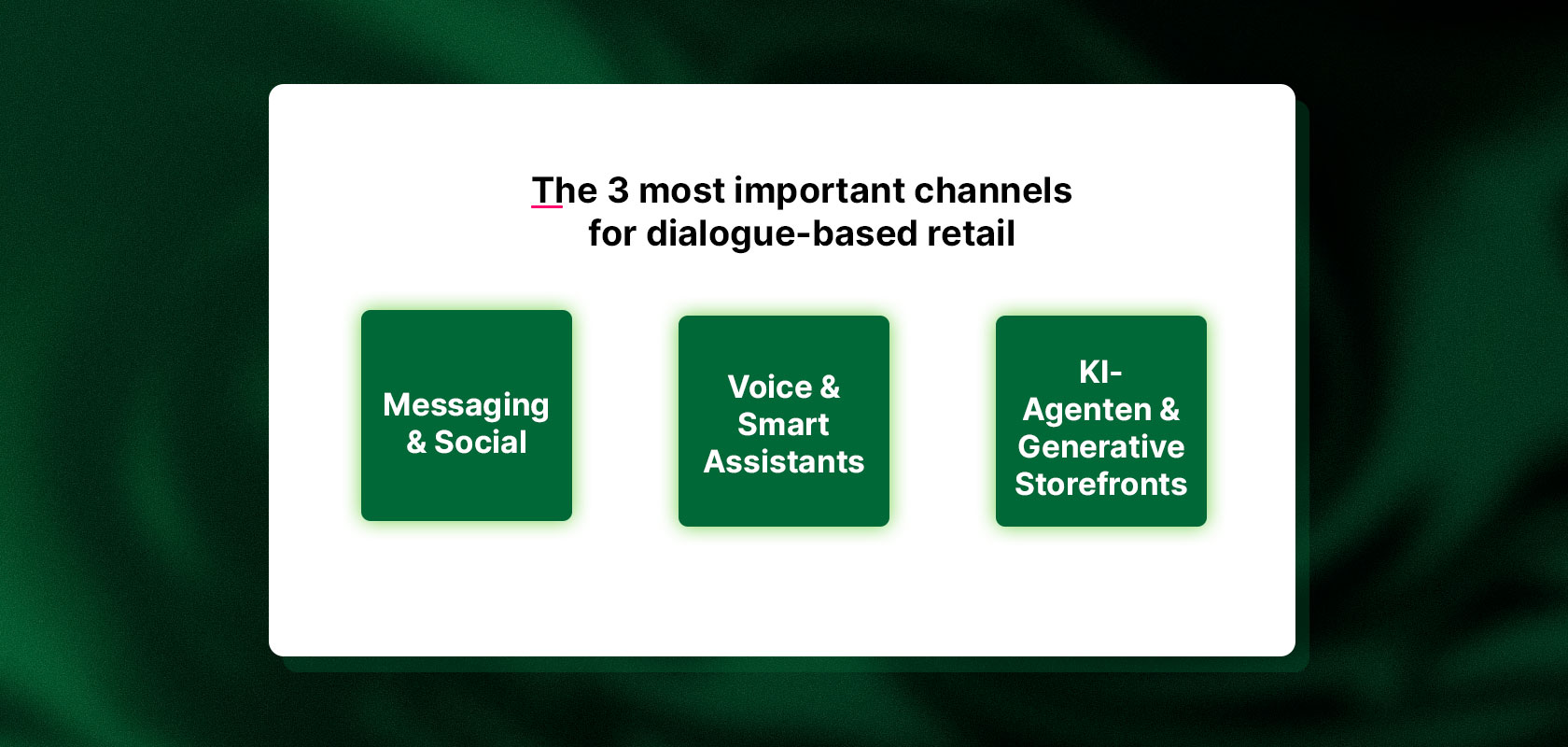
When is each channel best suited?
Messaging apps are particularly well-suited for direct customer communication and high interaction rates.
Voice commerce works best for repeat purchases that require little decision-making.
AI agents excel with products that require extensive consultation and large product catalogs, as they can understand context and generate personalized recommendations.
Messaging Apps & Social Chat
Platforms such as WhatsApp Business, Instagram Direct, and Facebook Messenger have extremely high open rates (often over 90% for WhatsApp). Here, retailers establish a direct, permanent connection to their customers’ contact lists.
Generative AI Agents & On-Site Widgets
Modern AI assistants and on-site widgets on websites mark the transition from passive product catalogs to active sales advisors. They replace the inflexible chatbots of the past, which often slowed users down with rigid menus and quickly reached their limits when faced with individual questions.
Through direct integration with product databases (PIM), enterprise resource planning (ERP) systems, and your e-commerce platform (such as Shopify Plus), generative AI agents access inventory levels, product specifications, and customer context in real time. As a result, they function like highly qualified expert advisors in a store: They understand complex product questions, take individual preferences into account, suggest suitable alternatives, and seamlessly guide your customers through the entire purchasing process—around the clock, highly scalable, and in any number of languages simultaneously.
Quick Insight: Generative AI vs. Rule-Based Chatbots
Earlier chatbots used rigid decision trees (“Press 1 for returns, press 2 for shipping”). Generative AI systems, on the other hand, understand free-form text, dialects, typos, and multi-step follow-up questions. They respond dynamically and can recommend specific products tailored to individual needs.
Voice Commerce
Voice commerce shifts the purchasing process from screens to natural spoken language. With the help of voice assistants such as Apple Siri, Amazon Alexa, or Google Assistant, consumers can make purchases completely hands-free and without distraction—for example, while driving, cooking, or during the hustle and bustle of everyday life.
Although this channel is less suited for visually browsing for new lifestyle products, it offers enormous potential for fast-moving, repeat-purchase consumer goods and reorders. For online retailers, this opens up the opportunity to become even more deeply embedded in their customers’ daily lives: Once the voice interface is set up, the reorder process is reduced to a single simple sentence, which significantly strengthens customer retention.
Quick Insight: Voice Commerce
With voice commerce, interaction is purely auditory. The assistant draws on past order history. Example: “Alexa, reorder my usual laundry detergent.” The purchase is processed in the background without any screen interaction.
Implementing Conversational Commerce with Shopify
For many merchants, once the theory is understood, the crucial question quickly arises: How exactly can conversational commerce be integrated into Shopify?
The good news: Shopify already comes with numerous features that are ideal for dialogue-driven shopping experiences. Instead of building a completely new commerce platform, businesses can enhance existing Shopify processes with messenger, chat, and AI features.
The Key Shopify Building Blocks
| Shopify Feature | Benefits for Conversational Commerce |
|---|---|
| Shopify Inbox | Live chat directly in the store and handoff to support agents |
| Shopify Flow | Automation of chat workflows, notifications, and follow-ups |
| Shopify Functions | Personalized discounts, bundles, and offers based on conversation context |
| Shopify Payments | Seamless checkout and payment processes without media disruption |
| Shopify Customer Accounts | Access to order history, preferences, and customer context for personalized advice |
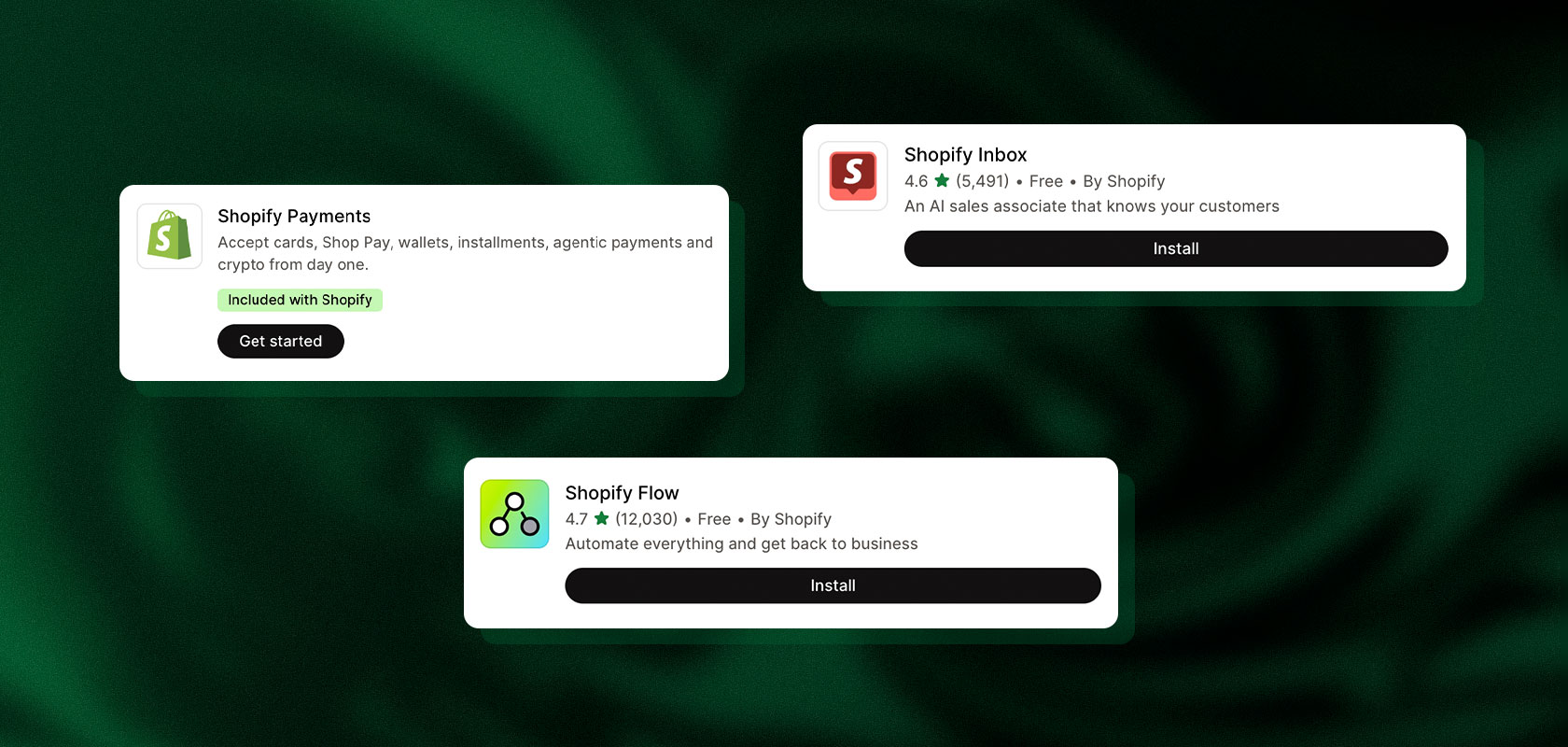
Example: WhatsApp Consultation with Shopify A typical conversational commerce flow in Shopify might look like this:
The customer initiates the conversation via WhatsApp or an AI widget in the store.
The AI asks about the use case, budget, and preferences.
Suitable products are loaded in real time via an interface with Shopify.
The customer receives an interactive product carousel with images, prices, and availability.
With a single click, the product is added to the Shopify cart or paid for directly via a payment link.
The key advantage: Product data, inventory levels, and prices all come from the same Shopify database. This ensures there are no conflicting details between the chat, the store, and checkout.
AI + Shopify: The Key to Scalable Customer Service
Conversational commerce becomes particularly exciting when combined with generative AI. Modern assistants can not only answer FAQs, but also:
recommend products using natural language,
narrow down sizes or variants,
make cross-selling suggestions,
automatically process order status and returns,
and transfer conversations to a human agent when needed.
This means a customer no longer has to search for “men’s running shoes, size 44, neutral cushioning,” but can simply type:
“I’m training for my first half-marathon and need a comfortable running shoe for asphalt, up to 140 euros.”
The AI translates this intent into structured Shopify product data and immediately presents relevant options.
Why Shopify Is Particularly Well-Suited for Conversational Commerce
Shopify is particularly well-suited for C-Commerce projects because the platform already features an API-first architecture. Messaging apps, AI assistants, CRM systems, and marketing automation tools can be integrated relatively easily without having to redevelop the actual store.
Shopify Plus, in particular, offers additional benefits:
Shopify Flow for complex automations,
Checkout Extensibility for personalized checkout experiences,
B2B features for customer-specific pricing and approval processes,
as well as the ability to roll out conversational commerce processes internationally across multiple markets and languages.
Practical Tip for Getting Started
Don’t start with a fully automated AI sales agent. In most projects, a step-by-step approach has proven effective:
Live chat with Shopify Inbox
Automated responses to frequently asked questions
WhatsApp integration for customer support and order status updates
AI-powered product recommendations
Complete conversational commerce journey, including checkout
This minimizes risks, allows support teams to be integrated gradually, and enables accurate measurement of the actual impact on conversion rate, AOV, and customer satisfaction.
Accurately measure conversion rates, AOV, and customer satisfaction.
Latori Practical hint: Especially for consultation-intensive D2C brands, B2B stores, and international Shopify Plus projects, it’s clear that conversational commerce doesn’t replace the traditional online store—it enhances it with a personalized, scalable layer of consultation.
A Direct Comparison: Traditional vs. Conversational E-Commerce
What is the fundamental difference between traditional online shopping and the dialogue-based approach? While traditional e-commerce relies on customers silently navigating through categories and filters, conversational commerce places the personal conversation at the center.

The following overview shows the key differences in the customer journey at a glance:
| Criterion | Traditional E-Commerce | Conversational Commerce |
|---|---|---|
| Search Logic | Search, filter, compare, select | Ask questions, receive advice, confirm |
| User Experience | Passive clicking | Active, personalized dialogue |
| Drop-off Rate | High due to detailed questions or uncertainty | Low, as barriers are addressed directly in the chat |
| Main Channels | Desktop/mobile website, store apps | WhatsApp, AI widgets, Instagram, Voice |
| Personalization | Based on anonymous tracking cookies | Based on real customer context & preferences |
| Checkout Process | Multiple redirects (Cart → Checkout) | Direct in-chat payment (In-Chat Payments) |
3 Real-World Examples from B2C & B2B
B2C Fashion: The Digital Style Advisor via WhatsApp
A D2C fashion label uses an AI-powered WhatsApp bot for styling consultations.
The conversation: The customer writes: “I’m invited to a beach wedding in July. Dress code: boho-chic. What would go well with that?”
The solution: The AI analyzes the occasion, checks the inventory, and sends a product carousel featuring a matching dress, sandals, and accessories. The customer selects her size and completes the purchase directly via Apple Pay in the WhatsApp chat.
Reading tip: Learn more about WhatsApp marketing in this article.
B2B Wholesale: Reordering Materials on the Construction Site
A tradesperson on the construction site has neither the time nor a laptop to log in to the B2B portal.
The conversation: He sends a short voice message to the wholesaler’s WhatsApp channel: “Need 15 bags of quick-setting cement at the North construction site by 8 a.m. tomorrow.”
The solution: The system converts the voice message to text, assigns it to the customer’s account, checks the special terms, and simply requests confirmation with a single click.
Reading tip: Find out how B2B companies are modernizing their digital customer journey in our guide: B2B E-Commerce.
Service & Travel: The AI Concierge in the Hospitality Industry
The Conversation: A hotel guest sends a text message: “We won’t arrive until 11 p.m. Can we still get something to eat delivered to our room?”
The Solution: The AI concierge confirms the late check-in, sends the digital room key, and immediately presents three options for midnight snacks, which will be added to the total bill.
Step-by-Step Roadmap: How to Successfully Implement C-Commerce
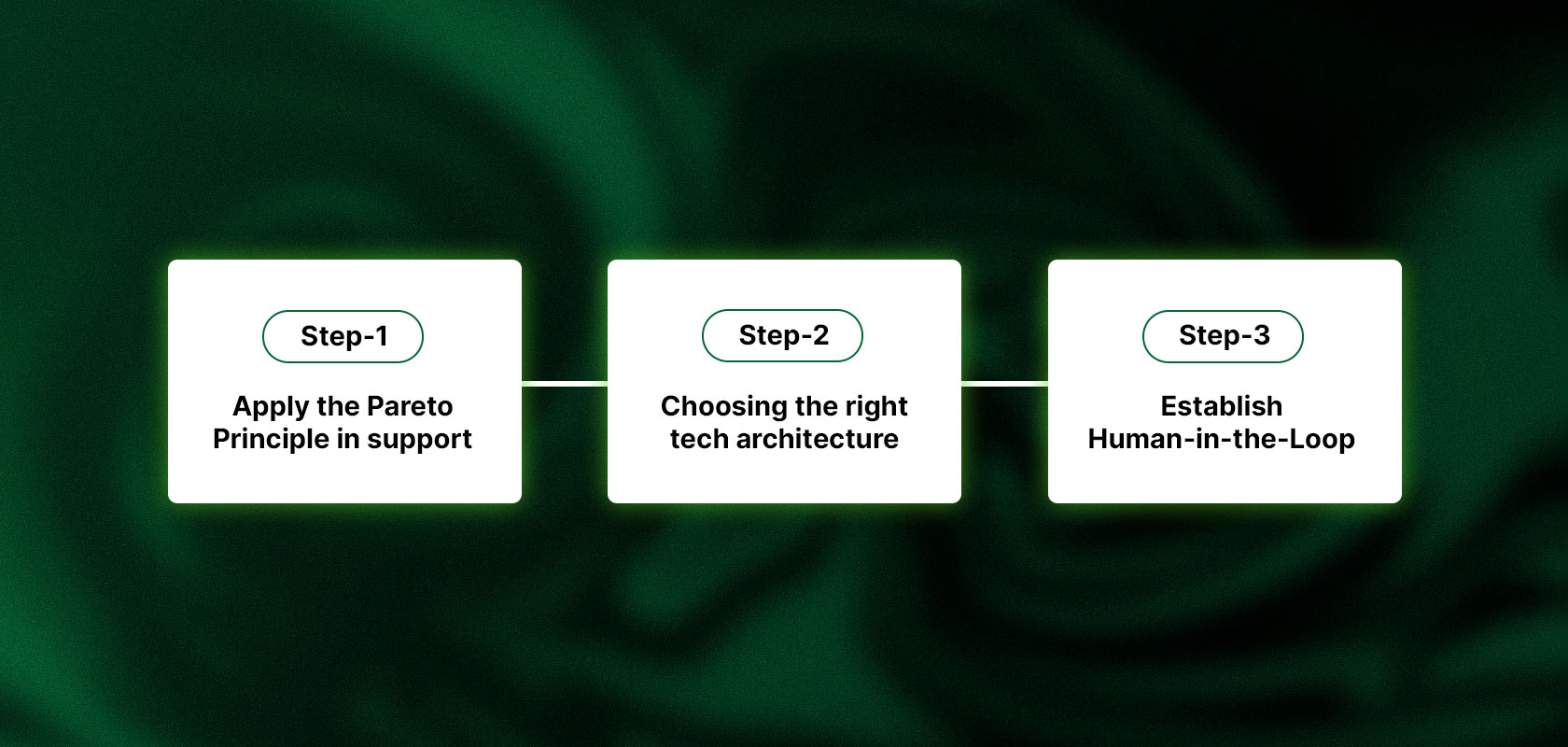
Step 1: Apply the Pareto Principle to Customer Support
Analyze your customer service data from the past six months. Typically, 80% of all inquiries relate to the same 20% of topics (e.g., “Where is my package?”, “How does size M fit?”). Automate these recurring questions first.
Step 2: Choosing the Right Tech Architecture
Make sure your C-commerce solution can be seamlessly integrated with your store system (e.g., Shopify Plus) and your ERP/CRM. Rigid, siloed solutions without real-time inventory synchronization lead to customer frustration.
GDPR hint: For WhatsApp, be sure to use the official WhatsApp Business API via established providers (BSPs—Business Solution Providers). This is the only way to ensure 100% GDPR compliance and protect customer data.
Step 3: Establish a “Human-in-the-Loop” Approach
A bot should never be a dead end. Implement clear handover logic (Human Handover). If the AI cannot answer a question with 90% certainty or if the customer expresses dissatisfaction, the conversation must be immediately transferred to a human support agent.
Reading tip: Are you planning to take your e-commerce architecture to the next level? Learn more about scalable systems like Shopify Plus in our article.
Key KPIs: How to Measure Success
To transparently evaluate the ROI of your conversational commerce initiative and continuously optimize it, you should keep an eye on the following five key performance indicators (KPIs):
Conversion Rate (Chat-to-Sale): How many users who start a conversation with the bot or an agent end up making a purchase?
Chat Conversion Rate = (Total number of chat sessions / Purchases via the chat channel) × 100
First Contact Resolution (FCR): What percentage of customer inquiries are fully resolved during the very first interaction, without the need for human intervention or follow-up?
Cart Abandonment Rate: How much does the abandonment rate decrease when customers receive direct support via chat if they encounter uncertainties during the checkout process or while in their shopping cart?
Average Order Value (AOV): Does targeted advice via chat lead to larger shopping carts through relevant cross-selling and up-selling recommendations?
Customer Satisfaction Score (CSAT): How satisfied are customers with the speed and quality of the conversations? (Measurable via a quick 1-click rating directly at the end of the chat).
Conclusion: The Future Belongs to Dialogue
Conversational commerce is far more than a fleeting trend—it is the logical next step in the evolution of digital commerce. Today’s customers are no longer looking for product lists, but for quick, reliable answers and personalized advice.
By integrating conversations directly into your sales channels, you drastically lower barriers to purchase, reduce the workload on your customer service team, and sustainably increase your conversion rate.
Your next steps:
Analyze support tickets: Which recurring questions are currently blocking sales?
Define a use case: Start with a focused pilot project (e.g., a digital gift finder before the holiday season).
Choose a tech setup: Build on a flexible, scalable infrastructure that seamlessly connects your systems.
Would you like to implement conversational commerce in your Shopify (Plus) store? As an experienced Shopify agency, we at Latori can help you with the design, system integration, and GDPR-compliant implementation of WhatsApp and AI assistants. Schedule a no-obligation consultation now.
Frequently Asked Questions About Conversational Commerce
What Is Conversational Commerce?
Conversational commerce refers to the sale of products or services through dialogue-based channels such as WhatsApp, AI chatbots, live chat, or voice assistants. Customers communicate with a brand using natural language and receive personalized recommendations, support, or purchasing options directly within the conversation—often without having to leave the conversation.
Which channels are part of conversational commerce?
The most important channels include:
WhatsApp Business
Instagram Direct
Facebook Messenger
Live chat on the website
AI chatbots
Apple Messages
Alexa, Siri, and Google Assistant
In e-commerce in particular, messaging apps and AI-powered website assistants are currently the most relevant applications.
What is the difference between conversational commerce and social commerce?
Social commerce focuses on making products visible and directly purchasable on social networks, such as through Instagram Shopping or TikTok Shop.
Conversational commerce, on the other hand, uses active dialogue as its central sales tool. The customer asks questions, receives advice, and is guided step-by-step through the purchasing process.
Both approaches can be combined, but they differ in their focus.
What advantages does conversational commerce offer online stores?
The key advantages are:
faster responses to customer questions,
fewer abandoned carts,
higher conversion rates,
personalized product recommendations,
reduced workload for customer service,
and improved customer satisfaction through immediate assistance.
Especially for products that require extensive consultation, a guided dialogue can be significantly more effective than traditional filter and search functions.
What role does AI play in conversational commerce?
Artificial intelligence makes it possible to understand free-form text inputs, ask follow-up questions, and generate personalized recommendations. Unlike traditional rule-based chatbots, generative AI operates contextually and can process even complex inquiries. Typical applications include product advice, size recommendations, order status, cross-selling, and automated customer service.
What is the difference between a chatbot and Conversational AI?
A traditional chatbot typically follows rigid decision trees and offers predefined response options. Conversational AI understands natural language, recognizes context, handles typos or dialects, and can react dynamically to new situations. This makes the interaction feel significantly more natural and much closer to a real consultation.
Can Conversational Commerce be implemented with Shopify?
Yes. Shopify already provides key foundational tools for this, such as:
Shopify Inbox for live chat
Shopify Flow for automated workflows
Shopify Functions for personalized offers
Shopify Payments for seamless checkout processes
Additionally, external solutions for WhatsApp Business, AI chatbots, or CRM integrations can easily be connected.
Which KPIs are particularly important for Conversational Commerce?
Key metrics for measuring success include:
Chat-to-Sale Conversion Rate
First Contact Resolution (FCR)
Cart Abandonment Rate
Average Order Value (AOV)
Chat Response Time
Customer Satisfaction Score (CSAT)
These numbers demonstrate both the commercial value and the quality of customer interactions.
What is the most logical way to get started with Conversational Commerce?
A pragmatic starting point involves three steps:
Analyze common support inquiries
Define a clear use case (e.g., product advisory or order status updates)
Pilot a single channel, such as WhatsApp or an on-site AI chat
This allows you to test and optimize processes before rolling out a comprehensive Conversational Commerce strategy.
